
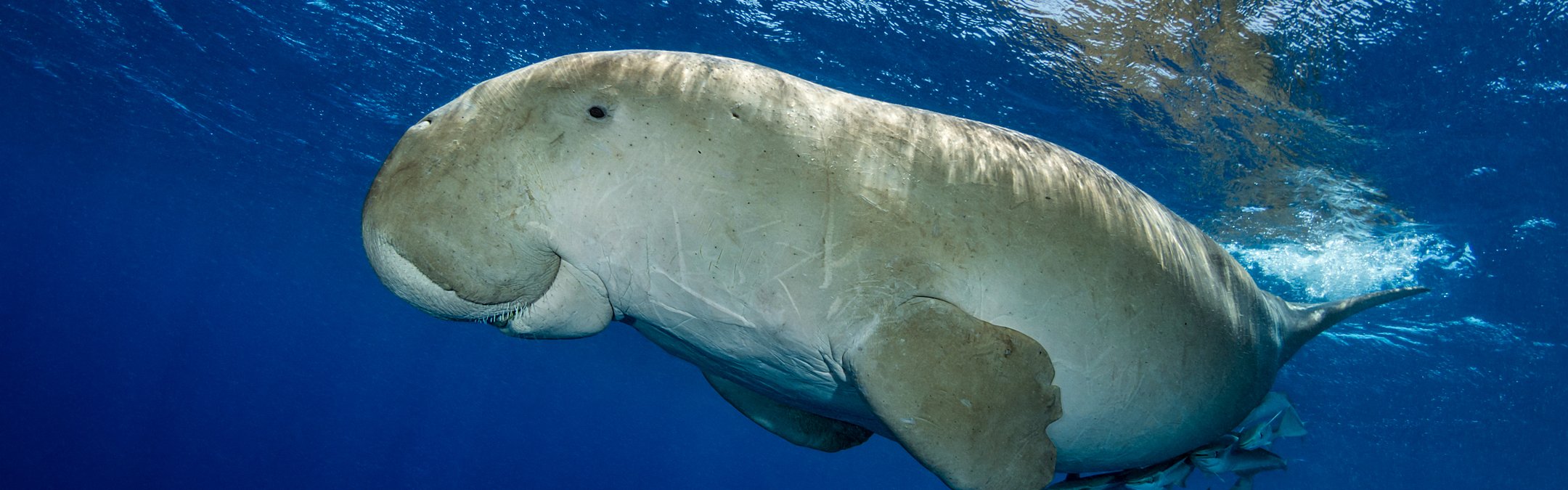
Is it a manatee or a dugong?
2 minute read
Often victims of mistaken identity, manatees and dugongs share many similarities at first glance. However, a closer look reveals several key differences between these closely related 'sea cows'.
Similarities
These aquatic mammals are frequently confused because they look remarkably alike. This is no coincidence, as both belong to the scientific order Sirenia, a name derived from the sirens of Greek mythology, creatures said to lure sailors to their doom. Despite this dramatic association, manatees and dugongs are gentle, slow-moving herbivores that pose no threat to humans. In fact, their link to sirens likely comes from sailors mistaking them for mermaids when spotting them from a distance.
A more fitting nickname for both species is "sea cow", reflecting their calm nature and entirely plant-based diet. They spend much of their lives grazing on seagrass and other aquatic vegetation. Sadly, one of their closest relatives, Steller's sea cow, was hunted to extinction in the 18th century, largely because it was slow-moving, approachable, and easy for people to catch.
Although they may look somewhat similar to seals and walruses (pinnipeds), their closest living relatives are actually elephants. Their resemblance to seals is an example of convergent evolution, a process in which unrelated species independently evolve similar features because they have adapted to the same environments.
Physical differences
One of the easiest ways to distinguish a manatee from a dugong is by looking at the tail. Manatees have a broad, paddle-shaped tail similar to a beaver's, while dugongs possess a ‘fluked’ tail resembling those seen on dolphins and whales. Both use powerful up-and-down tail movements to propel themselves through the water.
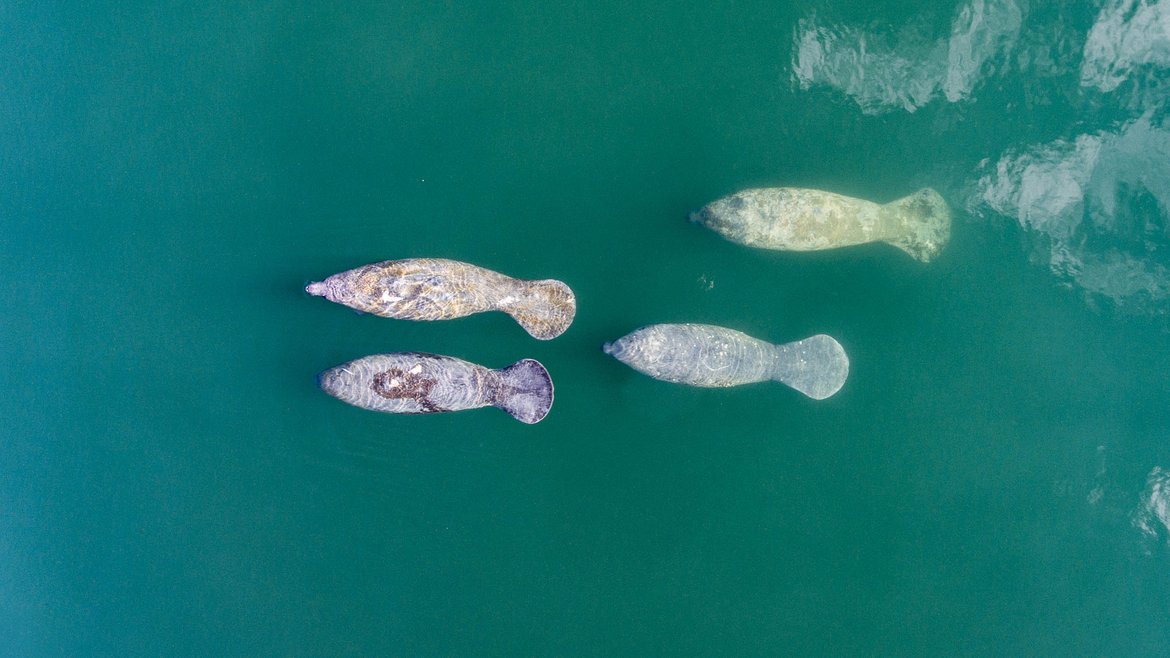
Manatees have paddle shaped tails which make them easily recognisable if viewing them from above
Image credit: David Gross/Ocean Image Bank
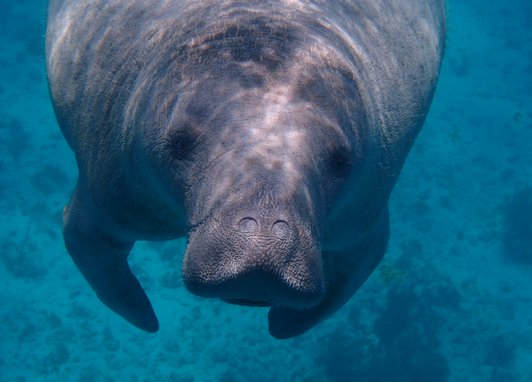
A manatee's snout is quite prominent | Image credit: Maegan Luckiesh
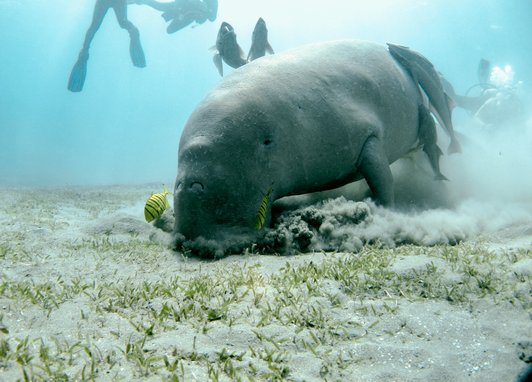
A dugong's snout is more vacuum shaped than a manatee's | Image credit: Geoff Trodd
The front flippers can also help with identification. Many manatee species have small nails on the tips of their flippers, whereas dugongs do not. Combined with their paddle-shaped tail, these nails can make manatees easier to recognise at a glance.
Regional differences
You will never find manatees or dugongs living naturally around the United Kingdom, as both favour warm tropical and subtropical waters. The seas surrounding the UK are simply too cold for them. However, you will also never encounter both species in the same place either, as their natural ranges do not overlap.
Dugongs are found throughout the Indo-Pacific region, from the east coast of Africa through Southeast Asia to northern Australia. Manatees, meanwhile, have a more fragmented distribution and can inhabit freshwater, saltwater, and brackish environments across the Americas, Western Africa, and the Amazon Basin.
There are three recognised manatee species. The West Indian manatee ranges from Florida to Brazil and throughout the Caribbean, the African manatee is found along the west coast of Africa, and the Amazonian manatee occurs exclusively within the Amazon River basin.
Difference around humans
Dugongs are generally more wary of humans than manatees and are more likely to swim away from people or loud disturbances. They can also be harder to spot because they typically inhabit deeper coastal waters. In addition, dugongs face predation from large sharks, making vigilance and flight-over-fight important survival strategies.
Manatees, by contrast, have very few natural predators. As a result, they have not evolved the same tendency to flee when approached. They also frequently inhabit rivers, estuaries, and coastal waterways where encounters with people and boats are common. Over time, this has led many manatees to become relatively tolerant of human presence.
For these reasons, most people are far more likely to observe a manatee than a dugong in the wild.
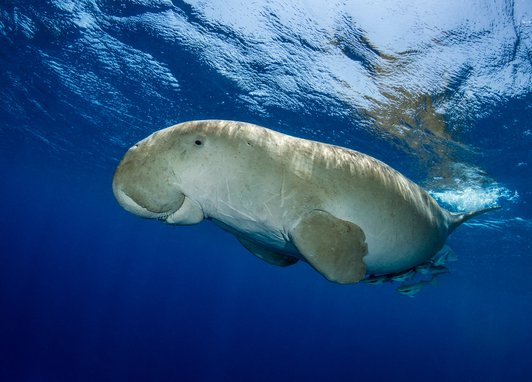
A dugong and remora fish in Marsa, Egypt | Image credit: Fabrice Dudenhofer/Ocean Image Bank
Unfortunately, coastal development, pollution, and climate change are damaging or destroying seagrass meadows across the world. As these vital feeding grounds disappear, dugongs and manatees face increasing difficulty finding enough food to survive.
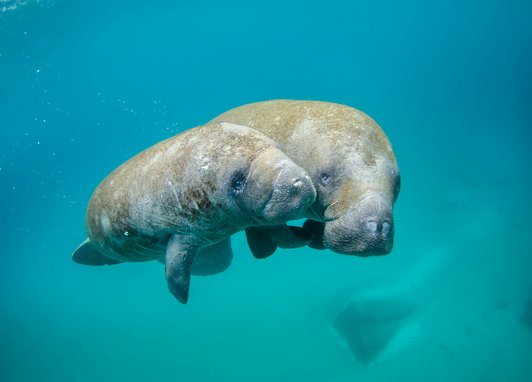
A manatee mother and calf | Image credit: NOAA
Support our blue planet
The ocean is home to an extraordinary diversity of life, but it faces growing threats from climate change, human activity, habitat destruction and pollution. Your support helps fund vital science-based conservation, research, and restoration projects that make a real difference.