

Help us save our Atlantic Coast's spectacular species. Donate today.

Wonderful whale facts

3 minute read

Whales are some of the most majestic sea animals found on our blue planet. Covering long-standing feuds, interesting defence tactics and even the popular question 'can a whale swallow a human?', prepare to be amazed!

There are two types of whales

Whales come in all shapes and sizes but every one of them can be classified into two separate types and it is to do with their mouths. 

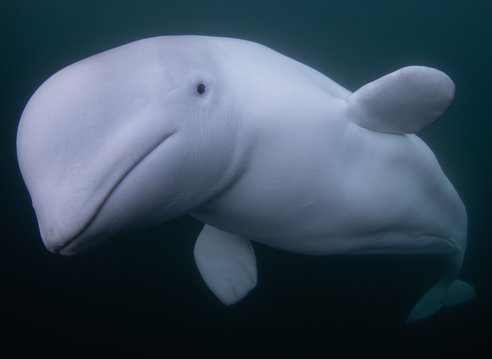
Whales that have teeth are, unsurprisingly, called toothed whales and they generally hunt fish, squid and other invertebrates that require the ability to grip onto slippery prey. Well known toothed whales include sperm whales and belugas however dolphins and porpoises are a subclass of toothed whales meaning they evolved from this class of whale too.
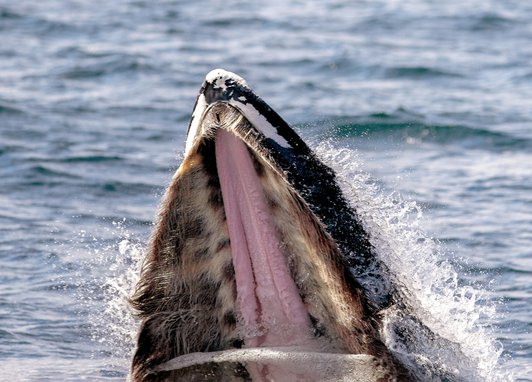
The other type are baleen whales. Instead of teeth, their mouth is filled with hairlike bristly plates that allow them to filter feed. They generally eat huge amounts of tiny plankton and fish which get stuck in their plates – it's an amazing feat in eating by the volume! 

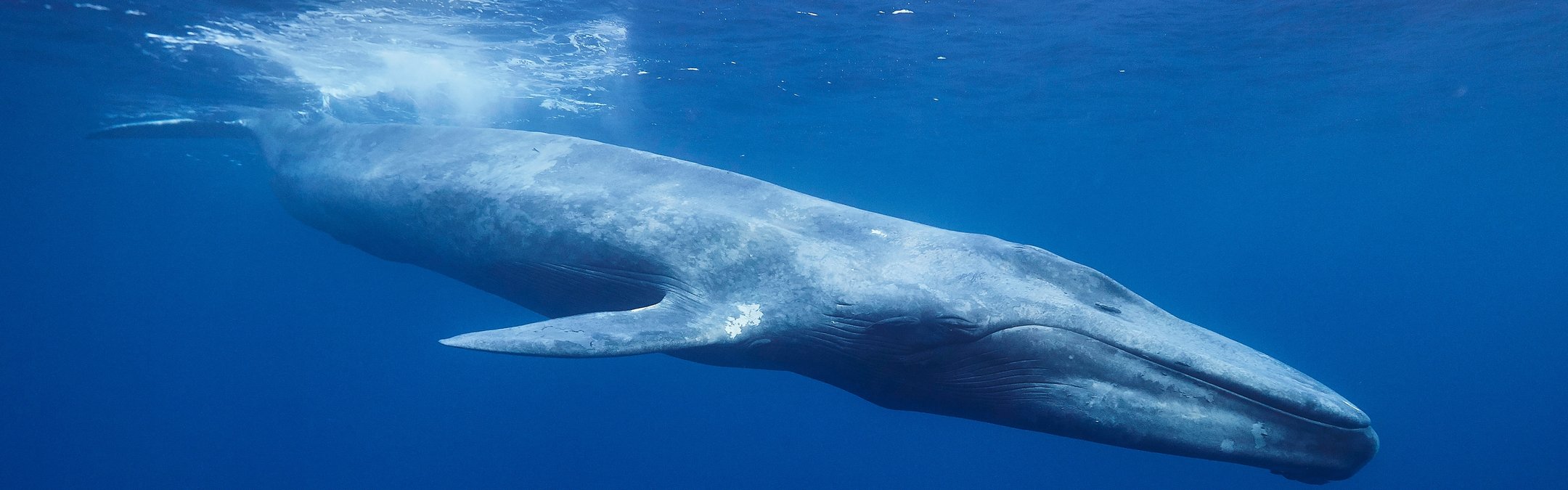
The most recognisable baleen whale is also the largest animal on the planet, the blue whale.

Humpback and minke whales are also well-known baleen whales. Their baleen plates are made of keratin, a protein that is found in our fingernails and hair.

A Humpback whale's head is visible outside the sea and has its mouth open.

A humpback's open mouth showing its baleen plates  |  Image credit: Christopher R Mazza

Another way to differentiate these two classes of whale is their blowhole. Baleen whales have two blowholes compared to the single one that toothed whales have.

Not all toothed whales have recognisable teeth 

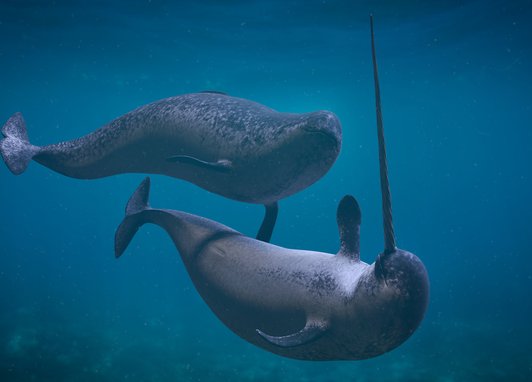
Despite their name, there are some toothed whales that have rather unconventional 'teeth'. The narwhal for example does have teeth but unlike other toothed whales, the males’ tusk is actually one of its teeth. They also have two main canine teeth in the upper jaw, but they don't have rows of teeth like other toothed whales.
Another example of an odd-toothed whale are beaked whales, with only one or two pairs in the lower jaw instead of spread between their entire mouth. The strap-toothed whale is one such example, with two large teeth curving upwards and across its beak. Unlike most toothed whales, these teeth are thought to be used for fighting with other males rather than catching food. 

Instead of using their teeth to bite or chew their prey, both these unique-looking whales will often swallow their prey whole instead.

Two narhals swimming around one another. The male (with a tusk) is underneath, wheas the female is above

A male and female narwhal swimming in the ocean together  |  Image credit: dottedhippo

Whales have belly buttons and hair 

You may know that whales are mammals and they have a small area where their umbilical cord was attached while they were developing inside their mother’s womb. 

Unlike a human’s belly button, which is quite noticeable and might stick out, a whale’s belly button is rather difficult to see as it is usually a small, flat scar on the underside of its body. 
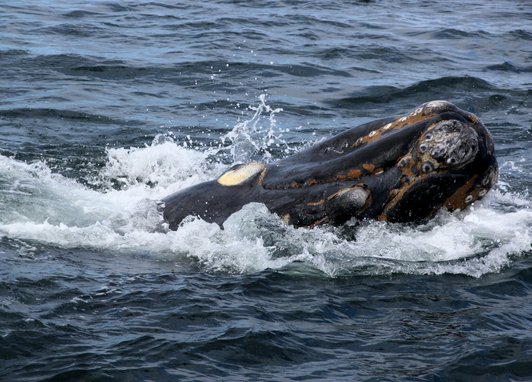
Another mammalian attribute that they all also possess is hair! Despite living in the ocean, whales have tiny hairs on their body. Bowhead whales in particularly can have hundreds of short, whisker-like hairs concentrated all around their lips, chin and upper jaw. 

These hairs called tubercles have evolved to sense vibrations in the water to help the whale detect swarms of tiny fish and obstructions like sea ice. They also have a few hairs around the blowhole which act as a sensor to detect their blowhole is above the ocean surface and therefore safe to be opened without inhaling water.

A bowhead whale emergining out of some choppy waves. Its nose is out of the water

A bowhead whales rostrum with its tubercles (sensory bumps are clear)  |  Image credit: Barbara Yuste Zambrano

Only some whales have the ability to smell

It may seem odd but evolving to live in the ocean has meant that a lot of whales have lost their olfactory bulbs (the structure in the brain that processes information on smell).  

Toothed whales such as the beluga and long-finned pilot whale cannot smell at all, relying on their echolocation to find and hunt down food. However, baleen whales such as the Sei whale and humpback still have a sense of smell through their blowhole. However, they can't use it while underwater. Because of how scent works, they can only detect airborne odours when at the surface. 

It is thought that some baleen whales might even be able to find areas containing lots of prey using their super-smell allowing them to locate food across huge areas of ocean. 

Check out our A-Z of whales

Dive in

Only the sperm whale could theoretically swallow a human whole
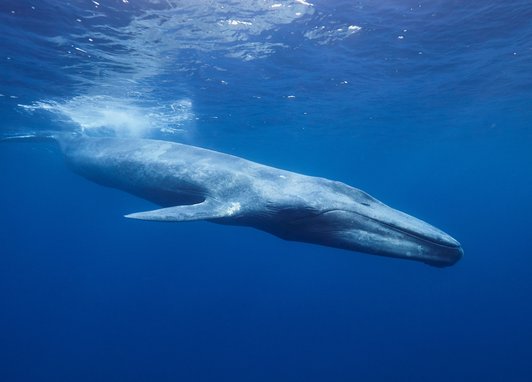
You might think that due to the size of some whale species, they could easily swallow a person but this is not possible in most cases. The largest species, the blue whale has an oesophagus about the size of a grapefruit meaning that even if a whale wanted to, their throats just aren’t big enough. There have been some recorded cases where whales such as the humpback have accidentally engulfed swimmers or kayakers while feeding on krill near the surface. Realising their mistake, they have pushed them back out again using their tongue.

A blue whale  |  Image credit: Ajit S. N.
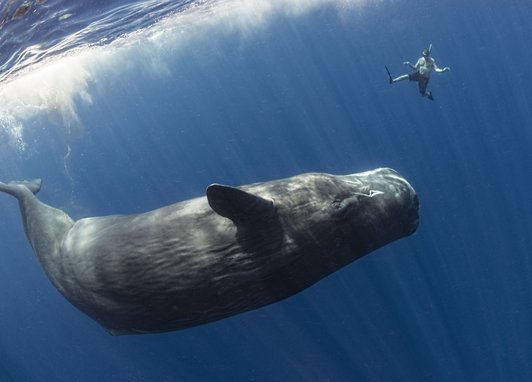
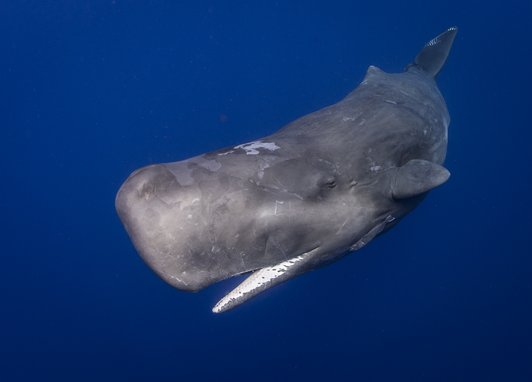
Because it is a toothed whale and has evolved to consume large creatures, the sperm whale could theoretically swallow an adult human whole however there has been no credible cases of this. The likelihood of this happening is very minimal because sperm whales hunt in the deep ocean where humans would need special equipment to survive. 

Unlike baleen whales that blindly engulf fish, sperm whales are predatory hunters that use echolocation to hunt down specific food sources such as sharks and deep-sea cephalopods like giant squid. Their echolocation techniques would completely prevent a sperm whale from mistaking humans for prey.

A sperm whale swimming close by to a snorkeler. The size difference betwee the whale and the man is big with the sperm whale's face being approximately the length of the man's height

The size difference between a man and a sperm whale | Image credit: Amanda Cotton/Ocean Image Bank  |  Image credit: Amanda Cotton/Ocean Image Bank

Humpback whales appear to dislike orcas
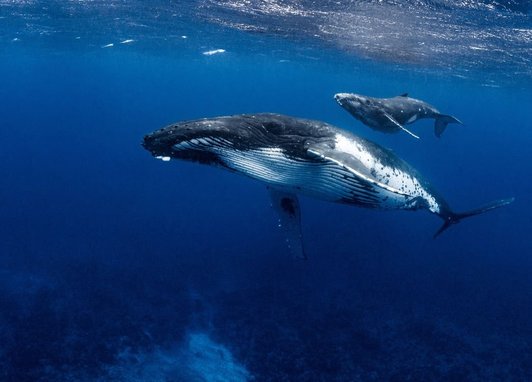
Humpbacks have been recorded purposely preventing orcas (also known as killer whales) from hunting prey like pinnipeds (seals and sea lions) as well as other whale species. Scientists are not completely sure why do this but there might be some truth behind the idea that the two species have an ancient feud.

Because orcas hunt humpback calves, it is thought that they might have developed an instinct to act aggressively when they hear orcas attacking something regardless of what is being attacked. They have been recorded charging at orcas and smacking them with their flippers and tail while orcas are trying to hunt and have also been seen positioning themselves in front of the prey to prevent orcas from reaching it.

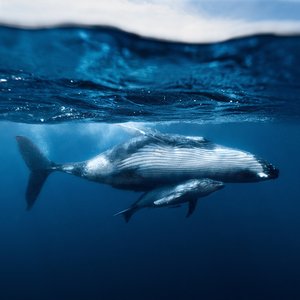
A humpback whale swims below her calf. With a view from below, the humpbacks white ridged underside is clearly visible as is her long, knobbly flipper.

Humpback whale with calf  |  Image credit: Hannes Klostermann / Ocean Image Bank

Scientists have also not ruled out the possibility that humpbacks may actually get involved because they want to protect other animals from predators like a form of ocean guardian. In one recorded case in 2017, a humpback appeared to protect a diver in the Cook Islands from an approaching tiger shark, that it may have thought was a threat, by guiding her (quite forcefully) toward her boat.

Sperm whales use poo as a defence mechanism
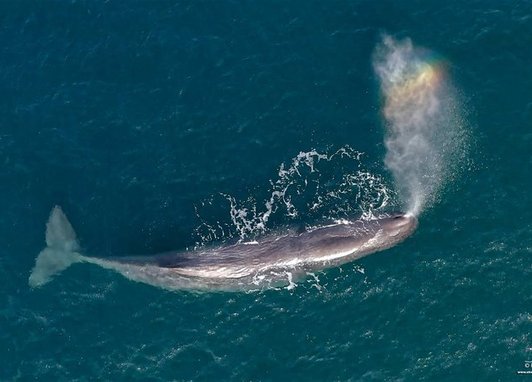
When threatened by orcas, sperm whales have been observed releasing huge clouds of faeces and thrashing their tails to spread them through the water, potentially helping to confuse or deter their attackers.  

This behaviour is known as defensive defecation, a tactic also seen in some other animals, including birds. One remarkable incident was captured in 2014, when a lone sperm whale surrounded a photographer with an enormous cloud of poo, nicknamed a “poopnado.” A decade later, in 2024, observers off Western Australia witnessed a group of sperm whales apparently using the same tactic while actually being attacked by orcas.

A sprm whale spraying water out of its blowhole  |  Image credit: Hugh Harrop

Sperm whales also tend to defecate together while socialising. During large gatherings, so many whales can empty their bowels that the surrounding water becomes cloudy with excrement, which the whales seem perfectly happy to continue swimming through. Scientists still aren't sure why they sometimes synchronise their bowel movements. One possibility is that because other behaviours become synchronised during social gatherings, defecating at the same time may simply be another part of this coordinated activity.
As unpleasant as it might sound, whale poo is incredibly important for the health of the ocean. It releases nutrients such as nitrogen and iron near the surface, where they can fertilise microscopic phytoplankton. These organisms form the foundation of marine food webs, ultimately supporting everything from small fish to enormous baleen whales. 

Phytoplankton also absorb carbon dioxide through photosynthesis, so by helping them grow, whales play a role in recycling nutrients, supporting productive oceans and influencing the ocean's carbon cycle. In other words, a whale going to the toilet can have benefits that ripple through an entire marine ecosystem.

A sperm whale  |  Image credit: Ellen Cuylaerts/Ocean Image Bank

Some whale populations have made remarkable conservation recoveries

In the past, whales were hunted in great numbers for meat, oil, bone and other materials which lead multiple species to be pushed close to extinction.
Luckily, no living species of whale is thought to have gone completely extinct from whaling though regional populations were completely hunted down.

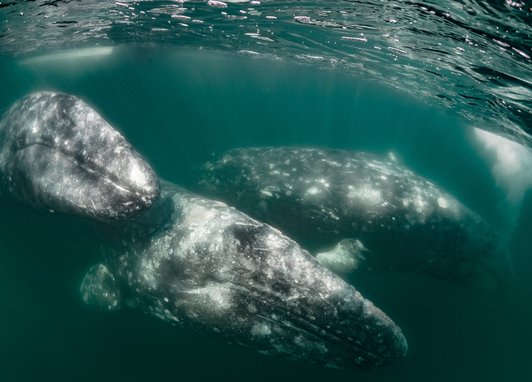
However, some species have made a remarkable recovery after the International Whaling Commission's (IWC) moratorium on commercial whaling came into force in 1986. One example of success has been the grey whale population which completely disappeared in the Atlantic. In 2024, grey whales from the Pacific were recorded returning to the Atlantic near New England suggesting an introduction back into the Atlantic ocean.

Three grey whales swimming toward a camera. The ocean surface is visible at the top of the image

A pod of grey whales off the coast of Mexico  |  Image credit: Hannes Klostermann / Ocean Image Bank

Whale populations are slow to rebound because they usually only give birth to one calf at a time and wait several years before mating again while caring for their baby. Whales also have long gestation periods, usually around 10 to 18 months, depending on the species, which means any harm that happens to a pregnant female can have a devastating effect on the next generation. 
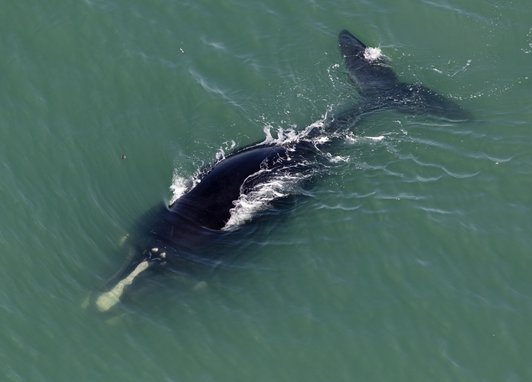
Unfortunately, some species of whales still have extremely low numbers because of these reasons. North Atlantic right whales are a key species where population growth is struggling. Though they are protected by an international ban on whaling the species since 1935, they are extremely vulnerable from human activity such as ship strikes and fishing gear entanglement. Fewer than 400 North Atlantic right whales are estimated to remain as of 2026, making them one of the most endangered large whales. 

An aerial view of a North Atlantic right wahle. It is obscured by the murky water but iits tail and rostrum is clearly outlined

A top down view of a North Atlantic right whale  |  Image credit: 6381380

Whales are still being discovered

Though it is unlikely that an entirely new species of whale never before seen will be found, species are still being formally recognised. In 2003, scientists reclassified an entirely new species that had previously been mistaken from genetic material. It was only in 2015 that scientists finally recognised Omura's whales in the wild and stopped mistaking them as small Bryde’s whales.
Because the ocean is extremely vast and some whales are rarely encountered since they live so far off shore or spend most of their lives at great depths, our understanding of whales is always changing. Despite being some of the largest animals on Earth, many whales remain surprisingly mysterious. As marine science advances, new technology, genetic research and observations at sea are helping scientists learn more about them and sometimes rethink what we thought we knew. There is still so much to discover about whales, and the whale family tree that what we know today may change as marine science progresses. 

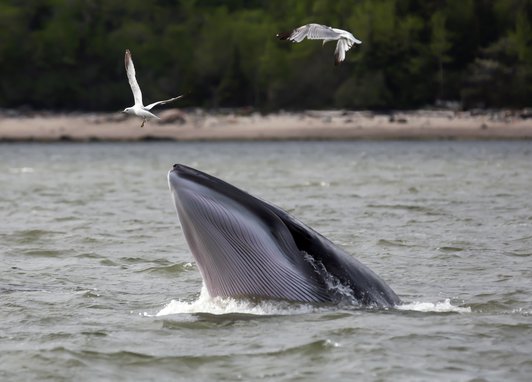
A beautiful, elusive minke whale raises its mouth out of the water while two gulls fly close. The top of its head is grey while the underside of its mouth is ridged pearlescent white with grey ridges. A sandy shore fringed with trees is in the background

A minke whale  |  Image credit: Annie Leblanc
Marine Conservation Society

20 Oct 2026