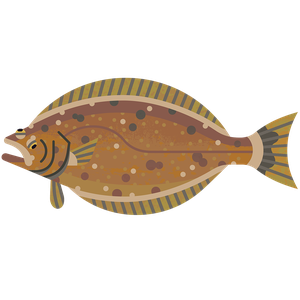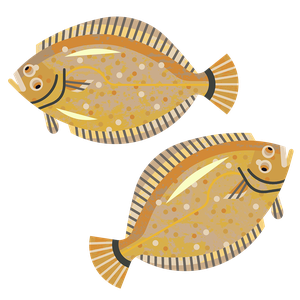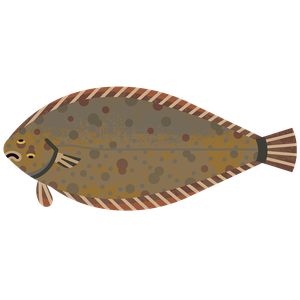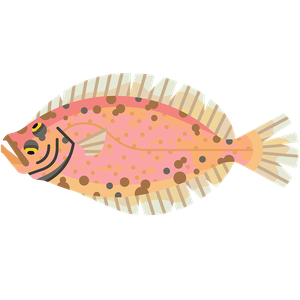

Brill
What to check for
North Sea, Skagerrak and Kattegat, English Channel: All areas
Net (gill or fixed)
Rating summary
Brill in this region is considered underfished and the stock is harvested sustainably. Few management measures in the North Sea and English Channel are specifically designed for brill. Nevertheless, the stock is currently abundant and appears to be harvested sustainably. Although a species-specific TAC was only introduced in 2024, catch limits have been set in line with scientific advice and have effectively controlled fishing mortality. The fishery has a well‑developed and effective Monitoring, Control, and Surveillance (MCS) system with reliable enforcement and low levels of IUU activity. Gillnets have minimal impacts on benthic habitats because they cause little disturbance to the seabed. However, their non-selective nature can result in relatively high levels of bycatch, including ETP species such as harbour porpoise. In some areas, current harbour porpoise bycatch rates are considered unsustainable and are hindering population recovery. While current levels of brill removal are unlikely to have a significant effect on food-web dynamics, the bycatch associated with net fisheries has the potential to affect ecosystem function and alter trophic structure.
Rating last updated July 2026
References
Cook, R., Gaudian, G., des Clers, S. and Seip- Markensteijn, C.M., 2022. Marine Stewardship Council (MSC) Public Certification Report: Scottish Fisheries Sustainable Accreditation Group (SFSAG) Northern Demersal Stocks. Prepared by Control Union (UK) Limited on behalf of Scottish Fisheries Sustainable Accreditation Group (SFSAG). May 2022. Available at https://cert.msc.org/FileLoader/FileLinkDownload.asmx/GetFile?encryptedKey=BdxOJoY7Sf4DmNJEB/m47M6xx0rRfgP/niGx3vj5Ud8hadYI3XCNrnlSFL/jlTgK [Accessed on 08.07.2026].
Eigaard, O.R., Bastardie, F., Breen, M., Dinesen, G.E., Hintzen, N.T., Laffargue, P., Mortensen, L.O., Nielsen, J.R., Nilsson, H.C., O'Neill, F.G., Polet, H., Reid, D.G., Sala, A., SkOld, M., Smith, C., Sorensen, T.K., Tully, O., Zengin, M., Rijnsdorp, A.D., 2016. Estimating seabed pressure from demersal trawls, seines, and dredges based on gear design and dimensions. ICES Journal of Marine Science, Volume 73, Issue suppl 1. Pages i27-i43. Available at https://academic.oup.com/icesjms/article/73/suppl_1/i27/2573989 [Accessed on 08.07.2026].
Froese, R., Pauly, D. 2026. FishBase. Brill, Scophthalmus rhombus. Available at: Scophthalmus rhombus, Brill : fisheries, gamefish [Accessed on 25.08.2026].
GOV.UK. 2025. Technical Conservation and Landing Obligation rules and regulations 2025. Available at: Technical Conservation and Landing Obligation rules and regulations 2025 - GOV.UK [Accessed on 08.07.2026].
GOV.UK. 2025. Marine protected areas Stage 3 Consultation. Available at: Marine protected areas Stage 3 Consultation - GOV.UK [Accessed on 08.07.2026].
Hiddink, J., Jennings, S., Sciberras, M., Szostek, C.L., Hughes, K.M., Ellis, N., Rijnsdorp, A.D., McConnaughey, R.A., Mazor, T., Hilborn, R., Collie, J.S., Pitcher, C.R., Amoroso, R.O., Parma, A.M., Suuronen, P. and Kaiser, M.J. 2017. Global analysis of depletion and recovery of seabed biota after bottom trawling disturbance. PNAS. 114:31, pp. 8301-8306. https://doi.org/10.1073/pnas.1618858114.
ICES. 2026. Brill (Scophthalmus rhombus) in Subarea 4 and divisions 3.a and 7.d–e (North Sea, Skagerrak and Kattegat, English Channel). In Report of the ICES Advisory Committee, 2026. ICES Advice 2026, bll.27.3a47de, https://doi.org/10.17895/ices.advice.30931967
ICES. 2026. Working Group on the Assessment of Demersal Stocks in the North Sea and Skagerrak (WGNSSK). ICES Scientific Reports. 08:43. 1183 pp. https://doi.org/10.17895/ices.pub.32676345
ICES. 2025 Celtic Seas Ecosystem – fisheries Overview. In Report of the ICES Advisory Committee, 2025. ICES Advice 2025, section 7.2. https://doi.org/10.17895/ices.advice.30710879
ICES. 2025. Celtic Sea mixed fisheries considerations. In Report of the ICES Advisory Committee, 2025. ICES Advice 2025. https://doi.org/10.17895/ices.advice.30374749
ICES. 2025. Greater North Sea ecoregion – fisheries overview In Report of the ICES Advisory Committee, 2025. ICES Advice 2025, section 9.2. https://doi.org/10.17895/ices.advice.30710897
ICES. 2025. Greater North Sea mixed fisheries considerations. In Report of the ICES Advisory Committee, 2025. ICES Advice 2025. https://doi.org/10.17895/ices.advice.30316027
ICES. 2024. Greater North Sea ecoregion – Ecosystem overview. In Report of the ICES Advisory Committee, 2024. ICES Advice 2024, Section 7.1, https://doi.org/10.17895/ices.advice.25714239
ICES. 2024. Celtic Seas Ecoregion – Ecosystem overview. In Report of the ICES Advisory Committee, 2024. ICES Advice 2024, Section 7.1, https://doi.org/10.17895/ices.advice.25713033
ICES. 2025. Cod in Subarea 4, divisions 6.a and 7.d, and Subdivision 20 (North Sea, West of Scotland, eastern English Channel and Skagerrak). In Report of the ICES Advisory Committee, 2025. ICES Advice 2025, cod.27.46a7d20. https://doi.org/10.17895/ices.advice.27202566
ICES. 2024. Spurdog (Squalus acanthias) in Subareas 1-10, 12 and 14 (the Northeast Atlantic and adjacent waters). In Report of the ICES Advisory Committee, 2024. ICES Advice 2024, dgs.27.nea. https://doi.org/10.17895/ices.advice.25019237
Kennelly, S. J. & Broadhurst, M. K., 2021. A review of bycatch reduction in demersal fish trawls. Rev Fish Biol Fisheries 31, 289–318. https://doi.org/10.1007/s11160-021-09644-0.
Kynoch, R., Fryer, R. & Neat, F., 2015. A simple technical measure to reduce bycatch and discard of skates and sharks in mixed-species bottom-trawl fisheries. ICES J Mar Sci,72(6):1861.
Lynam, C.P., Llope, M., Möllmann, C., Helaouët, P., Bayliss-Brown, G.A. and Stenseth, N.C., 2017. Interaction between top-down and bottom-up control in marine food webs. Proceedings of the National Academy of Sciences, 114(8), pp.1952-1957.
MMO (2025) UK National North Sea Cod Avoidance Plan. Available at: https://assets.publishing.service.gov.uk/media/678f8ffc1784b7a1338e9db0/UK_National_Cod_Avoidance_Plan.pdf [Accessed on 08.07.2026].
Silva, F., Ellis, J. & Catchpole, T., 2012. Species composition of skates (Rajidae) in commercial fisheries around the British Isles and their discarding patterns. J Fish Biol., 80:1678–1703.
Thorpe, R.B., Arroyo, N.L., Safi, G., Niquil, N., Preciado, I., Heath, M., Pace, M.C. and Lynam, C.P., 2022. The response of North Sea ecosystem functional groups to warming and changes in fishing. Frontiers in Marine Science, 9, p.841909.
van Denderen, P. Bolam, S., Hiddink, J.G., Jennings, S., Kenny, A., Rijnsdorp, A., and van Kooten, T., 2015. Similar effects of bottom trawling and natural disturbance on composition and function of benthic communities across habitats. Mar Ecol Prog Ser. 2015;541:31–43.
Wilson, D., Cieri, M. 2026. Marine Stewardship Council (MSC) 3rd Surveillance Audit Report: Scottish Fisheries Sustainable Accreditation Group (SFSAG) Northern Demersal Stocks. Prepared by Control Union (UK) Limited on behalf of Scottish Fisheries Sustainable Accreditation Group (SFSAG). March 2026. Available at: Assessments SFSAG Northern Demersal Stocks - MSC Fisheries [Accessed on 08.07.2026].