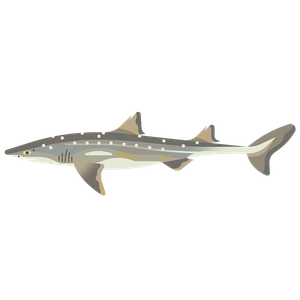

Blue skate
Dipturus batis
What to check for
Location
Location
Location refers to two things:
- Where the fish population or stock lives, e.g., North Sea, or South Pacific.
- Who is managing the fishery. If it says “All areas”, this means that our scoring for management covers the same area as the fish stock.
North Sea and Skagerrak; Celtic Sea and West of Scotland: All areas
Technical location
Technical location
A global system is used to split the ocean into different zones, areas, and subdivisions. Each zone is indicated by a number and/or letter. By law, this must be shown on all unprocessed seafood sold in the EU and UK, alongside the fishing method used to catch it. Look for these details on the packet to match your seafood to our ratings.
7: Irish Sea, Porcupine Bank, English Channel, Bristol Channel, Celtic Seas, West and Southwest of Ireland, 6: Rockall, West of Scotland
Caught by
Caught by
Bottom trawl (beam)
Beam trawling involves towing a net over the seabed. The net is held open by a heavy beam. There can be tickler chains or chain matting, which drag along the front of the net. They disturb the fish, causing them to swim up and into the net, which is then hauled onto the boat.
Bottom trawl (otter)
Otter trawling involves towing a net over the seabed. The net is held open by two panels, known as otter boards. Fish are herded between the boards and into the net, which is then hauled onto the boat.
Net (gill or fixed)
Gillnetting uses a net, suspended in the water, that is anchored to the seabed. It is kept vertical by buoys, to create a wall of netting that fish swim into and become entangled. The mesh size and length of time the nets are left at sea varies, depending on where they are fishing and what they are targeting.
Bottom trawl (beam), Bottom trawl (otter), Net (gill or fixed)
Rating summary
There is no targeted fishery for blue or flapper skate, as it is prohibited to fish for, land, or retain these species in UK or EU waters. Very little is known about the stocks, with both species assessed as Critically Endangered by IUCN and are listed by OSPAR as a threatened and declining species. Therefore, they are automatically red-rated species.
Rating last updated June 2026
How we worked out this Rating
Stock status
The size and health of a fish population, or 'stock', that is being targeted by fishermen is a crucial indicator of whether a fishery is sustainable. If the stock is too small to withstand fishing, it is at risk of crashing. We look at how big the stock is, and how much pressure there is from fishing, to assess this. The target level that many fisheries aim for is 'Maximum Sustainable Yield' - the most fish that can be caught year after year whilst keeping the population at a healthy size.
There is zero catch advice for both blue and flapper skate, and it is prohibited to catch them across most of Europe.
Blue skate and flapper skate are assessed together by ICES as part of the common skate complex (Dipturus spp.). Due to limited species-specific data, there are no robust indicators available to determine population trends, and no reference points have been established for biomass or fishing pressure.
Despite this lack of data, landings of the common skate complex have continued. Reported landings from the North Sea peaked at over 25 tonnes in 2018 and were most recently just over 10 tonnes in 2022, with Denmark accounting for the majority of these catches. However, no landings of blue skate or flapper skate have been permitted in UK and EU waters since 2009, with both species designated as prohibited since 2010. Current regulations therefore prohibit fishing, retention on board, transshipment, and landing of these species.
Both species exhibit very low resilience to fishing pressure, with a minimum population doubling time exceeding 14 years. Applying a precautionary approach, ICES advises zero catch for the Celtic Seas and western English Channel from 2025 to 2028, and zero catch for the North Sea, Skagerrak, and Kattegat from 2024 to 2027.
Discarding is known to occur, although discard survival rates have not been estimated.
Both blue skate and flapper skate are classified as Critically Endangered on the IUCN Red List. Misidentification is common among members of this genus in the region, including blue skate, flapper skate, Norwegian skate, and longnose skate. Although taxonomic distinction between blue and flapper skate has improved, some misidentification persists, meaning that reported landings are not reliable indicators of species composition or catch.
Management
Good management is vital to be sure that fishing doesn't cause fish populations to decline. We look at whether regulations follow the best available scientific advice, how well compliance is monitored and enforced, and whether this is effective in maintaining healthy fish stocks.
Management: Critical Fail
It is prohibited to catch blue and flapper skate across this area of Europe. Therefore, it is a critical fail on the Good Fish Guide.
The absence of reference points for the stock limits the development of robust management measures. ICES therefore advises that species-specific landings data should be collected for a wider range of skates and rays to improve understanding of stock status. However, introducing species-specific quotas may increase the risk of misreporting or discarding.
Current UK and EU regulations prohibit the fishing, retention on board, transshipment, or landing of the common skate complex (blue skate and flapper skate) across ICES Division 2.a and subareas 3–4 and 6–10. Both species are also listed as UK Priority Species and are included in the UK Biodiversity Action Plan (UK BAP), which aims to stabilise populations by minimising fishing mortality and securing legal protection in at least five key areas.
Marine Protected Areas (MPAs) form an important part of this conservation approach. The Loch Sunart to the Sound of Jura MPA, designated in 2014 with fisheries measures implemented in 2016, was established following tagging studies identifying it as an important area for both resident and transient flapper skate. The site lists “common skate” as a designated feature, aiming to reduce fishing mortality and protect critical habitat. A further MPA, Red Rocks and Longay, was designated temporarily in March 2021 and made permanent in 2023 to protect flapper skate egg cases in what is believed to be a key spawning and nursery area.
At the point of sale, skate and ray species are difficult to identify, as they are typically processed into wings with the body discarded and skin removed. DNA analyses of skate products in the UK suggest that blue and flapper skate rarely reach the market. Although landings are reported, these species are frequently misidentified and recorded as Norwegian skate or longnose skate.
The ICES Skate Working Group and OSPAR both emphasise the need to improve knowledge of species distributions and critical habitats to support future management. In particular, flapper skate may be more vulnerable to overfishing, highlighting the importance of monitoring and assessing these species separately.
Skates and rays caught in the Northwest waters (ICES subareas 6 and 7) and North Sea waters (ICES subareas 2a, 3a and 4) with all fishing gears, are exempt from the landing obligation, based on their high survivability rates. Any skates and rays that are discarded are required to be released immediately and below the sea surface.
The EU and UK both have fishery management measures, which can include catch limits, population targets, and gear restrictions. However, compliance in the EU and UK has been inconsistent, with ongoing challenges in implementing some regulations. The goal of reaching Maximum Sustainable Yield (MSY) by 2020 was missed, with less than half of UK TACs in 2024 following ICES advice. In 2024, the EU and UK reaffirmed their commitment to sustainable fisheries by aligning management with scientific advice to gradually approach MSY. However, no new target date has been set for achieving MSY across all fisheries. The Landing Obligation (LO), an EU law retained by the UK post-Brexit, requires all quota fish to be landed, even if unwanted (over-quota or below minimum size). It aims to encourage more selective fishing methods, reduce bycatch, and improve catch reporting. However, compliance is poor, and accurate discard levels are hard to quantify with current monitoring programmes. The UK is in the process of replacing the LO with country-specific Catching Policies.
The Marine Conservation Society views Remote Electronic Monitoring (REM) with cameras is one of the most cost-effective tools for providing reliable fisheries data and aiding informed management decisions. Fully monitored fisheries enhance collaboration, data accuracy, stock recovery, and reduce impacts on marine wildlife and habitats. However, the full potential of REM may only be achieved when it tracks fishing location and documents catch and bycatch, particularly where vulnerable species and habitats are at risk. As of January 2024, the EU is introducing a Remote Electronic Monitoring (REM) mandate for EU vessels, including CCTV cameras on vessels 18m or more that pose a potential risk of non-compliance, within the next 4 years. Across the UK, different approaches to REM are being taken and legislation is expected to be in place across all 4 countries within the next few years.
The Fisheries Act (2020) requires the development of Fisheries Management Plans (FMPs) (replacing EU Multi-Annual Plans) in the UK. 43 FMPs have been proposed and are at various stages of development and implementation, these should all be published by the end of 2028. FMPs have the potential to be very important tools for managing UK fisheries, although data limitations may delay them for some stocks. It is also essential the UK governments define and adopt a standardised approach or model across the four nations to a universally defined FMP design, to ensure the consistence, quality and coherence of all the proposal FMPs.
The Marine Conservation Society is keen to see publicly available Fishery Management Plans for all commercially exploited stocks, especially where stocks are depleted, that include:
- An overview of the fishery including current stock status, spatial coverage, current fishing methods and impacts
- Targets for fishing pressure and biomass, and additional management when those targets are not being met, based on the best scientific evidence
- Timeframes for stock recovery
- Improved data collection, transparency, and accountability, supported by technologies such as Remote Electronic Monitoring (REM)
- Consideration of wider environmental impacts of the fishery, including habitat impacts and minimising bycatch
- Stakeholder engagement
Capture method
Environmental impacts of fishing vary hugely, depending on the method used and where it's happening. We look at whether the fishing gear being used could have an effect on seabed habitats, and if so, how severe might this be. We also review whether it catches any other species by accident (bycatch), and what effect this might have on those species - especially if they're Endangered, Threatened, or Protected.
Blue and flapper skate can be caught using different fishing methods. As this species is a Fish to Avoid, capture method impacts have not been scored.
Blue and flapper skate occur in the Northeast Atlantic, ranging from Iceland to the British Isles. Historically, their distribution was much wider, extending into the Mediterranean Sea and along the coast of North Africa, but this range is believed to have contracted significantly due to fishing pressure.
These species are not targeted commercially but are taken as bycatch in fisheries targeting roundfish and flatfish, although the quantities caught are not well quantified. They may be captured by a range of fishing methods, including beam trawls, otter trawls, gillnets, and tangle nets. All of these gears can also result in bycatch of other vulnerable species, while mobile gears such as trawls may additionally impact benthic habitats.
The ICES Working Group on Elasmobranch Fishes recommends that mitigation measures to reduce incidental catches are trialled and implemented, such as modifying fishing gear (e.g. removing tickler chains in trawl fisheries).
References
Dedman, S., Officer, R., Brophy, D., Clarke, M. and Reid, D.G., 2017. Towards a flexible Decision Support Tool for MSY-based Marine Protected Area design for skates and rays. ICES Journal of Marine Science, 74 :2, pp.576–587 . Available at: https://doi.org/10.1093/icesjms/fsw147.
Dipturus batis summary page, n.d. FishBase. Available at: https://www.fishbase.us/summary/Dipturus-batis.html [Accessed on 01.06.2026].
Dipturus intermedius summary page, n.d. FishBase. Available at: https://www.fishbase.us/summary/Dipturus-intermedius.html [Accessed on 01.06.2026].
Eigaard, O.R., Bastardie, F., Breen, M., Dinesen, G.E., Hintzen, N.T., Laffargue, P., Mortensen, L.O., Nielsen, J.R., Nilsson, H.C., O’Neill, F.G., Polet, H., Reid, D.G., Sala, A., Sköld, M., Smith, C., Sørensen, T.K., Tully, O., Zengin, M. and Rijnsdorp, A.D., 2016. Estimating seabed pressure from demersal trawls, seines, and dredges based on gear design and dimensions. ICES Journal of Marine Science, 73 :suppl_1, pp.i27–i43 . Available at: https://doi.org/10.1093/icesjms/fsv099.
Ellis, J.R., Burt, G.J., Grilli, G., McCully Phillips, S.R., Catchpole, T.L. and Maxwell, D.L., 2018. At-vessel mortality of skates (Rajidae) taken in coastal fisheries and evidence of longer-term survival. Journal of Fish Biology, 92 :6, pp.1702–1719 . Available at: https://doi.org/10.1111/jfb.13597.
Fisheries Advisories, n.d. Shark Trust. Available at: https://www.sharktrust.org/fisheries-and-policy/resources/advisories [Accessed on 01.06.2026].
Hiddink, J.G., Jennings, S., Sciberras, M., Szostek, C.L., Hughes, K.M., Ellis, N., Rijnsdorp, A.D., McConnaughey, R.A., Mazor, T., Hilborn, R., Collie, J.S., Pitcher, C.R., Amoroso, R.O., Parma, A.M., Suuronen, P. and Kaiser, M.J., 2017. Global analysis of depletion and recovery of seabed biota after bottom trawling disturbance. Proceedings of the National Academy of Sciences, 114 :31, pp.8301–8306 . Available at: https://doi.org/10.1073/pnas.1618858114.
ICES, 2023. Common skate complex (Blue skate (Dipturus batis) and flapper skate (Dipturus intermedius) in Subarea 4 and Division 3.a (North Sea, Skagerrak and Kattegat). ICES Advice: Recurrent Advice. Available at: https://doi.org/10.17895/ices.advice.21856872.v1.
ICES, 2024. Common skate complex (Blue skate (Dipturus batis) and flapper skate (Dipturus intermedius) in Subarea 6 and divisions 7.a–c and 7.e–k (Celtic Seas and western English Channel). ICES Advice: Recurrent Advice. Available at: https://doi.org/10.17895/ices.advice.25019510.v1.
ICES, 2025. Report of the Working Group on Elasmobranch Fishes (WGEF). ICES Scientific Reports. Available at: https://doi.org/10.17895/ices.pub.30137623.v1.
Kennelly, S.J. and Broadhurst, M.K., 2021. A review of bycatch reduction in demersal fish trawls. Reviews in Fish Biology and Fisheries, 31 :2, pp.289–318 . Available at: https://doi.org/10.1007/s11160-021-09644-0.
Kynoch, R.J., Fryer, R.J. and Neat, F.C., 2015. A simple technical measure to reduce bycatch and discard of skates and sharks in mixed-species bottom-trawl fisheries. ICES Journal of Marine Science, 72 :6, pp.1861–1868 . Available at: https://doi.org/10.1093/icesjms/fsv037.
(PDF) Similar effects of bottom trawling and natural disturbance on composition and function of benthic communities across habitats, 2026. ResearchGate. Available at: https://doi.org/10.3354/meps11550
Sustainable swaps
Learn more about how we calculate our sustainability ratings.
How our ratings work
Add impact to your inbox
Join the movement: get updates on the issues you care about.
We'll email you inspiring stories about the work we're doing to save and recover our oceans, and news about our urgent campaigns for positive change.