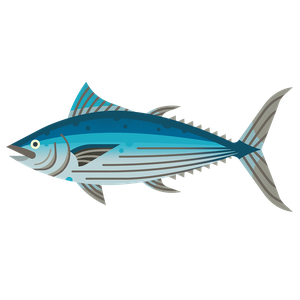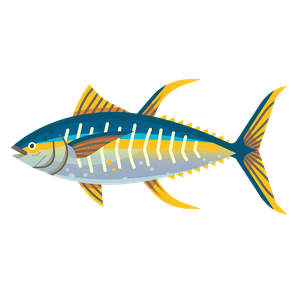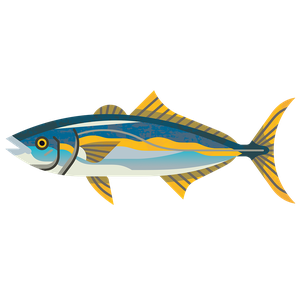


Atlantic bluefin tuna
Thunnus thynnus
What to check for
Location
Location
Location refers to two things:
- Where the fish population or stock lives, e.g., North Sea, or South Pacific.
- Who is managing the fishery. If it says “All areas”, this means that our scoring for management covers the same area as the fish stock.
East Atlantic & Mediterranean: UK Waters
Technical location
Technical location
A global system is used to split the ocean into different zones, areas, and subdivisions. Each zone is indicated by a number and/or letter. By law, this must be shown on all unprocessed seafood sold in the EU and UK, alongside the fishing method used to catch it. Look for these details on the packet to match your seafood to our ratings.
37 - Mediterranean and Black Sea
Caught by
Caught by
Hook & line (pole & line; handline)
Pole & line, or baitboat, fishing involves a number of rods being set up on a boat. They might be operated by hand or mechanically. Bait is used to attract the target species.
Handlining varies depending on where it is happening and what species is being targeted. In general, it uses a baited line from a stationary boat. The fisher pulls the line in by hand, rather than using rods or poles.
Both are also known as one-by-one fishing because the fish are landed onto the boat one at a time.
Hook & line (pole & line; handline)
Rating summary
Atlantic bluefin tuna in the east Atlantic and Mediterranean is recovering from historically low levels. Management has been effective at supporting stock recovery. However, there remains a lot of uncertainty about whether the stock has reached sustainable levels yet. Since 2023, the UK has held a small bluefin quota and established a strictly monitored, limited line‑caught fishery. UK waters are managed under tight regulations to support continued rebuilding. UK bluefin tuna are by surface fisheries such as handline and pole & line, which are generally low-impact methods.
Rating Last Updated July 2026
How we worked out this Rating
Stock status
The size and health of a fish population, or 'stock', that is being targeted by fishermen is a crucial indicator of whether a fishery is sustainable. If the stock is too small to withstand fishing, it is at risk of crashing. We look at how big the stock is, and how much pressure there is from fishing, to assess this. The target level that many fisheries aim for is 'Maximum Sustainable Yield' - the most fish that can be caught year after year whilst keeping the population at a healthy size.
Stock Status Score: 0.5
Atlantic bluefin tuna in the east Atlantic and Mediterranean is recovering from historically low levels. There remains concern for abundance, but not for fishing pressure.
Atlantic bluefin tuna is managed and assessed by the International Commission for the Conservation of Atlantic Tunas (ICCAT). The eastern stock was heavily fished from the 1950s until 1996, when management measures caused catches to drop from a peak of 60,000 tonnes to 10,00 tonnes. Recent catches have been around 30,000 tonnes. The last stock assessment was carried out in 2022, using data up to 2020. It is unclear when the next assessment will be carried out.
Route 2 (data limited) scoring has been applied to this rating owing to the lack of reference points in stock assessments. Atlantic bluefin tuna is considered to have medium resilience to fishing pressure.
The stock declined from the 1970s until 1991, coming close to stock collapse. It began to increase in the mid-2000s when a recovery plan was implemented. Assessments confirm a recent stock biomass increase, although the magnitude of the increase remains difficult to quantify. The assessment depends on recruitment estimates, which are highly unstable. It is also closely related to assumptions made about stock structure and migratory behaviour, which are poorly known. Given the levels of uncertainty, and that the stock is recovering from very low levels, MCS considers that there is still concern for the biomass.
Fishing mortality (F) increased from the 1970s until the recovery plan was introduced, and then declined sharply. It has recently been increasing again, but remains below the target level. F in 2020 is estimated to be 81% of F0.1, which is a proxy for FMSY and has been set with the aim of maintaining the biomass at B0.1. This is an increase from the estimate of average F from 2015-2017, which was 42.6% of the target level. However, F remains below the target and therefore, there is no concern for fishing pressure.
The outlook for this stock is highly uncertain because of the uncertainties in the data. However, it is projected that the spawning biomass will increase under the current TAC of 36,000t.
The fattening and farming activities in the Mediterranean since 1997 have resulted in increasing but unknown catches of juveniles going into farms. There have been considerable improvements in data quality and quantity over the past few years but important gaps remain.
It is unclear how much of the Eastern Atlantic stock mixes with and supports the Western Atlantic stock.
Atlantic bluefin was listed as Endangered on the IUCN Red List until 2021, when it was moved to Least Concern. It is still listed as Endangered in the Mediterranean and Gulf of Mexico.
Management
Good management is vital to be sure that fishing doesn't cause fish populations to decline. We look at whether regulations follow the best available scientific advice, how well compliance is monitored and enforced, and whether this is effective in maintaining healthy fish stocks.
Management of the Target Stock Score: 0.25
Alignment with Scientific Advice Score: 0
Monitoring, Control and Surveillance Score: 0
Management has been effective at supporting stock recovery. The UK has established a strictly monitored and tightly controlled line-caught fishery.
Tuna, marlin, and swordfish are highly migratory species, found on the high seas and in numerous countries' waters. This makes harmonised and effective management challenging. Regional Fisheries Management Organisations (RFMOs) are responsible for monitoring and managing these stocks on behalf of the countries that access them. However, the degree to which management is implemented, monitored and enforced by each country varies significantly.
Atlantic bluefin tuna is managed and assessed by the International Commission for the Conservation of Atlantic Tunas (ICCAT). After the eastern stock came close to collapse in the early 2000s, a rebuilding plan was introduced. It ran from 2007-2017 and included catch reductions and increases in minimum landing size. Although it is not known if the stock has reached target levels (Biomass at levels associated with Maximum Sustainable Yield), fishing pressure (F) was brought below FMSY. These measures are thought to have contributed to the subsequent rapid stock increase.
The UK’s targeted commercial Atlantic bluefin tuna fishery has continued to expand since the launch of the small-scale trial in 2023. For the 2026-2028 period, the UK has allocated an annual quota of 230.56 tonnes, with 120 tonnes reserved for a rod-and-reel based commercial fishery. Up to 30 vessels will be authorised to participate in the fishery, with each vessel receiving a quota allocation of 4 tonnes.
The fishery runs from 13 July to 31 December 2026 in UK waters excluding Northern Irish waters. Eligible vessels must be 12 metres or under, trips targeting bluefin tuna must last no more than 24 hours and all landings must be made at designated UK ports and be accompanied by an ICCAT Electronic Bluefin Tuna Catch Document.
Targeted recreational fishing for bluefin tuna in English waters is permitted only from a vessel holding an MMO catch-and-release recreational fishery permit. The 2026 season runs from 13 July to 30 November. At least one person on board must have successfully completed the Angling Trust-accredited mandatory training, and permit holders must comply with the Bluefin Tuna Code of Conduct and mandatory catch reporting. Bluefin tuna must be kept in the water and released alive; they must not be intentionally removed from the sea, retained on board, landed or sold. Accidental mortalities must be reported in accordance with permit conditions.
Commercial vessels without a specific bluefin tuna authorisation must not target the species and should release any bycaught fish alive and unharmed wherever possible. All bluefin tuna bycatch must be recorded. If a fish cannot be returned alive, fish at or above the minimum conservation reference size of 30 kg or 115 cm fork length must be landed and reported, while dead fish below that size must be discarded and recorded. Logbook vessels must also record all discards. These bycatch provisions are separate from the targeted rod-and-reel fishery.
Bluefin tuna remains a highly regulated quota species. Buyers should obtain clear traceability and confirm that any UK-caught fish was landed by a vessel authorised for the 2026 commercial fishery, at a designated port, with the required ICCAT electronic catch documentation. Tuna caught in the recreational catch-and-release fishery cannot legally be landed or sold.
Capture method
Environmental impacts of fishing vary hugely, depending on the method used and where it's happening. We look at whether the fishing gear being used could have an effect on seabed habitats, and if so, how severe might this be. We also review whether it catches any other species by accident (bycatch), and what effect this might have on those species - especially if they're Endangered, Threatened, or Protected.
Capture Method Score: 0
Habitat Impacts: 0
Bycatch Impacts: 0
Vulnerable and ETP Species: 0
Ecosystems and Trophic Webs: 0
Atlantic bluefin tuna in UK waters are primarily caught using rod and reel methods, including handline and pole and line fisheries. These are highly selective, low-impact fishing methods.
Most UK caught tuna are captured using rod-and-reel methods, which catch fish near the surface without contacting the seabed, resulting in negligible impacts on marine habitats. These methods are highly selective, allowing fishers to target bluefin tuna directly while minimising the capture of non-target species.
Other gear types, such as demersal and pelagic trawls, purse seines, ring nets and fixed nets, are not allowed to target bluefin tuna. If a bluefin tuna is accidentally caught and cannot be released alive, vessels are permitted to land one fish per trip.
Atlantic bluefin tuna below the minimum conservation reference size (MCRS) must not be targeted, retained on board, transhipped or landed. Any fish below the MCRS must be returned to the sea and recorded as a discard. The licensing conditions for bluefin tuna may be adjusted in response to quota uptake.
Bycatch levels in UK rod-and-line fisheries are generally very low compared with those of many large-scale commercial fishing methods. Fish are typically landed individually, enabling unwanted catch to be avoided or released where appropriate. The fishery therefore presents a relatively low risk to vulnerable marine species and sensitive habitats. Additionally, the UK fishery uses artificial lures, with live bait and chumming strictly prohibited.
References
Bluefin (BFT) by-catch rules within the commercial fishery, n.d. GOV.UK. Available at: https://www.gov.uk/guidance/bluefin-bft-by-catch-rules-within-the-commercial-fishery Accessed on 16.07.2026].
Bluefin tuna (BFT) commercial fishery within UK waters, 2026. GOV.UK. Available at: https://www.gov.uk/guidance/bluefin-tuna-bft-commercial-fishery-within-uk-waters [Accessed on 12.10.2026].
Bluefin tuna fisheries 2026, n.d. GOV.UK. Available at: https://www.gov.uk/government/news/bluefin-tuna-fisheries-2026 [Accessed on 16.07.2026].
Collette, B.B., Boustany, A., Fox, W., Graves, J., Juan Jorda, M. & Restrepo, V. 2021. Thunnus thynnus. The IUCN Red List of Threatened Species 2021: e.T21860A46913402. Available at https://dx.doi.org/10.2305/IUCN.UK.2021-2.RLTS.T21860A46913402.en [Accessed on 16.07.2026].
Froese, R. and Pauly, D. (Editors), 2026. Thunnus thynnus, Atlantic bluefin tuna. Available at https://www.fishbase.de/summary/Thunnus-thynnus.html [Accessed on 16.07.2026].
ICCAT, 2022. Report of the Standing Committee on Research and Statistics (SCRS). Revision, 6 October 2022. 26-30 September 2022. Madrid, Spain and Online. Available at https://www.iccat.int/com2022/ENG/PLE_104_ENG.pdf [Accessed on 16.07.2026]..
ICCAT, 2022. Resolutions, Recommendations and other Decisions. Available at https://www.iccat.int/en/RecRes.asp [[Accessed on 16.07.2026].
IPNLF, 2012. Ensuring sustainability of livebait fish, International Pole and Line Foundation, London, 57 pp. Available at https://ipnlf.org/wp-content/uploads/2021/02/ensuring-sustainability-of-livebait-fish-reportipnlfrocliffe-printable-04-12-12-.pdf.
ISSF, IPNLF, 2019. Skippers' Guidebook to Pole-and-Line Fishing Best Practices. First Edition, 2019. A Joint Publication by the International Seafood Sustainability Foundation and International Pole & Line Foundation. Available at https://www.iss-foundation.org/issf-downloads/download-info/issf-ipnlf-skippers-guidebook-to-pole-and-line-fishing-best-practices/ [Accessed on 16.07.2026].
ISSF, 2026. Status of the world fisheries for tuna. Jan. 2026. ISSF Technical Report 2026-01. International Seafood Sustainability Foundation, Pittsburgh, PA, USA. Available at https://www.iss-foundation.org/about-issf/what-we-publish/issf-documents/issf-2026-01-status-of-the-world-fisheries-for-tuna-january-2026/ [Accessed on 16.07.2026].
Sustainable swaps
Learn more about how we calculate our sustainability ratings.
How our ratings work
Add impact to your inbox
Join the movement: get updates on the issues you care about.
We'll email you inspiring stories about the work we're doing to save and recover our oceans, and news about our urgent campaigns for positive change.