
Comb jellyfish
Ctenophora
IUCN Status:Not Evaluated
While posing no threat to humans, comb jellies are relentless predators of plankton, helping to shape the microscopic world around them.
What do they look like?
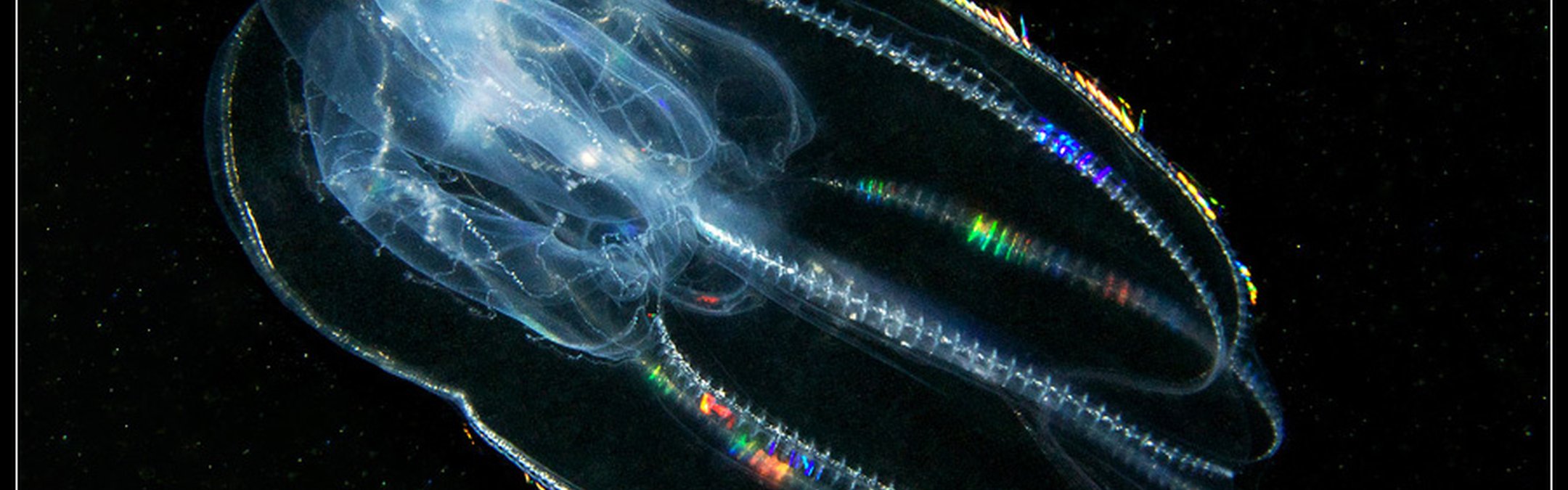
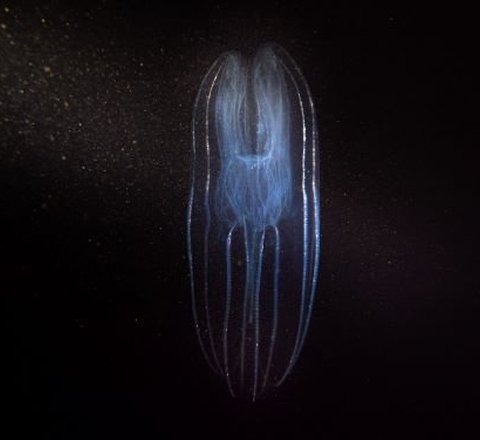
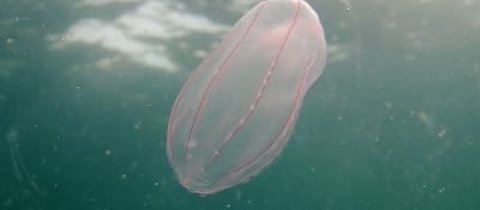
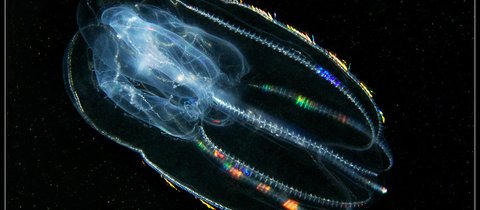
Comb jellyfish are usually translucent. Their bodies are lined with rows of tiny hair-like structures (cilia), arranged like the teeth of a comb. This is how they got their name. These cilia beat in coordinated waves, allowing comb jellyfish to glide smoothly through the water. As they move, the cilia refract and scatter light, creating a shimmering rainbow effect known as irridescence. Many comb jellyfish species can also produce bioluminescence, glowing blue or green in the dark. Their transparent bodies and gentle, floating movement usually give them an otherworldly appearance, which is no surprise due to their ancient nature - they have existed in Earth's oceans for hundreds of millions of years.
Where can they be found?
Found all over the world drifting on tides, especially in calm coastal waters, harbours, rockpools, and sheltered bays.
Did you know... Comb jellyfish are thought to have originated around 700 million years ago during the Cryogenian Period; a time when Earth was almost entirely frozen and the land was barren. Their lineage is so ancient that scientists believe comb jellies may represent the very first branch to split off from the universal ancestor of all animals. They're older than true jellyfish, dinosaurs, and even trees!
Key facts
Comb jellyfish are some of the ocean’s most mesmerising drifters. Despite their name, they're not actually true jellyfish and are their own animal category (Phylum Ctenophora).
They're not just one species - scientists have identified over 150 types, ranging from tiny forms just 0.1 millimetres long to giants reaching 1.5 metres. Despite their delicate glassy appearance, they’re found all over the world: from warm tropical seas to the icy waters of the poles and even around the UK coastline. The most familiar UK species is the sea gooseberry, but Beroe comb jellies, warty comb jellies, and occasional seasonal visitors also appear in British waters.
Comb jellies are predators, using sticky tentacles or lobes to capture plankton, fish larvae, and other drifting creatures. Despite their soft bodies, they’re efficient hunters and play an important role in marine food webs. They're also prey for larger animals, including fish, seabirds, and even true jellyfish.
Unlike true jellyfish, comb jellies do not have stinging cells, making them harmless to humans. However, they are extremely delicate and can be easily damaged if handled out of the water.
| IUCN status | Not Evaluated |
|---|---|
| Sting strength | Comb jellyfish do not have stinging cells and therefore cannot sting. |
| Length | Depending on the species, they can range from 0.1 millimetres long to up to 1.5 metres. |
| Weight | As they're made up of mostly water and rely on the currents, they're extremely light. Some species such as the sea gooseberry weigh under 1g. |
| Speed and distance | As planktonic drifters, they move as fast as the current will take them. They can move slightly with their cilia, but they're too weak to actually push against the current. They may move a few cms per second, but might move faster in short bursts if hunting. |
| Diet | They feed on plankton, fish larvae, and other drifting creatures |
| Habitat | Open ocean, coastal seas, rockpools and sometimes seen washed up on beaches. |
| Lifespan | The life cycles of comb jellyfish are complex, and the life span is influenced by factors such as water temperature, food availability and predation. In general, comb jellyfish are very short-lived, lasting from a few of weeks to a couple of months. |
Support our blue planet
The ocean is home to an extraordinary diversity of life, but it faces growing threats from climate change, human activity, habitat destruction and pollution. Your support helps fund vital science-based conservation, research, and restoration projects that make a real difference.