
By-the-wind sailor
Velella velella
IUCN Status:Not Evaluated
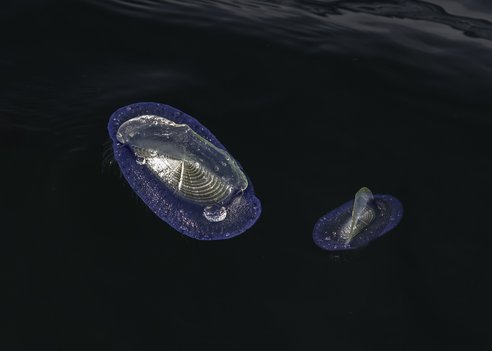
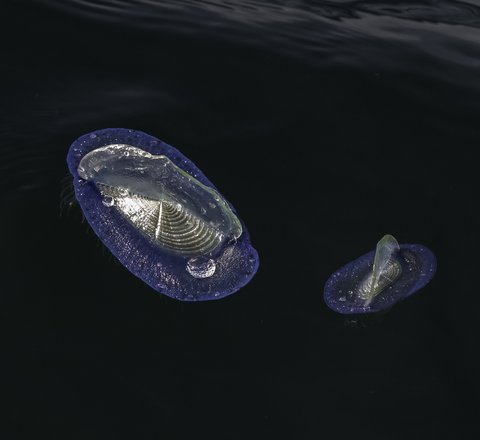
This false jellyfish, is actually a pelagic (open-water) colony of hydrozoan (Cnidaria) polyps, which serve different functions: feeding, by trapping prey using stinging cells (known as nematocysts), cells which contain zooxanthellae (producing nutrients from sunlight in a mutualistic relationship), and reproductive polyps.
What do they look like?
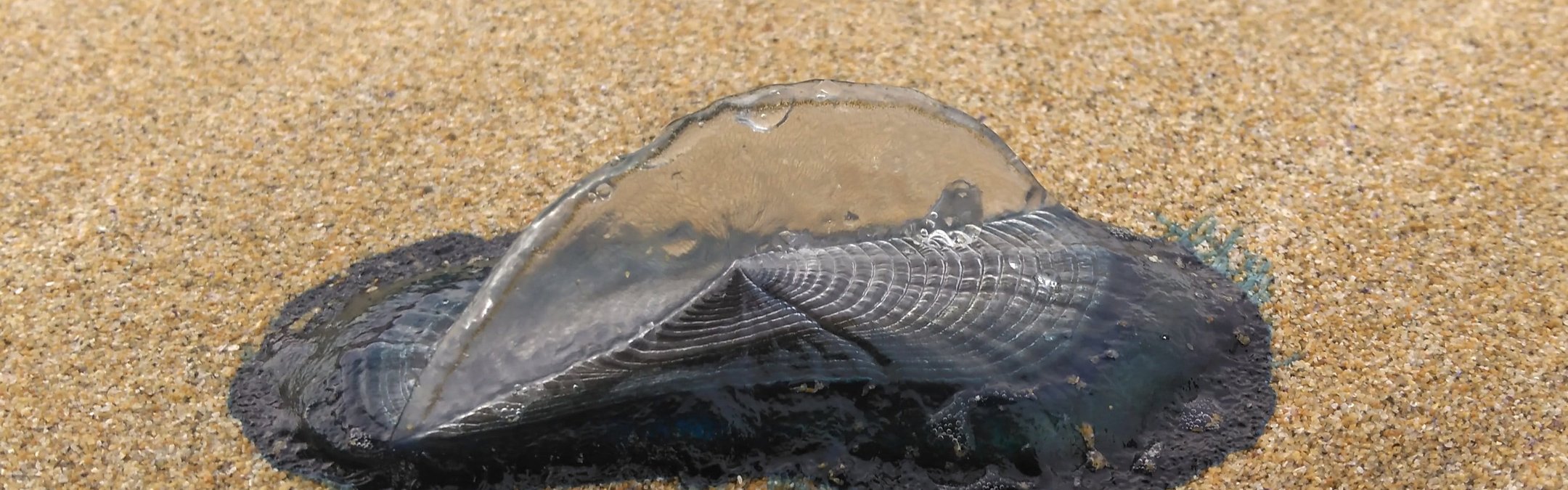
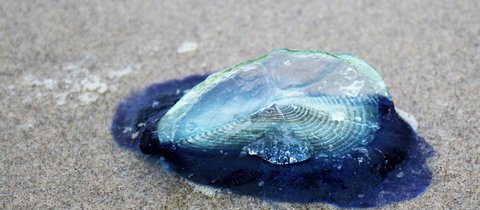
They have a diagonal sail that helps them catch the wind and travel across the ocean using their oval shaped body, filled with gas that lets them float. It is the bright blue characteristic sail that gives them their name: by-the-wind sailor. In fact, their latin name comes from the word 'velum' which actually means 'sail'. They are sometimes mistaken as their larger, more dangerous cousin, the Portuguese man o' war.
Where can they be found?
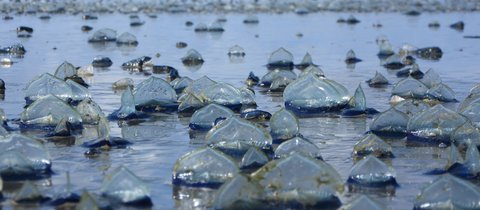
Typically southern and western coasts, and occasionally as far north as the Hebrides. November is often the best month for beach finds, as the month often brings the first of the the winter storms.
Did you know... The by‑the‑wind sailor's rich blue pigmentation protects it from the sun. The colour absorbs and deflects harmful ultraviolet radiation which is a major challenge for any organism that lives permanently at the ocean’s surface. This natural sunscreen shields their cells and genetic material from UV damage, allowing these delicate drifters to survive life in full sunlight.
Key facts
By-the-sea sailors are passive in nearly everything they do - they have little independent form of movement and drift at the whim of the wind, literally sailing through life. They tend to aggregate in swarms and can be found washed up in their hundreds or even thousands after stormy weather.
They use stinging tentacles to prey on young fish and other small animals while they travel. Thankfully, their venom is considered harmless to humans, but some people may react to it. Blue sea dragons, a type of nudibranch or sea slug, will often eat by-the-wind sailors as they are immune to its stings. However, it won't digest the stinging cells. Instead it will store them in its appendages to use as its own defence against predators.
The lifecycle of the by-the-wind sailor is actually quite complex, going from polyp-medusa-egg-planula-polyp. The reproductive polyps “bud” off tiny medusae, which look like small jellyfish, then the medusae sink to deeper waters and produce sperm and eggs released into the water column for fertilisation. Once fertilised, the planula larvae develops into a polyp and the life cycle begins again.
| IUCN status | Not Evaluated |
|---|---|
| Habitat | By-the-wind sailors are mostly seen washed upon beaches or the strandline. However, they travel all across the open ocean. |
| Diet | They feed on young fish, zooplankton and fish eggs using their small stinging tentacles. |
| Sting strength | Unlike the Portuguese man o' war, a sting from a by-the-wind sailor is pretty mild and their venom is considered harmless to humans. However, their sting can cause discomfort on sensitive skin. |
| Length | The by-the-wind sailor is a small creature at around 7-10cm long, with the sail standing at around 5cm tall. |
| Weight | Being so small they're incredibly light, with a 0.09g dry land weight. |
| Speed and distance | By-the-wind sailors can travel thousands of miles as they are completely reliant on the current of the ocean. |
| Lifespan | They have a very short life span of a couple of months, with a maximum of one year. |