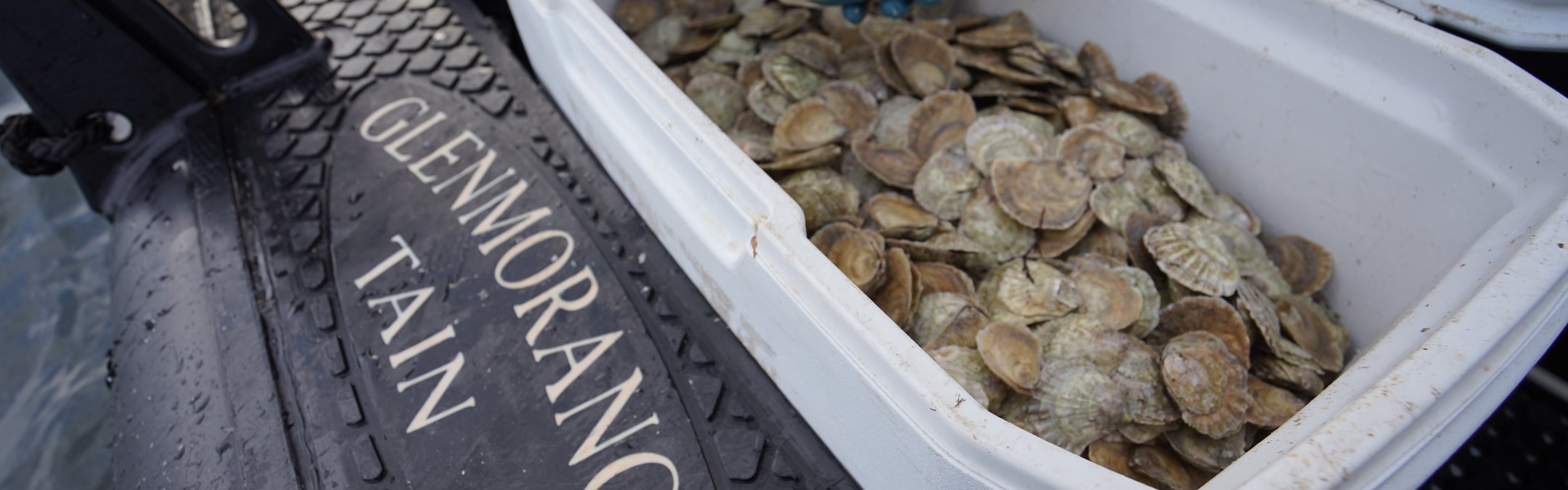
A white box filled with native oysters. The deck of hte boat it is sitting on reads "Glenmorangie Tain"

First oysters reproduce in Dornoch Firth for over 100 years

11 Nov 2026

1 minute read

For the first time in over a century, native oysters have successfully reproduced in Scotland's Dornoch Firth.

The finding comes as, alongside our project partners, The Glenmorangie Company and Heriot-Watt University, we place an additional 5,000 oysters in the water.
The baby oysters, or spat, were discovered and identified by Heriot-Watt University scientists in their field laboratory in Dornoch.  

Images of tiny babies, only a few millimetres in size, were first verified by expert invertebrate curators at the National Museums Scotland and its Welsh equivalent, Amgueddfa Cymru – Museum Wales.  

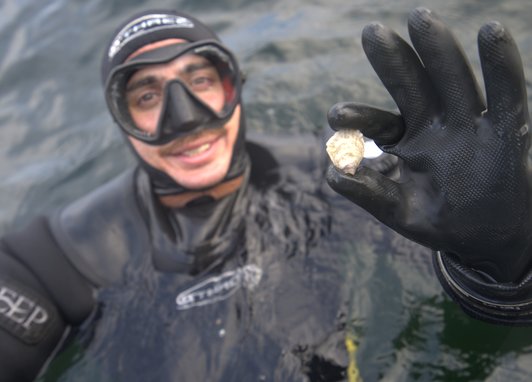
A return trip to visit the oysters showed us that some of the baby oysters had reached the size of a 50p piece, confirming that the Dornoch Firth oyster population is reproducing successfully.

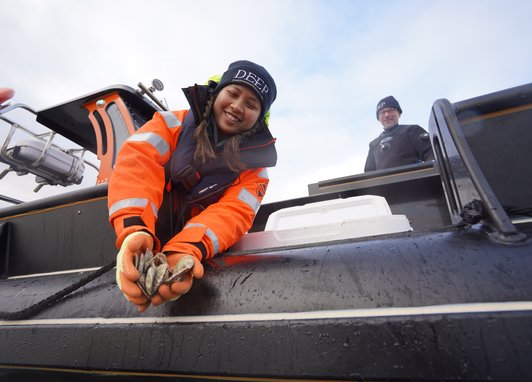
A close up of a girl wearing a hi-vis jacket dropping a handful of native oysters from a boat.

Aisyah Wan, DEEP intern adding oysters to the Dornoch Firth  |  Image credit: Gurjameer Ramday

The finding marks a major milestone in our 12-year Dornoch Environmental Enhancement Project (DEEP), which aims to restore the extinct oyster reef in the Dornoch Firth. 
Although native oysters were once abundant in the Firth, as with most of Europe’s oysters, they were fished to extinction in the late 1800s. Along with our project partners, The Glenmorangie Company and Heriot-Watt University, we established that the site would be suitable for a restoration project and in 2017, we placed the first 300 oysters from Loch Ryan on the floor of the Dornoch Firth.

By October 2026, over 140,000 juvenile oysters had been specially-bred, individually hand-cleaned by our volunteers and released into the Dornoch Firth by volunteers and scientists. And now they are beginning to breed.

A diver showing a baby oyster to the camera. They are swimming in a body of water.

Deep diver showing a baby oyster  |  Image credit: Gurjameer Ramday

The team will continue to monitor the site to establish how the oyster population is increasing and how biodiversity is improving.

Caspar MacRae, Glenmorangie's president and CEO, said: “At Glenmorangie, we aim not just to protect our beautiful Highland world, but to enhance it for future generations.

Rather like whisky, restoration takes time. Nature has started to take over, and this fledgling reef is on its way to becoming a fully biodiverse, self-sustaining ecosystem. This is a very proud moment for all of us.

Caspar MacRae, Glenmorangie president and CEO

The DEEP project recently won the Water Awareness and Conservation category at the National Sustainability Awards 2026.

Marine Conservation Society

11 Nov 2026