

Unbelievable sea creatures found in the depths of our ocean
4 minute read
Our blue planet is filled with some truly bizarre creatures but some of the most interesting live within the deepest parts of our ocean. Here are seven creatures of the deep that have evolved special traits to survive in the deep dark areas of the ocean.
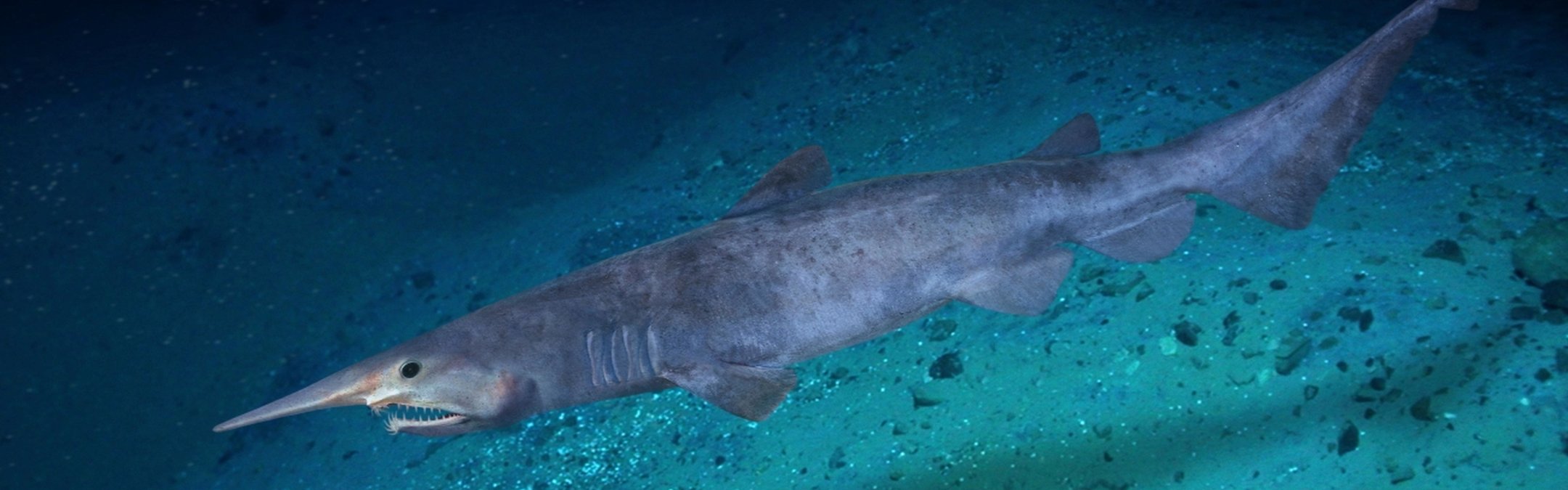
Goblin shark
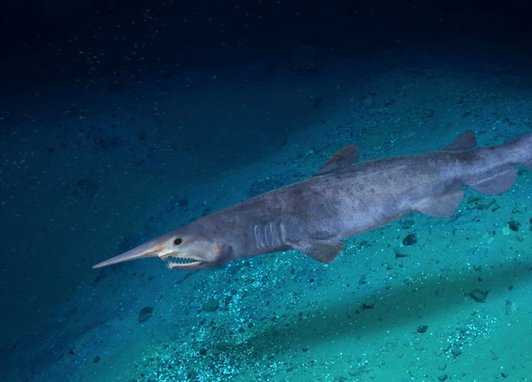
Image credit: Michigan State University
It was also recently recorded 700 metres deeper than it had previously been known to exist, setting a new record for the deepest mackerel shark (a group of sharks including great whites and basking sharks) recorded in history.
It gets its name from its resemblance to Japanese goblins called Tengu which have long noses like this shark. Its nose is filled with thousands of sensory organs named 'ampullae of Lorenzini'. These sensors are found in all sharks and help pick up tiny electrical signals from living animals. These help the shark hunt down prey where the darkness of the deep would be a hindrance if it relied on sight.
Despite looking brown in most pictures, goblin sharks are pink in colour when they are alive. Their skin is almost translucent so the pinkish colour comes from their blood showing through their thin skin.
Barbie sea pig
Although the sea pig became an internet sensation in 2024, scientists have known about these unusual deep-sea animals for over 140 years. This neon pink sea cucumber affectionally earned its nickname the ‘Barbie sea pig’ due to its colour and the success of the film that came out a year before.
This adorable creature can be found at 5,000 metres deep in the Pacific Ocean and unlike other deep sea creatures which will visit shallower waters, it spends its entire life on the abyssal plain seafloor living in darkness. The temperature is extremely cold, and the water pressure is incredibly high, however, the marshmallow-shaped sea pig is unaffected because of its jelly-like body and special proteins which let their cells function properly.
Barbie sea pigs have tiny ‘feet’ which they use to eat nutrients found on the sea floor. Like deep sea vacuum cleaners, these cute animals gobble up any organic matter that falls on the seabed including marine snow, decaying animals and other detritus. By cleaning up the deep sea they prevent dead organic material rapidly building up across the seabed.
The bottom of the ocean is quite empty of food, so it is thought they follow chemical trails to search for detritus. Because food is sparce, the sea floor can be littered with hundreds of Barbie sea pigs all congregating in one place when they find something to eat. Multiple groups have been observed moving in the same direction too, migrating together towards richer feeding grounds.
Flying spaghetti monster
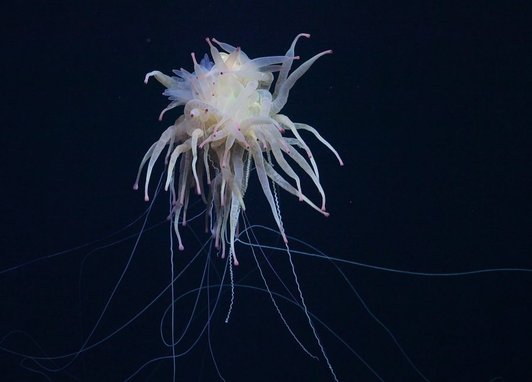
Image credit: Schmidt Ocean Institution
It is a colonial species called a siphonophore, which means each one of these animals are actually made up of many smaller units called zooids. Each zooid has its own specific job to perform such as digestion, reproduction or floatation! Together, they make up the flying spaghetti monster and are closely related to the Portuguese man o' war; another siphonophore.
Its slender tentacles can each grow up to several metres long. They use them to capture small fish and crustaceans unlucky enough to swim through them in the darkness. To avoid them escaping, each tentacle is armed with stinging cells which immobilise their prey. The flying spaghetti monster will then pull the unlucky fish closer to the specialised feeding zooids which will digest the fish.
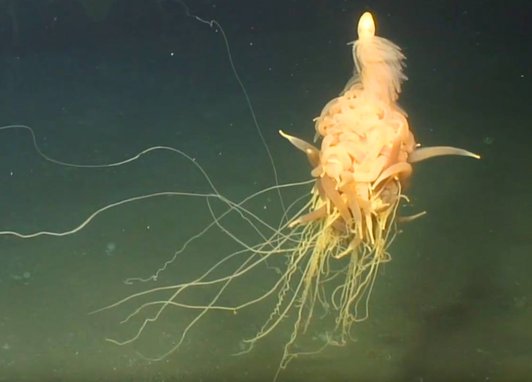
Image credit: National Oceanographic Centre/SERPENT Project
Big fin squid
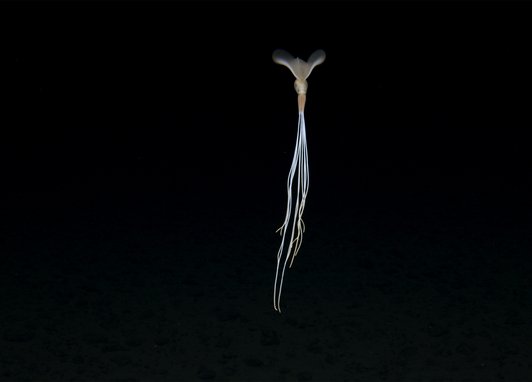
Image credit: Ocean Exploration Trust
Scientists even disagree on how they might use their elongated tentacles to catch prey. Some believe it might simply drift along in the ocean until a fish swims too close to it and it pulls it in to eat, while others think it may be more active, using its long arms to graze just above the seabed feasting on the animals along the floor.
Since cephalopods like squid tend to be one of the smartest invertebrates on Earth, it may be that both are hunting tactics of the big fin squid. In an area where food is scarce; having multiple ways to find food would be an evolutionary advantage. However, until scientists record a feeding in process, we can only speculate.
Dumbo octopus
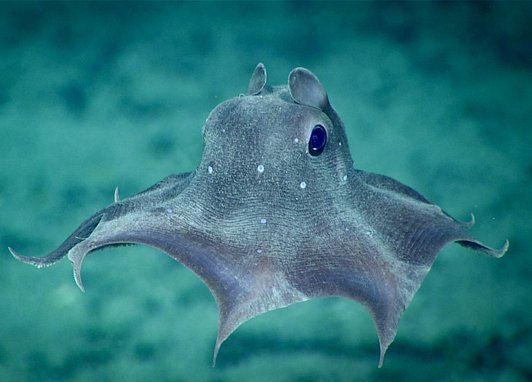
Image credit: NOAA Ocean Exploration
They have been found in the Porcupine Abyssal Plain, not far from the UK coast, proving not everything in the deep looks scary. Although they can swim gracefully using their "dumbo ears", they often spend time close to the seabed, using their arms to crawl across the ocean floor in search of food. Some individuals have been found at depths approaching 7,000 metres, making them among the deepest-living octopuses ever discovered!
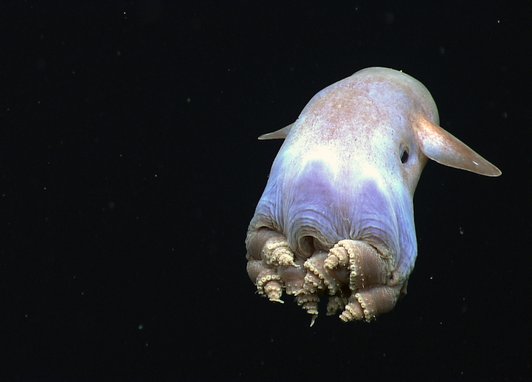
Image credit: NOAA Ocean Exploration
Like many deep-sea animals, dumbo octopuses are masters of conservation. They feed on small crustaceans, worms and other invertebrates found on or near the seabed, often swallowing their prey whole rather than tearing it apart like other octopuses. In an environment where meals can be few and far between, this simple strategy saves energy and reduces the risk of losing a hard-earned meal.
Dinner plate jellyfish
Most jellyfish drift through the ocean waiting for prey to come to them, but the dinner-plate jellyfish is thought to be one of the few species that actively hunts. Named for its broad, plate-shaped bell, it swims with its long, ribbon-like arms extended in front of its body, allowing it to sneak up on unsuspecting prey. These arms are covered in tiny stinging cells that help capture and immobilise animals before they can escape. Its diet includes other gelatinous creatures of the deep, such as comb jellies and siphonophores. Found in oceans around the world, it is thought to be an important predator in deep-sea ecosystems. Despite its size and global distribution, it remains one of the least frequently observed large jellyfish on Earth.
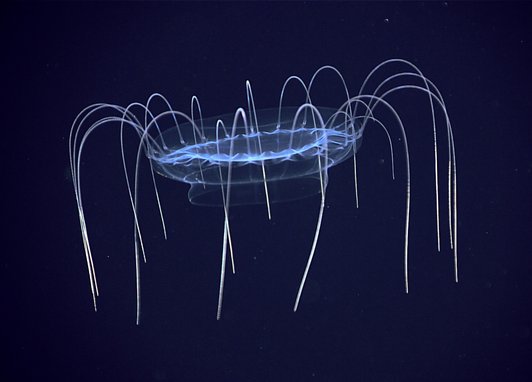
Image credit: NOAA Ocean Exploration
Like many jellyfish species, the dinner-plate jellyfish may also provide shelter for other animals. A small deep-sea fish known as the pelagic brotula is often observed swimming among its enormous arms. Researchers remain uncertain about the nature of this relationship. The fish may simply gain protection from predators or use the jellyfish as a nursery, but some scientists have suggested it could occasionally steal food from its host or even behave as a parasite. For now, the true nature of their partnership remains one of the many mysteries surrounding this elusive deep-sea giant.
Giant siphonophore
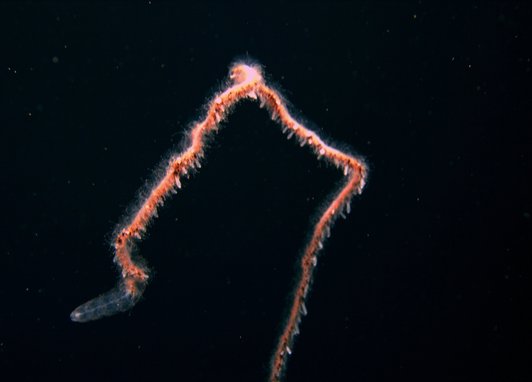
Image credit: NOAA Ocean Exploration
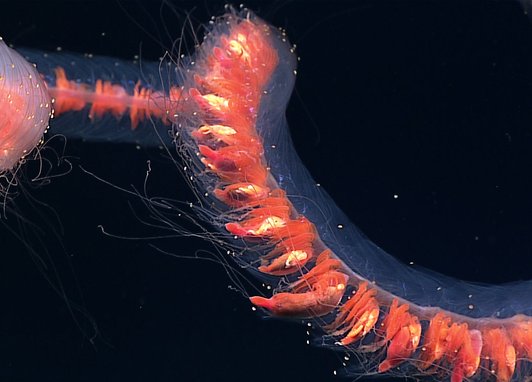
A close up of the zooids that make up the giant siphonophore | Image credit: NOAA Ocean Exploration
More to discover
Much of the deepest parts of our ocean are yet to be fully explored. What other unbelievable sea creatures might be found within the dark depths of our ocean? With new species being discovered all the time, we learn a little more about the amazing blue planet we live on.
Support our blue planet
The ocean is home to an extraordinary diversity of life, but it faces growing threats from climate change, human activity, habitat destruction and pollution. Your support helps fund vital science-based conservation, research, and restoration projects that make a real difference.