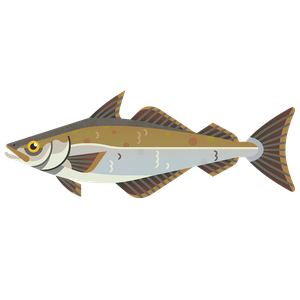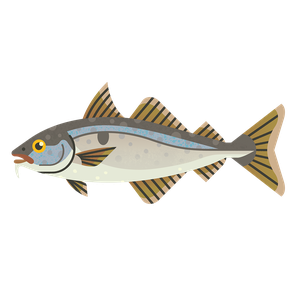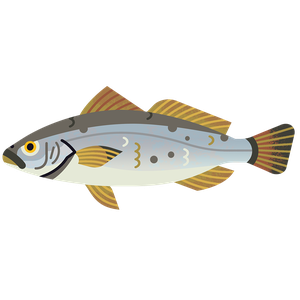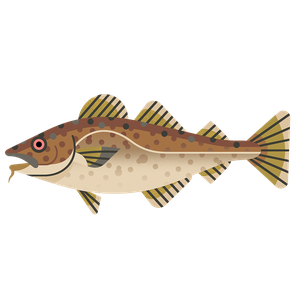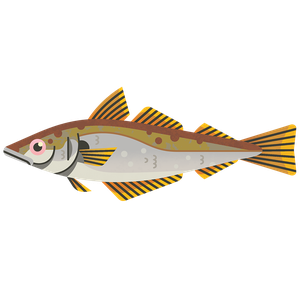
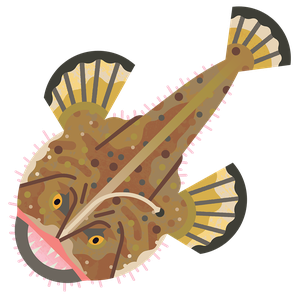
Tusk
Brosme brosme
What to check for
Location
Location
Location refers to two things:
- Where the fish population or stock lives, e.g., North Sea, or South Pacific.
- Who is managing the fishery. If it says “All areas”, this means that our scoring for management covers the same area as the fish stock.
Northeast Atlantic: All areas
Technical location
Technical location
A global system is used to split the ocean into different zones, areas, and subdivisions. Each zone is indicated by a number and/or letter. By law, this must be shown on all unprocessed seafood sold in the EU and UK, alongside the fishing method used to catch it. Look for these details on the packet to match your seafood to our ratings.
8: Bay of Biscay, 5b: Faroes Grounds, 7: Irish Sea, Porcupine Bank, English Channel, Bristol Channel, Celtic Seas, West and Southwest of Ireland, 4: North Sea, 9: Portuguese Waters, 3a: Skagerrak and Kattegat, 6a: West of Scotland, 12b: Western Hatton Bank
Caught by
Caught by
Hook & line (longline)
Longlining uses a long fishing line with baited hooks. There can be hundreds of hooks on one line. The type and size of the hook, the bait used, and the position of the longline (at the surface, mid-water, or on the sea floor) vary depending on what fishers are trying to catch.
Hook & line (longline)
Rating summary
There is no concern for population size or fishing pressure for tusk in the Northeast. There are a number of management measures for tusk. However, it is a data limited species, so there is no way of assessing how well it is managed across the Northeast Atlantic as a whole. Tusk caught by longlines in the Northeast Atlantic are unlikely to cause habitat impacts. Although longlines are considered to pose low risk of bycatch there are concerns regarding the lack of information about bycatch of vulnerable species, more data on bycatch species and quantities is needed.
Rating last updated July 2026.
How we worked out this Rating
Stock status
The size and health of a fish population, or 'stock', that is being targeted by fishermen is a crucial indicator of whether a fishery is sustainable. If the stock is too small to withstand fishing, it is at risk of crashing. We look at how big the stock is, and how much pressure there is from fishing, to assess this. The target level that many fisheries aim for is 'Maximum Sustainable Yield' - the most fish that can be caught year after year whilst keeping the population at a healthy size.
Stock Status Stock: 0.25
Tusk in the Northeast Atlantic are a data limited stock, but there appears to be no concern for population sizes or fishing pressure.
Route 2 scoring has been applied to this rating owing to the lack of references points to indicate whether biomass and fishing pressure are at sustainable levels. Tusk are considered to have medium resilience to fishing pressure.
Stock assessments are carried out by the International Council for the Exploration of the Sea (ICES). The most recent assessment was published in 2025 using data up to 2024. The next assessment is expected in 2027.
The total biomass or weight of tusk has been steadily increasing since 2003. In 2019 these were the highest levels since recording began in 2000. This is measured by landings per unit of effort (kg caught per 1,000 hooks in the longline fishery), which increased by an average of 127 kg/1000 hooks from 2016-2018, to 143 kg/1000 hooks from 2018-2020. However, the biomass has been decreasing since 2020 and was 84.68 kg/1000 hooks in 2024, which is the lowest biomass since 2005. This decrease could be of concern if it continues, however the biomass index levels are still above Itrigger (71kg/1000 hooks) therefore there is no concern for biomass at this time.
The abundance of tusk landed has showing an overall decline since the early 90s and early 2000s, with a low of 3,408t in 2021. Landings have increased slightly in the most recent years including in 2023 and 2024, where the landings were 4,332t and 5,160t, respectively. However, the length-based fishing pressures proxy is still below FMSY proxy and landings are still lower than the recommended limit and have been since 2011. Therefore, there is no concern for fishing pressure.
ICES advises that when the MSY approach is applied, catches should be no more than 5,336 tonnes in 2026 and 2027. This is a 23% decrease on the previous advice, mainly due to the decrease in the biomass index.
Management
Good management is vital to be sure that fishing doesn't cause fish populations to decline. We look at whether regulations follow the best available scientific advice, how well compliance is monitored and enforced, and whether this is effective in maintaining healthy fish stocks.
Management Score: 0.5
Some but not all appropriate relevant management measures are in place, enforced but appear to be having insufficient effect. There is no joint management plan that encompasses the whole stock area.
This tusk stock covers a wide area, but management measures are only in place for some areas. Most tusk are caught as bycatch in trawl, gillnet and longline fisheries. Catches are mainly by Norwegian and the Faroe Islands longliners in the northern North Sea (4a) and the Faroese waters (5b1). There is some bycatch by UK trawlers in the North Sea.
Varying catch limits (Total Allowable Catches, TACs) apply to different parts of the stock area, and the combined catch limits are lower than the scientifically recommended limits. Norway and the Faroe Islands have agreed a bilateral tusk quota, alongside a UK-Faroe Islands agreement permitting a targeted tusk fishery using longline and jig-reel gear and an allocation for EU vessels in the Norwegian zone. In 2025, TACs added up to 7,588 tonnes, exceeding the scientific advice of 6,924 tonnes, however catches have continuously been below advice. The stock assessment used to make these recommendations has some uncertainties, so management should be precautionary to ensure that tusk will not be overexploited. Scientific advice for 2026-2027 is less than 5,336 tonnes.
In Faroese waters there are a licensing scheme and some limits on fishing effort. These days-at-sea limits were originally aimed at controlling other fisheries (saithe, cod, and haddock), but they have not been effective at keeping catches in those fisheries at sustainable levels. Additionally, because of lower quotas for cod the fishing pressure for tusk has increased. Therefore, these effort limits may not be adequate for controlling fishing pressure.
There is no minimum landing size in Norwegian waters, and the Faroese minimum size is 40cm - smaller than the estimated size at maturity of 50cm. Measures do not, therefore, prevent juvenile tusk from being caught. The Norwegian and Faroese fleet are not allowed to discard tusk, and incentives for illegal discarding are believed to be low.
The EU and UK both have fishery management measures, which can include catch limits, population targets, and gear restrictions. However, compliance in the EU and UK has been inconsistent, with ongoing challenges in implementing some regulations. The goal of reaching Maximum Sustainable Yield (MSY) by 2020 was missed, with less than half of UK TACs in 2024 following ICES advice. In 2024, the EU and UK reaffirmed their commitment to sustainable fisheries by aligning management with scientific advice to gradually approach MSY. However, no new target date has been set for achieving MSY across all fisheries. The Landing Obligation (LO), an EU law retained by the UK post-Brexit, requires all quota fish to be landed, even if unwanted (over-quota or below minimum size). It aims to encourage more selective fishing methods, reduce bycatch, and improve catch reporting. However, compliance is poor, and accurate discard levels are hard to quantify with current monitoring programmes. The UK is in the process of replacing the LO with country-specific Catching Policies.
The Marine Conservation Society views Remote Electronic Monitoring (REM) with cameras is one of the most cost-effective tools for providing reliable fisheries data and aiding informed management decisions. Fully monitored fisheries enhance collaboration, data accuracy, stock recovery, and reduce impacts on marine wildlife and habitats. However, the full potential of REM may only be achieved when it tracks fishing location and documents catch and bycatch, particularly where vulnerable species and habitats are at risk. As of January 2024, the EU is introducing a Remote Electronic Monitoring (REM) mandate for EU vessels, including CCTV cameras on vessels 18m or more that pose a potential risk of non-compliance, within the next 4 years. Across the UK, different approaches to REM are being taken and legislation is expected to be in place across all 4 countries within the next few years.
Capture method
Environmental impacts of fishing vary hugely, depending on the method used and where it's happening. We look at whether the fishing gear being used could have an effect on seabed habitats, and if so, how severe might this be. We also review whether it catches any other species by accident (bycatch), and what effect this might have on those species - especially if they're Endangered, Threatened, or Protected.
Capture Method Score: 0.5
Most tusk in the Northeast Atlantic are caught by longlining. This method can have a bycatch of vulnerable and endangered seabird and shark species, but the impacts of this are not fully understood.
Tusk are taken in mixed fisheries with ling and as a bycatch species in longline, trawl and gillnet fisheries targeting a range of species, including cod. Longliners account for 87% of the catch of tusk in these areas, 98% of landings occurred in areas 4, 5.b. or 6.a. In Area 5b around 90% of catch was by longline around the Faroe Plateau and on the Faroe Bank in areas deeper than approximately 200 m.
The fisheries catching tusk are not thought to fish in marine protected areas. In some areas, closures are in place to protect juvenile tusk and spawning areas.
Longlining uses baited hooks set along a long fishing line to attract the target fish. This bait, and the fish that have been hooked, attract other animals such as seabirds and sharks, which are also then caught on the lines.
Longlining in demersal species, such as tusk, have a lower risk of habitat impacts than towed gear such as bottom trawling. The accidental bycatch of species such as seabirds and sharks are of greater concern. In the North Atlantic monitoring of bycatch is poor and better data is needed. There is limited information about bycatches in the ling longline fishery.
Longline fisheries within the Northeast Atlantic are thought to have low levels of bycatch, but there are records of bycatch of endangered, threatened and protected species. This includes the common guillemot, northern fulmer, and black-legged kittiwake. Common guillemot is at high risk of extinction as a breeding species along the Norwegian coast. While northern fulmars are abundant in some areas but endangered in others, this species is listed as endangered in Europe. Additionally, bycatch levels may have had a negative impact on the black-legged kittiwake which has experienced severe decline in areas 4 and 6 as well as in Norway. Overall, pelagically feeding seabirds breeding along the Norwegian coast have declined substantially since the start of monitoring in 1980.
A better understanding is needed of the impacts of this fishery on these species. Norwegian regulations require bird scarers on longliners, which reduces interactions. However, this does not meet best practice recommendations. For example, the Agreement on the Conservation of Albatrosses and Petrels (ACAP) states that the most effective measures are line weighting to sink baited hooks and reduce their availability to seabirds, bird scaring lines, and setting longlines at night.
There may also be bycatch of skates, rays, and sharks. More data is needed to understand the level of catch and impact that this is having. Where the fishery overlaps with the Northeast Atlantic Fisheries Commission management area, longlining deeper than 200m is prohibited to protect deep water sharks.
Longline fisheries have a much lower impact on habitats than bottom-towed gear such as trawls. However, they can get entangled on habitat features and mooring weights/anchors can cause abrasion and penetration of the seabed. Therefore, if they dragged across the seabed during fishing and hauling they can negatively impact on vulnerable species such as corals and sponges, which can be slow to recover.
Longlining uses bait to attract the target species. Bait use is well understood in the Norwegian fishery but appears to be less understood elsewhere. Monitoring of bait use is important to ensure that the fishery is not having a negative impact on bait species such as squid, herring and mackerel.
References
Agnesi, S., Annunziatellis, A., Chaniotis, P., Mo, G., Korpinen, S., Snoj, L., Tunesi, L., Reker, J., 2020, Spatial Analysis of Marine Protected Area Networks in Europe’s Seas III. ETC/ ICM Technical Report 3/2020: European Topic Centre on Inland, Coastal and Marine waters, 40 pp. Available at: https://www.eionet.europa.eu/etcs/etc-icm/products/etc-icm-report-3-2020-spatial-analysis-of-marine-protected-area-networks-in-europe2019s-seas-iii [Accessed on 07.07.2026].
ACAP, 2026. ACAP 2026 Summary Best Practice Advice for Reducing the Impact of Pelagic Longline Fisheries on Seabirds. Reviewed at the Fifteenth Meeting of the Advisory Committee, Swakopmund, Namibia, 1 – 5 June 2026. Available at https://acap.aq/resources/bycatch-mitigation/mitigation-advice/5296-acap-pelagic-ll-summary-bpa/file [Accessed on 07.07.2026].
Anderson, O.R.J., Small, C.J., Croxall, J.P., Dunn, E.K., Sullivan, B.J., Yates, O. and Black, A., 2011. Global seabird bycatch in longline fisheries, Endang Species Res 14. p 91-106. Available at https://doi.org/10.3354/esr00347. [Accessed on 07.07.2026].
Clark, M., Althaus, F., Schlacher, T., Williams, A., Bowden, D., Rowden, A., 2016. The impacts of deep-sea fisheries on benthic communities: a review. ICES Journal of Marine Science 73: suppl_1. P. i51–i69. Available at https://doi.org/10.1093/icesjms/fsv123. [Accessed on 07.07.2026].
Froese, R. and D. Pauly (Editors), 2026. FishBase. Tusk (Brosme, brosme). Available at: https://www.fishbase.org/summary/SpeciesSummary.php?ID=51&AT=Tusk [Accessed on 07.07.2026].
Gilman, E., Chaloupka, M., Benaka, L.R., Bowlby, H., Fitchett, M., Kaiser, M. and Michael Musyl, M., 2022. Phylogeny explains capture mortality of sharks and rays in pelagic longline fisheries: a global meta-analytic synthesis. Sci Rep 12: 18164. Available at https://doi.org/10.1038/s41598-022-21976-w. [Accessed on 07.07.2026].
ICES, 2024. Greater North Sea ecoregion – Ecosystem overview. In Report of the ICES Advisory Committee, 2024. ICES Advice 2024, Section 7.1, Available at https://doi.org/10.17895/ices.advice.25714239. [Accesses on 07.07.2026].
ICES, 2024. Celtic Seas Ecoregion – Ecosystem overview. In Report of the ICES Advisory Committee, 2024. ICES Advice 2024, Section 7.1, Available at https://doi.org/10.17895/ices.advice.25713033 [Accesses on 07.07.2026].
ICES, 2025. Working Group on the Biology and Assessment of Deep-Sea Fisheries Resources (WGDEEP). ICES Scientific Reports. 7:59. p221 – 245. Available at https://doi.org/10.17895/ices.pub.29086478 [Accesses on 07.07.2026].
ICES, 2025. Tusk (Brosme brosme) in subareas 4 and 7-9 and divisions 3.a, 5.b, 6.a, and 12.b (Northeast Atlantic). In Report of the ICES Advisory Committee, 2025. ICES Advice 2025, usk.27.3a45b6a7-912b. Available at https://doi.org/10.17895/ices.advice.27202932 [Accessed on 07.07.2026].
ICES, 2026. Stock Annex: Tusk (Brosme brosme) in subareas 4 and 7-9, and in divisions 3.a, 5.b, 6.a, and 12.b. ICES Stock Annexes. 14pp. Available at https://doi.org/10.17895/ices.pub.31834156. [Accessed on 07.07.2026].
Pham, C., Diogo, H., Menezes, G., Porteiro, F., Braga-Henriques, A., Vandeperre F. and Morato, T., 2014. Deep-water longline fishing has reduced impact on Vulnerable Marine Ecosystems. Sci Rep 4, 4837. Available at https://doi.org/10.1038/srep04837. [Accessed on 07.07.2026].
Sustainable swaps
Learn more about how we calculate our sustainability ratings.
How our ratings work
Add impact to your inbox
Join the movement: get updates on the issues you care about.
We'll email you inspiring stories about the work we're doing to save and recover our oceans, and news about our urgent campaigns for positive change.