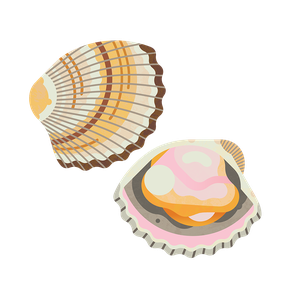

King scallop
Pecten maximus
What to check for
Location
Location
Location refers to two things:
- Where the fish population or stock lives, e.g., North Sea, or South Pacific.
- Who is managing the fishery. If it says “All areas”, this means that our scoring for management covers the same area as the fish stock.
England (English Channel - Lyme Bay: 7e.L): Pot fishery
Technical location
Technical location
A global system is used to split the ocean into different zones, areas, and subdivisions. Each zone is indicated by a number and/or letter. By law, this must be shown on all unprocessed seafood sold in the EU and UK, alongside the fishing method used to catch it. Look for these details on the packet to match your seafood to our ratings.
7e: English Channel (West)
Caught by
Caught by
Pot, trap or creel (Disco pots)
Involves using modified, standard crustacean (crab/lobster) pots that are equipped with small LED lights to attract scallops. The term "disco" comes from the lights that illuminate the pots on the seafloor, which attract scallops due to their high sensitivity to light
Pot, trap or creel (Disco pots)
Rating summary
The most recent scallop assessment for the UK was unable to provide estimates of fishing pressure and biomass for the Lyme Bay area. As such there is concern for biomass and fishing pressure. Some management measures are in place for this novel fishery. However, the stock remains at risk due to the absence of catch and effort limits, and concern for both fishing pressure and stock biomass. The fishery has a well‑developed and effective Monitoring, Control, and Surveillance (MCS) system with reliable enforcement and low levels of IUU activity. Scallop pots can have low seabed impacts when deployed and retrieved correctly. Few vessels currently operate in the fishery, so bycatch and ETP interactions are low. Increased scallop removals are unlikely to significantly affect local food webs, although uncertainties remain around the use of artificial light attractants and the expansion of fishing into areas that may previously have acted as scallop refuges.
Rating last updated August 2026
How we worked out this Rating
Please note this rating uses our new methodology.
Stock status
The size and health of a fish population, or 'stock', that is being targeted by fishermen is a crucial indicator of whether a fishery is sustainable. If the stock is too small to withstand fishing, it is at risk of crashing. We look at how big the stock is, and how much pressure there is from fishing, to assess this. The target level that many fisheries aim for is 'Maximum Sustainable Yield' - the most fish that can be caught year after year whilst keeping the population at a healthy size.
Stock Status Score: 0.75
There is concern for fishing pressure and biomass of king scallops in Lyme Bay due to uncertainty associated with landings originating from outside the surveyed area.
Since 2017, Cefas has conducted annual stock assessments for king scallops in ICES Divisions 27.7.d, 27.7.e, 27.7.f and 27.4.b. Within these divisions, assessment areas were defined to reflect regional differences in scallop growth rates and patterns of fishery exploitation. This assessment focuses on the Lyme Bay stock (7.e.L) in the western English Channel.
Although a 2025 assessment report is available, it does not provide estimates of harvestable biomass or harvest rate for Lyme Bay. This is because evidence suggests that a substantial proportion of landings may have originated from scallop grounds outside the survey area, creating uncertainty in the relationship between surveyed biomass and fishery removals. Work is ongoing to resolve this issue. Consequently, this rating is based on the most recent assessment that includes stock status estimates for Lyme Bay, using data from the 2023/2024 survey period.
Scoring for this stock is therefore based on information presented in the 2025 assessment, drawing on data collected up to 2023/2024. However, the absence of a biomass reference point for estimating Maximum Sustainable Yield (MSY) introduces additional uncertainty into the assessment. As a result, Route 2 scoring has been applied, with king scallops considered a species of high resilience to fishing pressure.
Harvestable biomass, defined as the weight of scallops above the minimum landing size within areas open to dredging, fluctuated between approximately 2,600 and 4,500 tonnes from 2017 to 2024. Biomass increased in recent years, rising from 2,808 tonnes in 2022 to 4,524 tonnes in 2024. While this suggests an improving trend, the lack of biomass reference points means it is not possible to determine whether current biomass represents a healthy stock level. Furthermore, the 2024 estimate relates only to the surveyed area, while evidence of fishery activity outside the survey boundaries raises uncertainty about how representative this figure is of the stock supporting the fishery. For this reason, the latest assessment did not provide a harvestable biomass estimate for Lyme Bay, and a precautionary concern for biomass remains.
Fishing pressure is assessed using the harvest rate (HR), defined as the proportion of harvestable biomass removed by fishing during the 12 months following each stock survey. Cefas estimates that an HR of 24.4% is consistent with MSY and would maintain the stock at approximately 35% of its unfished biomass. In 2023, the estimated HR was 63.8%, down from 73.1% in 2022, but still substantially above the MSY proxy. Although the latest assessment does not provide an updated HR estimate for Lyme Bay because of the uncertainty surrounding landings from outside the survey area, fishing mortality has exceeded the MSY proxy since 2017. Therefore, there remains concern regarding fishing pressure.
Additional uncertainties also affect the assessment. Biomass estimates are derived from a combination of dredge surveys and underwater video surveys, allowing coverage of areas where dredging is not possible, such as conservation zones or unsuitable habitats. Scallop stocks are also known to occur outside the surveyed areas, but the extent to which these populations contribute to the surveyed stock remains unclear. In particular, there is uncertainty regarding larval exchange between surveyed and unsurveyed areas and whether dredged grounds are sustained by local recruitment or by connectivity with adjacent populations.
Management
Good management is vital to be sure that fishing doesn't cause fish populations to decline. We look at whether regulations follow the best available scientific advice, how well compliance is monitored and enforced, and whether this is effective in maintaining healthy fish stocks.
Management of the Target Stock Score: 0.5
Alignment with Scientific Advice Score: 1
Monitoring, Control and Surveillance Score: 0.25
Some appropriate management measures are in place for the king scallop potting fishery in Lyme Bay, including permit requirements, vessel restrictions, minimum sizes, and spatial closures. However, the stock remains at risk due to the absence of catch and effort limits, and concern for both fishing pressure and stock biomass. The fishery has a well‑developed and effective Monitoring, Control, and Surveillance (MCS) system with reliable enforcement and low levels of IUU activity.
Stock assessments for King Scallop (Pecten maximus) in the English Channel only began in 2017. Although the quality and availability of data have improved since then, some uncertainties remain, which may limit the effectiveness of evidence-based management. There is also evidence that inshore and offshore scallop populations may be connected through larval exchange, suggesting that stock sustainability depends on coordinated management across a range of spatial scales.
This rating focuses on the inshore scallop potting fishery in Lyme Bay (ICES Area 7e), where the majority of catches are made by UK vessels. Some scallop grounds fall within 6 nautical miles of the coast and are managed by two Inshore Fisheries and Conservation Authorities (IFCAs): Southern IFCA and Devon & Severn IFCA. However, several scallop beds extend beyond the 6 nm boundary into areas managed under national legislation. This overlap highlights the importance of coordination between local and national management frameworks, particularly if inshore and offshore stocks are interconnected.
Both IFCA districts have introduced management measures which regulate fishing activity and reduce pressure on the stock. As this assessment relates specifically to scallop potting, regulations that apply solely to dredging fisheries have not been considered.
Devon & Severn IFCA management measures:
- Potting Permit required, with flexibility for new conditions.
- Maximum vessel length: 14.99 m
- Minimum Conservation Reference Size (MCRS): 100 mm
- Spatial closures prohibiting potting in certain areas, including Knoll Pins and the Lundy No Take Zone.
Southern IFCA management measures:
- Permit required
- Maximum vessel length: 12 m
- Fishing curfew: 19:00-07:00
- Minimum Conservation Reference Size (MCRS): 100 mm in ICES Area 7e and 110 mm in ICES Area 7d
Together, these measures provide some protection for the stock by limiting access to the fishery, restricting fishing activity, and reducing the harvest of juvenile scallops. The minimum size requirements of 100-110 mm exceed the approximate size at maturity of 80 mm, allowing most individuals to reproduce before capture. However, these measures may not fully protect spawning biomass, as larger scallops make a disproportionate contribution to egg production and recruitment.
There is also no Total Allowable Catch (TAC) for scallops and therefore no catch limit to reduce the risk of overexploitation. Furthermore, the scallop potting industry remains relatively new, and uncertainties remain regarding its long-term management, regulation, economic viability, and ecological impacts.
Scallop pots can access grounds that were previously unfished by dredgers, potentially reducing the refuge effect that these areas may once have provided. At present, there is limited evidence to determine whether fishing in these previously inaccessible areas is affecting stock productivity or resilience. As both potting and dredging target the same scallop resource, further research is needed to understand the cumulative impacts of the two fisheries and to ensure they can be managed sustainably alongside one another.
Monitoring, control and surveillance of UK fisheries are delivered through licensing, vessel tracking, statutory reporting, observer coverage, inspections and other monitoring systems. All commercial fishing vessels must hold a valid UK fishing licence to operate in UK waters, although exemptions may apply to some unpowered vessels under 10 metres. Depending on the area, target species and activity, additional permits or authorisations may also be required.
Vessel tracking requirements vary by vessel size, area and administration through Vessel Monitoring Systems (VMS) and, where applicable, inshore VMS (iVMS).
• Vessels 12 m and over must report their position every two hours via VMS.
• Vessels under 12 m report their position continuously where iVMS applies, or may operate full VMS where required by licence conditions or when fishing offshore.
Reporting of fishing activity, catches, landings, discards and port movements is mandatory, with logbooks supporting traceability:
• Vessels 12 m and over submit electronic logbooks under Council Regulation 1224/2009.
• Vessels 10–12 m (and under 10 m Producer Organisation vessels) use paper logbooks, updated daily and submitted within 48 hours of landing.
• Non-PO vessels under 10 m are generally exempt unless required by licence conditions.
UK vessels must also carry fishery observers when directed, providing independent verification of activity and catch. Remote Electronic Monitoring (REM), using cameras, sensors and positional data, is being increasingly deployed to improve data quality and support enforcement. Its rollout is supported by the Fisheries Act 2020 and the Joint Fisheries Statement.
Together, these measures help prevent illegal, unreported and unregulated (IUU) fishing through vessel licensing, catch documentation, positional monitoring, statutory reporting and compliance checks. Enforcement action may include financial penalties, prosecution, licence suspension or other sanctions. The UK has committed to reducing IUU fishing and maintains a blacklist of vessels involved in such activities. This rating reflects full compliance with UK monitoring, control and surveillance requirements.
The Marine Conservation Society views Remote Electronic Monitoring (REM) with cameras is one of the most cost-effective tools for providing reliable fisheries data and aiding informed management decisions. Fully monitored fisheries enhance collaboration, data accuracy, stock recovery, and reduce impacts on marine wildlife and habitats. However, the full potential of REM may only be achieved when it tracks fishing location and documents catch and bycatch, particularly where vulnerable species and habitats are at risk.
The Fisheries Act (2020) requires the development of Fisheries Management Plans (FMPs) (replacing EU Multi-Annual Plans) in the UK. 43 FMPs have been proposed and are at various stages of development and implementation, these should all be published by the end of 2028. FMPs have the potential to be very important tools for managing UK fisheries, although data limitations may delay them for some stocks. It is also essential the UK governments define and adopt a standardised approach or model across the four nations to a universally defined FMP design, to ensure the consistence, quality and coherence of all the proposal FMPs.
The Marine Conservation Society is keen to see publicly available Fishery Management Plans for all commercially exploited stocks, especially where stocks are depleted, that include:
• An overview of the fishery including current stock status, spatial coverage, current fishing methods and impacts
• Targets for fishing pressure and biomass, and additional management when those targets are not being met, based on the best scientific evidence
• Timeframes for stock recovery
• Improved data collection, transparency, and accountability, supported by technologies such as Remote Electronic Monitoring (REM)
• Consideration of wider environmental impacts of the fishery, including habitat impacts and minimising bycatch
• Stakeholder engagement
A King Scallop FMP has been proposed, coordinated by Defra and the Welsh Government which incorporates this stock. At the time of writing, it is too soon to know whether proposed management measures will be effective in managing the stock. For more information about this FMP and expected progress and timelines, see [https://www.gov.uk/government/collections/fisheries-management-plans#published-fmps].
Capture method
Environmental impacts of fishing vary hugely, depending on the method used and where it's happening. We look at whether the fishing gear being used could have an effect on seabed habitats, and if so, how severe might this be. We also review whether it catches any other species by accident (bycatch), and what effect this might have on those species - especially if they're Endangered, Threatened, or Protected.
Capture Method Score: 0
Habitat Impacts: 0
Bycatch Impacts: 0
Vulnerable and ETP Species: 0
Ecosystems and Trophic Webs: 0
Scallop pots have low seabed impacts when deployed and retrieved correctly. As a novel fishery, increased effort within the Lyme Bay SAC could pose risks to low-recoverability species. However, the small number of vessels currently using this gear means habitat impacts are likely to be lower than those associated with established crustacean pot fisheries. Scallop pots may also catch crustaceans when bait is used, raising concerns for crab and lobster stocks that are already under pressure in the area. Nevertheless, the limited scale of the fishery suggests that any additional exploitation is currently low. Increased scallop removals are unlikely to significantly affect local food webs, although uncertainties remain around the use of artificial light attractants and the expansion of fishing into areas that may previously have acted as scallop refuges.
Scallop pots are specialised pots that target scallops using light as an attractant rather than bait. Unlike traditional crustacean pots, which use bait to attract crabs and lobsters, scallop pots typically feature a wide, low-profile entrance ramp fitted with prongs. Scallops swim towards the light and pass through the prongs, which make it difficult for them to escape. Although designed for scallops, these pots can also retain crustaceans and cephalopods, enabling fishers to diversify their catch. In 2025, an estimated 40 vessels were deploying scallop pots around the UK, suggesting that current fishing effort and associated ecological impacts are limited. However, the fishery is novel and may expand through diversification or new entrants, meaning its future footprint may increase.
Lyme Bay contains a mixture of sandy, muddy, mixed sediment, and reef habitats. The area is recognised as a biodiversity hotspot, supporting more than 1,300 marine species, including the UK's largest known colony of pink sea fans and the rare sunset coral, both classified as Endangered, Threatened, or Protected (ETP) species. To safeguard these sensitive habitats, much of the bay is protected within the Lyme Bay and Torbay Special Area of Conservation (SAC), where bottom-towed fishing gear is prohibited. Since these restrictions were introduced, species richness within protected areas has increased by 52% between 2008 and 2023.
While potting is generally considered less damaging than bottom-towed fishing methods, studies within the Lyme Bay SAC have shown that it can still affect seabed habitats through crushing, abrasion, and scouring. At higher fishing intensities, potting has been associated with reduced abundance and catch rates of commercial species and may hinder the recovery of sensitive benthic organisms, including Ross coral and Neptune's heart sea squirt. A decline in pink sea fan abundance was also observed at higher pot densities, although the relationship was not statistically significant. However, scallop potting currently represents only a small proportion of overall potting effort in the area, meaning its contribution to these impacts is likely to be considerably lower than that of established crab and lobster potting.
In terms of bycatch, scallop pots may capture undersized scallops, which must be returned to the sea in accordance with local regulations. Survival rates are likely to be higher than for scallops caught by dredging due to the lower-impact nature of the gear. Scallop pots may also retain crustaceans, particularly where bait is used alongside light attractants. This raises concerns regarding the additional removal of crab and lobster, as lobster stocks in the region show signs of low biomass and fishing mortality above target levels, while brown crab in the Western English Channel is subject to fishing mortality slightly above FMSY. These pressures have been further worsened by the 2025/26 octopus bloom, which has significantly reduced shellfish abundance and landings across southwest England. However, as scallop potting is currently undertaken by relatively few vessels and represents only a small proportion of overall potting effort in the region, removals of crustaceans within this fishery are likely to be low at present.
King scallops are low-trophic-level suspension feeders that consume plankton filtered from the water column and are prey for a range of fish, crustaceans, cephalopods, and elasmobranchs throughout their life cycle. However, scallops are not considered a keystone prey species, and increased removals are therefore unlikely to drive significant trophic cascades or broader ecosystem restructuring. Expansion of the fishery into areas previously inaccessible to dredging could, however, reduce the refuge value of these habitats and alter local shellfish abundance. Given that scallop potting is currently undertaken by relatively few vessels, any impacts on food-web dynamics and ecosystem functioning are likely to be minimal at present.
The primary ecosystem concerns associated with this fishery therefore relate to its novelty and the resulting uncertainty around its impacts. In particular, little is known about the ecological consequences of using artificial lights to attract scallops, including potential behavioural effects on target and non-target species. Similarly, the impacts of expanding fishing activity into previously unfished or lightly fished areas remain poorly understood. While potting is generally considered a lower-impact fishing method than dredging, these uncertainties highlight the need for further monitoring and research as the fishery develops. However, given the current scale of the fishery, ecosystem impacts are likely to be limited at present.
References
Blue Marine Foundation, 2023. Lyme Bay Reserve Case Studies. BLUEPrint for Marine Protected Areas: A guide to establishing and managing MPAs. Available at BLUEPrint-for-MPAs-Case-Study-Lyme-Bay-.pdf [Accessed on 12.08.2026].
Cappell, R., Huntington, T., Nimmo, F., and MacNab, S. 2018. UK scallop fishery: current trends, future management options and recommendations. Report produced by Poseidon Aquatic Resource Management Ltd. Available at http://www.nwwac.org/_fileupload/Papers%20and%20Presentations/2019/Madrid_2019/1417%20Poseidon%20UK%20Scallop%20final%20report%2011_10_18.pdf [Accessed on 14.06.2022].
Cefas. 2026. Assessment of king scallop stock status for selected waters around the English coast 2025. Available at: Assessment of king scallop stock status for selected waters around the English coast 2025 [Accessed on 12.08.2026].
Cefas. 2025. Assessment of king scallop stock status for selected waters around the English coast 2024. Available at: https://assets.publishing.service.gov.uk/media/68308562b33f68eaba953a59/SCE_assessment_report_2024.pdf [Accessed on 12.08.2026].
Devon & Severn IFCA. 2024. D&S IFCA Byelaw Booklet. Available at: https://www.devonandsevernifca.gov.uk/enforcement-and-legislation/ds-ifca-byelaw-book-and-minimum-conservation-reference-size-list/ [Accessed on 12.08.2026].
Devon & Severn IFCA. 2023. Scallops. Available at: https://www.devonandsevernifca.gov.uk/environment-research/research/molluscan-research-in-ds-ifcas-district/scallops/ [Accessed on 12.08.2026].
Enever, R., Doherty, P.D., Ashworth, J., Duffy, M., Kibel, P., Parker, M., Stewart, B.D. and Godley, B.J., 2022. Scallop potting with lights: a novel, low impact method for catching European king scallop (Pecten maximus). Fisheries Research, 252, p.106334.
Fishtek Marine. Scallop Potting Technology. Available at: Scallop Potting Technology - Fishtek Marine [Accessed on 12.08.2026].
Hiddink, J., Jennings, S., Sciberras, M., Szostek, C.L., Hughes, K.M., Ellis, N., Rijnsdorp, A.D., McConnaughey, R.A., Mazor, T., Hilborn, R., Collie, J.S., Pitcher, C.R., Amoroso, R.O., Parma, A.M., Suuronen, P. and Kaiser, M.J. 2017. Global analysis of depletion and recovery of seabed biota after bottom trawling disturbance. PNAS. 114:31, pp. 8301-8306. https://doi.org/10.1073/pnas.1618858114
Howarth, L. M. & Stewart, B. D. 2014. The dredge fishery for scallops in the United Kingdom (UK): effects on marine ecosystems and proposals for future management. Report to the Sustainable Inshore Fisheries Trust. Marine Ecosystem Management Report no. 5, University of York, 54 pp. Available at http://eprints.whiterose.ac.uk/79233/1/Howarth_and_Stewart_2014_Ecosystem_effects_management_of_UK_scallop_fisheries.pdf
ICES. 2024. Scallop Assessment Working Group (WGScallop). ICES Scientific Reports. 06:104. 96 pp. https://doi.org/10.17895/ices.pub.28015394
Marine Planning Consultants Ltd. (2014). Lyme Bay Fisheries and Conservation Reserve: Integrated Fisheries Management Plan. A report produced for the Lyme Bay Fisheries and Conservation Reserve Working Group, UK. Available at: https://www.lymebayreserve.co.uk/download-centre/files/LymeBay_MAINREPORT_IntegratedMgt_180914.pdf [Accessed on 12.08.2026].
Marshall, C.E. & Wilson, E. 2008. Pecten maximus Great scallop. In Tyler-Walters H. Marine Life Information Network: Biology and Sensitivity Key Information Reviews. Plymouth: Marine Biological Association of the United Kingdom. Available at: https://www.marlin.ac.uk/species/detail/1398 [Accessed on 12.08.2026].
Palomares, M.L.D. and D. Pauly. King Scallop, Pecten maximus. Available at: https://www.sealifebase.se/summary/Pecten-maximus.html [Accessed on 12.08.2026].
Rees, A., Sheehan, E.V. and Attrill, M.J., 2021. Optimal fishing effort benefits fisheries and conservation. Scientific Reports, 11(1), p.3784.
Southern IFCA. 2024. Regulations. Available at: https://www.southern-ifca.gov.uk/all-regulations [Accessed on 12.08.2026].
Sustainable swaps
Learn more about how we calculate our sustainability ratings.
How our ratings work
Add impact to your inbox
Join the movement: get updates on the issues you care about.
We'll email you inspiring stories about the work we're doing to save and recover our oceans, and news about our urgent campaigns for positive change.