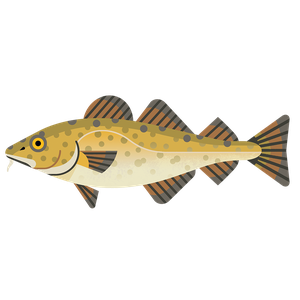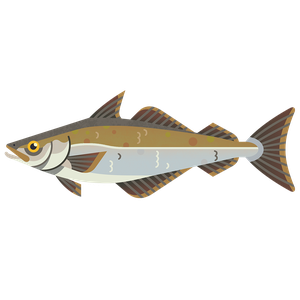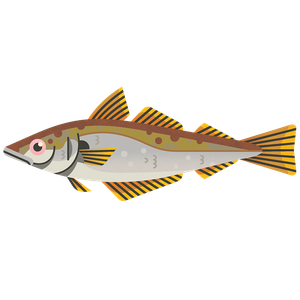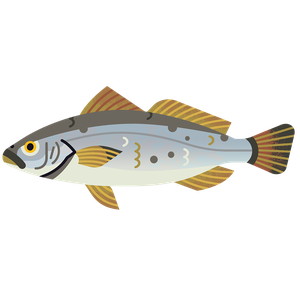

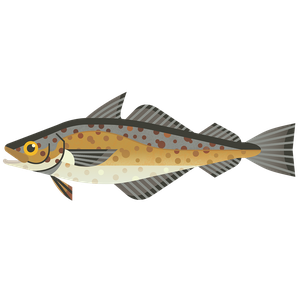
Haddock
Melanogrammus aeglefinus
What to check for
Location
Location
Location refers to two things:
- Where the fish population or stock lives, e.g., North Sea, or South Pacific.
- Who is managing the fishery. If it says “All areas”, this means that our scoring for management covers the same area as the fish stock.
Iceland: All areas
Technical location
Technical location
A global system is used to split the ocean into different zones, areas, and subdivisions. Each zone is indicated by a number and/or letter. By law, this must be shown on all unprocessed seafood sold in the EU and UK, alongside the fishing method used to catch it. Look for these details on the packet to match your seafood to our ratings.
5a: Iceland Grounds
Caught by
Caught by
Net (demersal seine)
Demersal seining involves placing a net on the seabed and slowly closing it. As ropes move over the seabed to close the net, they herd fish into it. This method sometimes involves towing the net along the seabed. It is also known as flyshooting, Danish seining, and Scottish seining, depending on how it's set up.
Net (demersal seine)
Certification
Marine Stewardship Council (MSC)
The Marine Stewardship Council (MSC) is an independent, international non-profit organisation that was founded in 1997 to find a solution to the problem of overfishing. Together with scientists, fishery experts and conservation groups, the MSC has developed an environmental standard to assess and reward fisheries that are well-managed and sustainable. Consumers can identify products from certified sustainable fisheries by the blue MSC ecolabel.
Marine Stewardship Council (MSC)
Rating summary
Icelandic haddock is not in an overfished state. However, fishing pressure is too high. There is a management plan in place. Catch limits are generally set in line with scientific advice but catches regularly exceed them. All Icelandic haddock landed by the Icelandic fleet is MSC certified. Some Icelandic haddock catches are by demersal seine, which is unlikely to have significant bycatch or cause damage to the seabed.
Rating last updated July 2026.
How we worked out this Rating
Please note this rating uses our new methodology.
Stock status
The size and health of a fish population, or 'stock', that is being targeted by fishermen is a crucial indicator of whether a fishery is sustainable. If the stock is too small to withstand fishing, it is at risk of crashing. We look at how big the stock is, and how much pressure there is from fishing, to assess this. The target level that many fisheries aim for is 'Maximum Sustainable Yield' - the most fish that can be caught year after year whilst keeping the population at a healthy size.
Stock Status Score: 0.25
Icelandic haddock is not in an overfished state. However, fishing pressure is too high.
Haddock fishing in Iceland dates back to at least the early 1900s. Catches peaked at 120,000 tonnes in the 1960s before fluctuating around 50,000t. After another peak at 110,000t in 2007, catches dropped sharply to 34,000t in 2014. Recent catches have been around 80,000t.
Stock assessments are carried out annually by the International Council for the Exploration of the Sea (ICES). The most recent assessment was published in 2026 using data up to 2026. The next assessment is expected in 2027.
The stock assessment defines reference points for harvest rate (HR) and biomass (B). For the harvest rate, there is a target to keep HR at or below Maximum Sustainable Yield (MSY). For biomass, there is no target. However, there is a trigger point (MSY BTrigger). Below this level, HR should be reduced to allow the stock to increase. Because BMSY is not defined, the Good Fish Guide applies its own definition of 1.4 x MSY BTrigger.
The spawning-stock biomass (SSB) peaked at very high levels in 2004, at around 150,000 tonnes. Since 2012, it has been relatively stable at around 80,000t. In 2026 it is 139,691t, which is well above target levels (MSY BTrigger, 64,400t). The stock is therefore not in an overfished state.
The Harvest Rate (HR) was high between the 1980s and 2010s, exceeding levels associated with Maximum Sustainable Yield (HR MSY, 0.35). After briefly falling below this level from 2014-2016, it is again above MSY. In 2025, HR was 0.42, 20% above FMSY, indicating that the stock is being subjected to overfishing.
Based on Iceland's management plan, catches in the fishing year 2026/2027 should be no more than 63,206 tonnes. This is a 20% decrease on the advice from the previous year because in the reduction in reference biomass.
Management
Good management is vital to be sure that fishing doesn't cause fish populations to decline. We look at whether regulations follow the best available scientific advice, how well compliance is monitored and enforced, and whether this is effective in maintaining healthy fish stocks.
Management of the Target Stock Score: 0.5
Alignment with Scientific Advice Score: 1
Monitoring, Control and Surveillance Score: 0
There is a management plan in place. Catch limits are generally set in line with scientific advice, but catches regularly exceed them. All Icelandic haddock landed by the Icelandic fleet is MSC certified.
This fishery is MSC certified with conditions relating to bycatch and environmental impacts. There are no requirements or recommendations to make any improvements to management.
The Icelandic Ministry of Industries and Innovation (MII) is responsible for management of the Icelandic fisheries and implementation of legislation. Improved management measures by Iceland for most of its major stocks, including cod, haddock, saithe, redfish and herring have resulted in decreased fishing mortality, increased stocks and reduced pressure on benthic habitats.
A Harvest Control Rule (HCR) is in place for haddock and is reviewed every five years. ICES considers it to be precautionary. It sets catch limits (Total Allowable Catches, TACs) with the aim of maintaining haddock at Maximum Sustainable Yield. TACs have been set in line with scientific advice since 2013/14. Catches have exceeded them in most years, usually by less than 10%. Catches from 2021-2025 consistently exceeded advice, including in the most recent year.
Iceland's scientific body, the Marine and Freshwater Research Institute, reports the causes for excess catches to be transfers of quota share between fishing years and conversion of TAC from one species to another. The management approach is therefore not successful at enforcing catch limits.
According to the most recent stock assessment in 2026, the stock biomass is above target levels, but estimated fishing pressure is above MSY.
In addition to TACs, the following measures are in place:
- There is no minimum landing size because all catches must be landed by law. To prevent catching juveniles, there are some dynamic closures in areas when a certain proportion of catches includes undersize fish.
- Since 1998 the minimum codend mesh size allowed in the trawling fishery has been 135 mm, which could reduce the catch of undersize fish.
- Spawning areas are closed for 2-3 weeks during the spawning season for all fisheries.
The effects of these measures have not been evaluated.
Discarding unwanted fish at sea is banned by the Icelandic government. Discards of haddock may have been substantial in the early 1990s but in recent years are estimated to be less than 3% in weight and numbers.
There are a series of measures for monitoring and enforcement, including: publication of individual vessel quotas, independent verification and recording of landings, gear restrictions (and inspections), catch logs, and the coast guard has powers to intercept and inspect vessels.
Capture method
Environmental impacts of fishing vary hugely, depending on the method used and where it's happening. We look at whether the fishing gear being used could have an effect on seabed habitats, and if so, how severe might this be. We also review whether it catches any other species by accident (bycatch), and what effect this might have on those species - especially if they're Endangered, Threatened, or Protected.
Capture Method Score: 0.25
Habitat Impacts: 0
Bycatch Impacts: 0.25
Vulnerable and ETP Species: 0.25
Ecosystems and Trophic Webs: 0.25
Some Icelandic haddock catches are by demersal seine, which is unlikely to have significant bycatch or cause damage to the seabed.
100% of Icelandic haddock landed by the Icelandic fleet is MSC certified. Around 64% of catches are from bottom trawling, 22% from longlining, and 14% from demersal or Danish seine.
In the Icelandic area, ICES indicates that abrasion from bottom trawling has affected fragile biogenic habitats (e.g. sponge aggregations, coral gardens, and coral reefs), mainly in deeper waters below 200m. Effects of bottom trawling on soft substrates in shallow waters have been shown to be minor. Demersal seine nets are a lighter and lower-impact gear than trawls, but they can still cause some abrasion of the seabed, as they make contact with the seafloor.
Most seining happens in shallow inshore waters on muddy or sandy sediments. Benthic seines interact with the seabed and have the potential to cause some damage to sea floor habitats, but the majority of the interaction comes from ropes which have a lighter impact than otter and beam trawl fisheries.
Sharks and skates are taken as bycatch in Icelandic fisheries, but catch rates are incomplete and the status of stocks is unknown. The endangered Atlantic halibut and porbeagle are impacted by fisheries around Iceland, so there is landings ban and mandatory release.
References
Government of Iceland, 2026. Management Strategy and Harvest Control Rules Available at https://www.government.is/topics/business-and-industry/fisheries-in-iceland/management-strategy-and-harvest-control-rules/#haddock-melanogrammusaeglefinus60208e [Accessed on 14.07.2026].
Government of Iceland, 2022. Ministry of Food٫ Agriculture and Fisheries: Fisheries Management. Available at https://www.government.is/topics/business-and-industry/fisheries-in-iceland/fisheries-management/ [Accessed on 14.07.2022].
Honneland, G., Poliono, V. and Scarcella, G., 2025. ISF Iceland multi-species demersal fishery: Public Certification Report. Carried out by Global Trust Certification on behalf of Iceland Sustainable Fisheries (ISF). Published on 31 October 2025. Available at https://fisheries.msc.org/en/fisheries/isf-iceland-multi-species-demersal-fishery/@@assessments [Accessed on 15.07.2026].
Honneland, G., Scarcella, G., and Tsitsika, E., 2025. ISF Iceland haddock: 3rd Surveillance Report. Carried out by LRQA (Seafood) Limited on behalf of Iceland Sustainable Fisheries (ISF). Published on December 2025. Available at https://fisheries.msc.org/en/fisheries/isf-iceland-haddock/@@assessments [Accessed on 15.07.2026].
ICES, 2022. Icelandic Waters ecoregion –Ecosystem overview. In Report of the ICES Advisory Committee, 2022. ICES Advice 2022, Section 11.1, Available at https://doi.org/10.17895/ices.advice.21731663 [Accessed on 15.07.2026].
ICES, 2024. Icelandic Waters ecosystem – Fisheries overview. In Report of the ICES Advisory Committee, 2024. ICES Advice 2024, section 11.2, Available at https://doi.org/10.17895/ices.advice.27879909 [Accessed on 15.07.2026].
ICES, 2026. Northwestern Working Group (NWWG). ICES Scientific Reports. 08:37. 994 pp. Available at https://doi.org/10.17895/ices.pub.32414577 [Accessed on 15.07.2026].
ICES, 2026. Haddock (Melanogrammus aeglefinus) in Division 5.a (Iceland grounds). In Report of the ICES Advisory Committee, 2026. ICES Advice 2026, had.27.5a. Available at https://doi.org/10.17895/ices.advice.30932060 [Accessed on 15.07.2026].
Reeves, S. A., Bell, J. B., Cambie, G., Davie, S. L., Dolder, P., Hyder, K., Pontalier, H., Radford Z. and Vaughan, D., 2018. An international review of fisheries management regimes. Cefas. Issued 2 August 2018. Available at http://randd.defra.gov.uk/Document.aspx?Document=14357_A_Review_of_International_Fisheries_Management_Regimes.pdf [Accessed on 06.07.2021].
Sustainable swaps
Learn more about how we calculate our sustainability ratings.
How our ratings work
Add impact to your inbox
Join the movement: get updates on the issues you care about.
We'll email you inspiring stories about the work we're doing to save and recover our oceans, and news about our urgent campaigns for positive change.