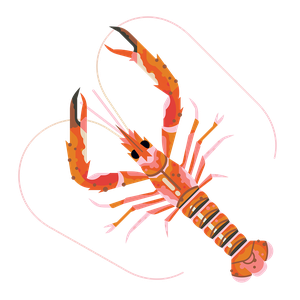
European lobster
Homarus gammarus
What to check for
Location
Location
Location refers to two things:
- Where the fish population or stock lives, e.g., North Sea, or South Pacific.
- Who is managing the fishery. If it says “All areas”, this means that our scoring for management covers the same area as the fish stock.
Jersey: Granville Bay Treaty Area
Technical location
Technical location
A global system is used to split the ocean into different zones, areas, and subdivisions. Each zone is indicated by a number and/or letter. By law, this must be shown on all unprocessed seafood sold in the EU and UK, alongside the fishing method used to catch it. Look for these details on the packet to match your seafood to our ratings.
7e: English Channel (West)
Caught by
Caught by
Pot, trap or creel
Pots, traps and creels are small containers which are left on the seabed for a period of time, and later retrieved by boats. Bait is used to attract animals into them. They are usually made of wire and nylon netting and structured so that animals can enter but not leave. A boat can carry and set out anything from dozens to hundreds of pots at a time, depending on its size.
Pot, trap or creel
Certification
Marine Stewardship Council (MSC)
The Marine Stewardship Council (MSC) is an independent, international non-profit organisation that was founded in 1997 to find a solution to the problem of overfishing. Together with scientists, fishery experts and conservation groups, the MSC has developed an environmental standard to assess and reward fisheries that are well-managed and sustainable. Consumers can identify products from certified sustainable fisheries by the blue MSC ecolabel.
Marine Stewardship Council (MSC)
Rating summary
European lobster in this MSC-certified fishery is harvested sustainably and fully fished. A range of appropriate management measures are in place. However stock indicators suggest the fishery has experienced a decline in abundance, and there is not yet evidence of a sustained recovery back to BMSY. Although there are no catch limits in this fishery, there is no current concern for fishing pressure or biomass. The fishery benefits from a well-developed Monitoring, Control and Surveillance (MCS) framework, with effective enforcement and little evidence of illegal, unreported or unregulated (IUU) fishing. Crab and lobster pots have low seabed impacts when deployed and retrieved correctly. The fishery operates as part of a mixed crustacean fishery and, although the selective nature of potting helps minimise impacts on juvenile individuals and non-target species, continued catches of brown crab may be limiting recovery of this declining stock. There is no evidence of significant impacts on ETP species. Trophic and wider ecosystem impacts are also considered low.
Rating last updated July 2026
How we worked out this Rating
Please note this rating uses our new methodology.
Stock status
The size and health of a fish population, or 'stock', that is being targeted by fishermen is a crucial indicator of whether a fishery is sustainable. If the stock is too small to withstand fishing, it is at risk of crashing. We look at how big the stock is, and how much pressure there is from fishing, to assess this. The target level that many fisheries aim for is 'Maximum Sustainable Yield' - the most fish that can be caught year after year whilst keeping the population at a healthy size.
Stock Status Score: 0.25
European lobster in this MSC-certified fishery is harvested sustainably and fully fished.
This fishery is Marine Stewardship Council (MSC) certified. This stock is assessed using a standardised abundance index (IAS), where values above 1 indicate biomass above BMSY. The management strategy aims to maintain IAS above this threshold, and if it falls below 1, harvest control rules are triggered.
IAS for both the Jersey and Normandy fisheries increased between 2007 and 2015 but have since steadily declined. A 2026 surveillance report for this MSC-certified fishery indicates that IAS has remained below 1 in recent years based on LPUE estimates, which suggests that the stock is currently below BMSY. In 2024, LPUE reached its lowest level in the time series at 8.4 kg per 100 pots. Despite this decline, it remains above the limit reference point (LRP) of 6 kg per 100 pots, which corresponds to the lowest observed catch rate (recorded in 1996). Although IAS has declined in both areas, the stock remains above the LRP.
Other indicators suggest the stock is in relatively good health. There has been an increase in undersized lobsters in recent years, with no evidence of reduced recruitment. Both fishery-dependent and fishery-independent data indicate strong recent recruitment, suggesting a low risk of recruitment overfishing and a low likelihood of reaching the point of recruitment impairment (PRI). As such, we consider the stock to be fully fished, as it is below BMSY (IAS) but above MSY Btrigger (LRP).
Multiple models (C-MSY, SpiCT, and JABBA) are used to estimate fishing mortality (F), and all indicate that F is currently at or below FMSY. While F exceeded FMSY until around 2021, it has remained below this threshold in recent years. This may be linked to a decline in lobster landings. In Jersey, annual landings have decreased significantly in recent years, due to poor winter weather conditions, the Covid-19 pandemic, and the UK leaving the European Union. Landings in Normandy have also decreased, although to a lesser extent. As F is currently below FMSY, we consider European lobster to be harvested sustainably.
Management
Good management is vital to be sure that fishing doesn't cause fish populations to decline. We look at whether regulations follow the best available scientific advice, how well compliance is monitored and enforced, and whether this is effective in maintaining healthy fish stocks.
Management of the Target Stock Score: 0.25
Alignment with Scientific Advice Score: 0.5
Monitoring, Control and Surveillance Score: 0.25
A range of appropriate management measures are in place. However stock indicators suggest the fishery has experienced a decline in abundance, and there is not yet evidence of a sustained recovery back to BMSY. Although there are no catch limits in this fishery, there is no current concern for fishing pressure or biomass. The fishery benefits from a well-developed Monitoring, Control and Surveillance (MCS) framework, with effective enforcement and little evidence of illegal, unreported or unregulated (IUU) fishing. However, recent governance changes mean that the long-term effectiveness of the current management arrangements has yet to be fully demonstrated.
The Normandy and Jersey lobster fishery was previously managed under the Granville Bay Agreement between Jersey and France. Following the UK's withdrawal from the EU, the Agreement ceased to apply, and management is now governed through the UK-EU Trade and Cooperation Agreement (TCA). Under the Granville Bay Agreement, stock assessments and management were reviewed through the Joint Advisory Committee (JAC), Joint Management Committee (JMC) and Shellfish Working Group. However, with the cessation of the Agreement and no clearly defined replacement for the JAC and JMC, it is currently unclear what formal mechanisms exist to provide equivalent review of stock assessments and management advice under the TCA framework.
The fishery operates under a management framework designed to control fishing effort and protect stock productivity. Key measures include limits on the number of vessels permitted to participate in the fishery, restrictions on the number of pots that may be deployed, controls on the use of parlour pots, mandatory escape gaps to allow undersized lobsters to escape, minimum landing sizes (MLS), and spatial management through closed areas. However, there is currently no total allowable catch (TAC) for the fishery, and the retention of berried (egg-bearing) females remains permitted.
Since recertification in 2023, the MLS in Jersey has increased from 87 mm to 89 mm carapace length (CL), with a further increase to 90 mm CL scheduled for 2026. Normandy has also committed to increasing the MLS to 90 mm CL in 2026. Alignment of MLS regulations aims to support stock rebuilding by providing consistent protection to the lobster stock, so that individuals may reproduce before capture. No other regulatory changes have been implemented in either jurisdiction since the previous certification surveillance audit. However, both Jersey and Normandy management authorities continue to evaluate a range of additional management options, including the introduction of a maximum landing size, further reductions in pot limits and the expansion of no-parlour-pot zones (NPPZs).
A key component of the management system is the harvest strategy, which incorporates harvest control rules (HCRs) based on stock status indicators. Management responses are determined according to the observed Index of Abundance Status (IAS), landings per unit effort (LPUE), and a limit reference point (LRP) of 6 kg per 100 pots. The fishery is classified into three management zones:
- Green zone: IAS > 1
- Orange zone: IAS < 1 but LPUE > LRP
- Red zone: LPUE < LRP
The objective of the harvest strategy is to maintain the fishery within the green zone. Previous analyses have indicated that an IAS value of 1 is consistent with maintaining the stock at a level equivalent to BMSY. However, IAS values have remained below 1 since 2018, indicating that the stock is no longer at a level consistent with BMSY and that the HCR should be triggered. In response, management authorities in Jersey and Normandy have implemented or proposed a range of rebuilding measures, including increases in the MLS to 90 mm CL, reductions in fishing effort, and consideration of additional controls on fishing activity and gear use. These measures are intended to halt the decline in stock status and support recovery towards levels consistent with BMSY.
However, current stock indicators continue to raise concerns. Although LPUE has remained above the LRP of 6 kg per 100 pots, it has shown a long-term declining trend in both the Jersey and Normandy fisheries since around 2015. In contrast, IAS has remained below the target threshold of 1 since 2018. While the index showed some recovery after reaching a low point in 2020, this improvement was not sustained, and IAS declined to its lowest recorded level in 2024. Together, these trends suggest that, despite catch rates remaining above the MSY Btrigger proxy (LRP) and multiple management measures being in place, the stock has not yet recovered to the green zone (IAS > 1). This may reflect the relatively recent introduction of some management measures, meaning insufficient time has elapsed for their benefits to be fully reflected in stock abundance indicators.
Responsibility for monitoring, control and surveillance (MCS) rests with the Jersey and French authorities, which manage their respective fleets while coordinating management of the shared stock. The fishery is subject to a range of MCS measures, including vessel licensing, pot marking and registration, catch and effort reporting, and inspections to verify compliance with minimum landing sizes (MLS), escape-gap requirements and pot regulations. There is little evidence of widespread non-compliance in either jurisdiction, and the Marine Stewardship Council (MSC) has concluded that compliance and enforcement arrangements are effective, awarding the fishery a score of 80 for compliance and enforcement.
However, following the UK's withdrawal from the EU, management now operates under the UK-EU Trade and Cooperation Agreement (TCA) rather than the former Granville Bay Agreement. While there is evidence that an effective MCS system remains in place, the current arrangements are relatively recent and have yet to demonstrate a consistent long-term track record. Furthermore, the former coordination mechanisms provided through the Joint Advisory Committee (JAC) and Joint Management Committee (JMC) no longer appear to have direct equivalents under the TCA framework. As a result, the effectiveness of cross-jurisdictional coordination and enforcement under the new governance arrangements cannot yet be fully assessed. Although performance is consistent with a good level of compliance and enforcement, there is currently insufficient evidence to provide the high degree of confidence required for a score of 100.
Capture method
Environmental impacts of fishing vary hugely, depending on the method used and where it's happening. We look at whether the fishing gear being used could have an effect on seabed habitats, and if so, how severe might this be. We also review whether it catches any other species by accident (bycatch), and what effect this might have on those species - especially if they're Endangered, Threatened, or Protected.
Capture Method Score: 0.25
Habitat Impacts: 0.25
Bycatch Impacts: 0.25
Vulnerable and ETP Species: 0
Ecosystems and Trophic Webs: 0
Crab and lobster pots have low seabed impacts when deployed and retrieved correctly. The fishery operates as part of a mixed crustacean fishery and, although the selective nature of potting helps minimise impacts on juvenile individuals and non-target species, continued catches of brown crab may be limiting recovery of this declining stock. There is no evidence of significant impacts on ETP species within the MSC-certified lobster fishery. Trophic and wider ecosystem impacts are also considered low, due to the passive nature of the gear, together with the ecological role of European lobster as a generalist predator and prey species.
The Normandy and Jersey lobster fishery is conducted by vessels under 12 m in length using static pots, making it a relatively low-impact fishing method in terms of physical disturbance to seabed habitats. Pots are deployed in strings of 12 to 50 and are typically held in place by weighted end pots rather than anchors. Habitat impacts may occur during deployment, soaking and retrieval through contact between pots, ropes and the seabed. However, available evidence suggests these impacts are generally limited and unlikely to be significant unless pot densities are particularly high (approximately 30 pots per 500 m²).
Potential habitat impacts are greatest where fishing overlaps with sensitive habitats such as rocky reefs, seagrass beds, kelp forests and maerl beds, which provide important nursery, refuge and settlement areas for a range of marine species. Some evidence suggests that fishing activity occurs over kelp and maerl habitats within parts of the fishery. Recent improvements in habitat impact monitoring include habitat footprint mapping in Normandy, deployment of iVMS in Jersey, and continued monitoring and recovery of lost gear. However, further spatial analysis of fishing effort and habitat overlap is still required and remains an area of ongoing assessment within the MSC certification process.
European lobster is caught as part of a mixed crustacean fishery alongside brown crab and spider crab. The use of pots, combined with mandatory escape gaps, makes the fishery relatively selective and helps reduce the risk of recruitment overfishing by allowing undersized individuals to escape or be returned alive, with high post-release survival expected. However, while these measures may help protect juvenile crustaceans, concerns remain regarding the overall status of brown crab stocks. Brown crab abundance has declined substantially since around 2012, with LPUE falling from over 20 kg per 100 pots to less than 7.5 kg per 100 pots, whereas spider crab abundance has increased over the same period. In response, Jersey increased the minimum landing size for brown crab to 150 mm carapace width to support stock recovery. However, market-sized crabs remain vulnerable to capture within the mixed fishery and, although there is no evidence that the lobster fishery is actively overexploiting brown crab, it may be limiting the stock's recovery.
Additional considerations relate to species used as bait. Red gurnard is a key bait species, yet information on its stock status remains limited. The fishery has recently reduced its use of horse mackerel in response to concerns regarding stock health, with wrasse species increasingly used instead. While wrasse populations are generally considered stable at a global scale, some local populations in northern Europe may be vulnerable to depletion due to targeted fisheries for use as cleaner fish in aquaculture, and life-history characteristics associated with low resilience. Their use as bait may therefore contribute additional mortality to local stocks. Consequently, the MSC assessment has recommended improved species-level identification and monitoring of wrasse catches.
Interactions with endangered, threatened and protected (ETP) species are considered very low due to the passive nature of the gear. The main risk arises from lost fishing gear, which can continue to catch organisms through ghost fishing or cause entanglement. However, this risk is mitigated through mandatory gear marking, reporting and retrieval of lost gear, and appropriate disposal or recycling of recovered equipment. As pots represent a significant financial investment, fishers also have a strong incentive to recover lost gear.
European lobster is a low-level predator, feeding on a range of species while also serving as prey for numerous predators throughout its life cycle. As neither lobsters nor their predators are highly dependent on a single species, the removal of lobster by the fishery is unlikely to result in significant trophic cascades or broader ecosystem restructuring. Nonetheless, changes in crustacean abundance within the region may influence ecosystem dynamics. Lobster and brown crab abundance have declined, while spider crab abundance has increased, potentially altering predator-prey interactions and competitive relationships. Despite these changes, the fishery is unlikely to generate significant ecosystem-level impacts through either fishing mortality or gear deployment. Instead, the main ecosystem concerns relate to the status of associated crustacean stocks, the sustainability of bait species, and the effects of environmental change on species distributions and food-web dynamics. Given declining lobster landings in recent years, any ecosystem impacts associated with lobster removals are also likely to have reduced over time.
References
Addison, J., des Clers, S., Deleau, M. 2023. Marine Stewardship Council (MSC) Public Certification Report (PCR). Normandy and Jersey lobster fishery On Behalf of Comité Régional des Pêches de Normandy, Government of Jersey Department of Infrastructure and Environment (Fisheries and Marine Resources) Prepared by Control Union (UK) Limited. Available at: https://fisheries.msc.org/en/fisheries/normandy-and-jersey-lobster/@@assessments [Accessed on 30.07.2026]
Deleau, M., Addison, J., des Clers, S. 2026. Marine Stewardship Council (MSC) 2nd Surveillance Audit Report. Normandy and Jersey Lobster fishery on behalf of Comité Régional des Pêches de Normandy, Government of Jersey Department of Infrastructure and Environment (Fisheries and Marine Resources) prepared by Control Union (UK) Limited. Available at: Assessments Normandy and Jersey lobster - MSC Fisheries [Accessed on 30.07.2026]
Froese, R., Pauly, D. 2026. FishBase. European lobster, Homarus gammarus. Available at: Homarus gammarus, European lobster : fisheries, aquaculture [Accessed on 30.07.2026]
Gov.je. Fishing Regulations. Available at: Fishing regulations [Accessed on 30.07.2026]
ICES. 2025. Horse mackerel (Trachurus trachurus) in Subarea 8 and divisions 2.a, 3.a, 4.a, 5.b, 6.a, 7.a–c, and 7.e–k (Northeast Atlantic and adjacent waters). In Report of the ICES Advisory Committee, 2025. ICES Advice 2025, hom.27.2a3a4a5b6a7a-ce-k8. https://doi.org/10.17895/ices.advice.27202650
Jersey Law, 2026. Sea Fisheries (Minimum Size Limits) (Jersey) Regulations 2001. Available at: Sea Fisheries (Minimum Size Limits) (Jersey) Regulations 2001 [Accessed on 30.07.2026]
Sustainable swaps
Learn more about how we calculate our sustainability ratings.
How our ratings work
Add impact to your inbox
Join the movement: get updates on the issues you care about.
We'll email you inspiring stories about the work we're doing to save and recover our oceans, and news about our urgent campaigns for positive change.