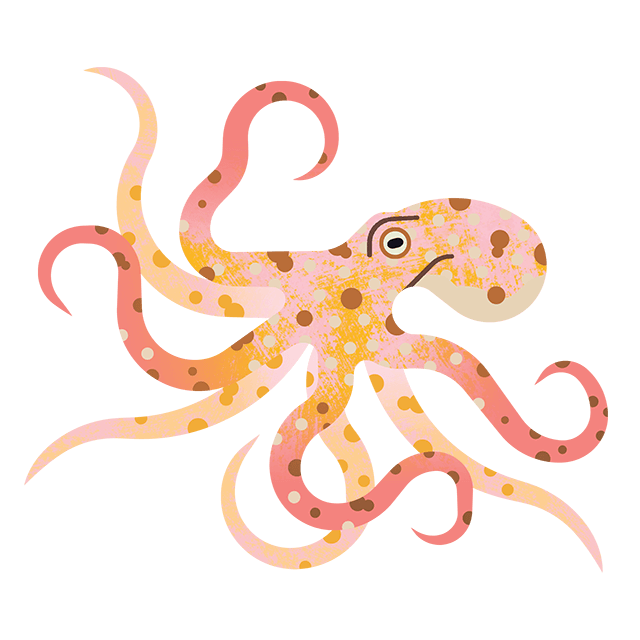

Common octopus
Octopus vulgaris
What to check for
Location
Location
Location refers to two things:
- Where the fish population or stock lives, e.g., North Sea, or South Pacific.
- Who is managing the fishery. If it says “All areas”, this means that our scoring for management covers the same area as the fish stock.
UK: UK EEZ (except Cornwall)
Technical location
Technical location
A global system is used to split the ocean into different zones, areas, and subdivisions. Each zone is indicated by a number and/or letter. By law, this must be shown on all unprocessed seafood sold in the EU and UK, alongside the fishing method used to catch it. Look for these details on the packet to match your seafood to our ratings.
7: Irish Sea, Porcupine Bank, English Channel, Bristol Channel, Celtic Seas, West and Southwest of Ireland, 4: North Sea, 6: Rockall, West of Scotland
Caught by
Caught by
Bottom trawl (otter)
Otter trawling involves towing a net over the seabed. The net is held open by two panels, known as otter boards. Fish are herded between the boards and into the net, which is then hauled onto the boat.
Bottom trawl (otter)
Rating summary
There is concern for the biomass of common octopus around the UK but no concern for fishing pressure. Management measures for common octopus in this region are very limited, with only a minimum landing weight in place. There are no catch limits, and the limited scientific advice available is not well integrated into management. The UK fishery has a well‑developed and effective Monitoring, Control, and Surveillance (MCS) system with reliable enforcement and low levels of IUU activity. Otter trawls have some impacts on the seabed. As octopus is taken primarily as bycatch, the fishery is considered to have low impact on non‑target species and is unlikely to be contributing to declines in vulnerable or ETP species. At typical population levels and under standard fishing pressure, the removal of octopus is unlikely to have significant impacts on ecosystem functioning or trophic-web dynamics. However, bottom trawling remains capable of causing broader ecosystem impacts.
Rating last updated July 2026
How we worked out this Rating
Please note this rating uses our new methodology.
Stock status
The size and health of a fish population, or 'stock', that is being targeted by fishermen is a crucial indicator of whether a fishery is sustainable. If the stock is too small to withstand fishing, it is at risk of crashing. We look at how big the stock is, and how much pressure there is from fishing, to assess this. The target level that many fisheries aim for is 'Maximum Sustainable Yield' - the most fish that can be caught year after year whilst keeping the population at a healthy size.
Stock Status Score: 0.5
There is concern for the biomass of common octopus in the UK, however there is no concern for fishing pressure.
Route 2 scoring has been applied to this rating due to the absence of biomass reference points. Common octopus is generally considered to have high resilience to fishing pressure.
Octopus landed in northern Europe is primarily common octopus (Octopus vulgaris), but also includes horned octopus (Eledone cirrhosa) and musky octopus (Eledone moschata). Common octopus is an important commercial cephalopod in European waters and holds high economic value. In the UK, most octopus catches (across all three species) occur in ICES Subarea 7, which includes the Bristol Channel, English Channel, Celtic Sea, and waters southwest of Ireland.
There are no formal stock assessments for common octopus in this region, and biomass estimates are derived solely from survey data and observed abundance trends. The species is highly sensitive to environmental conditions, resulting in substantial natural interannual variability in population size.
In 2025, an octopus "bloom" occurred, characterised by a sudden increase in common octopus abundance. Similar bloom events have been recorded since 1899, some of which were historically associated with declines in crustacean stocks along the southwest coast of the UK. These outbreaks are thought to result from larval dispersal from spawning grounds in France and the Channel Islands, as spawning within UK waters has previously been documented only at low levels. However, since the onset of the bloom in 2025, continuing into 2026, there have been increasing reports of breeding adults and juveniles in UK waters. This could prolong the current bloom event and may increase the likelihood of similar events recurring under favourable environmental conditions.
Despite the recent increase in abundance, biomass reference points remain unavailable, and successful spawning within UK waters remains highly dependent on environmental conditions. Consequently, there is still concerns regarding stock status and long-term biomass trends, particularly once the current bloom ends.
In the UK, octopus catches are reported at species, genus, or group level. MMO landings data up to 2024 show a marked decline in octopus landings by UK vessels, from 350 tonnes in 2022 to 169 tonnes in 2024. Following the 2025 bloom, catches increased dramatically, with the five largest landing ports reporting a combined 2,367 tonnes of octopus. Elevated catches have continued into 2026, with 2,169 tonnes reported between January and May alone. The fishery has also undergone a notable shift in the relative contribution of different gear types to total landings during 2025 and 2026, with the proportion of catches taken by pots increasing from less than 10% historically to more than 70%, replacing trawls as the dominant fishing method. Despite these exceptionally high catches, the bloom is currently considered an anomalous event rather than evidence of a sustained long-term increase in stock abundance or fishery productivity.
The UK is not the dominant state involved in the octopus fishery in this region. Since 2022, France has been the primary harvester in the English Channel (ICES 7d, 7e), landing over 800 tonnes in 2023. Catches around the UK remain small compared with those from southern Europe, where annual landings in ICES Area 8 and Area 9 averaged roughly 2,000 tonnes and 11,000 tonnes, respectively, between 2000 and 2023. Across the wider region, landings over the past three years (2021–2023) averaged 13,435 tonnes, only slightly below the long‑term mean of 13,926 tonnes. Given that removals around the UK represent just a small fraction of total catches, current evidence does not indicate any concern for fishing pressure.
Management
Good management is vital to be sure that fishing doesn't cause fish populations to decline. We look at whether regulations follow the best available scientific advice, how well compliance is monitored and enforced, and whether this is effective in maintaining healthy fish stocks.
Management of the Target Stock Score: 0.75
Alignment with Scientific Advice Score: 0.75
Monitoring, Control and Surveillance Score: 0.25
Management measures for common octopus in this region are very limited, with only a minimum landing weight in place. There are no catch limits, and the limited scientific advice available is not well integrated into management. The UK fishery has a well‑developed and effective Monitoring, Control, and Surveillance (MCS) system with reliable enforcement and low levels of IUU activity.
Management of common octopus in UK waters is currently very limited, with no catch controls or routine stock assessments in place to inform management decisions. The only species‑specific measure is a 750 g minimum landing weight, but this has been widely criticised for offering little biological protection. Evidence from Mediterranean and Iberian studies shows that males typically mature at 0.8–1.0 kg, while females mature later, at 1.0–1.4 kg, meaning many octopus can be legally landed before they have reproduced. This is a particular concern given that octopus reproduce only once before dying, making it essential that individuals survive to maturity to maintain spawning biomass and long‑term stock stability.
Reproductive behaviour also creates periods of differing vulnerability for each sex. Spawning occurs from April to July, during which both males and females migrate inshore to mate. Males then return to deeper waters, while females remain inshore to select dens and brood their eggs. Inshore landings peak in May and June, coinciding with the spawning season, while offshore landings peak from November to January, when males and non‑breeding individuals remain in deeper waters. These seasonal shifts mean octopus are exposed to fishing pressure at multiple stages, highlighting the need for management that avoids overlap between fishing activity and peak spawning and recruitment.
A major barrier to improved management is the lack of reliable data. Octopus populations are highly variable, and traditional fishery survey methods are poorly suited to cephalopods. Real‑time monitoring and stock forecasting will be essential, using indicators such as sex ratios, size distributions, recruitment strength, and environmental parameters. A dedicated survey could help build understanding of octopus and other cephalopod populations in UK waters, including their poorly quantified importance to the recreational sector. Stakeholders generally agree that it is too early to develop a targeted octopus fishery, but highlight the need to begin considering measures such as catch limits, minimum landing sizes aligned with maturity, gear restrictions, seasonal closures, and spatial management.
Currently, the only other management measures applicable to octopus are general technical measures for towed gears, including regional minimum mesh sizes, square‑mesh panels to improve escapement, and landing obligation rules for quota species. These measures provide little direct protection for octopus, underscoring the need for species‑specific management as interest in the fishery grows.
Monitoring, control and surveillance of UK fisheries are delivered through licensing, vessel tracking, statutory reporting, observer coverage, inspections and other monitoring systems. All commercial fishing vessels must hold a valid UK fishing licence to operate in UK waters, although exemptions may apply to some unpowered vessels under 10 metres. Depending on the area, target species and activity, additional permits or authorisations may also be required.
Vessel tracking requirements vary by vessel size, area and administration through Vessel Monitoring Systems (VMS) and, where applicable, inshore VMS (iVMS).
- Vessels 12 m and over must report their position every two hours via VMS.
- Vessels under 12 m report their position continuously where iVMS applies, or may operate full VMS where required by licence conditions or when fishing offshore.
Reporting of fishing activity, catches, landings, discards and port movements is mandatory, with logbooks supporting traceability:
- Vessels 12 m and over submit electronic logbooks under Council Regulation 1224/2009.
- Vessels 10–12 m (and under 10 m Producer Organisation vessels) use paper logbooks, updated daily and submitted within 48 hours of landing.
- Non-PO vessels under 10 m are generally exempt unless required by licence conditions.
UK vessels must also carry fishery observers when directed, providing independent verification of activity and catch. Remote Electronic Monitoring (REM), using cameras, sensors and positional data, is being increasingly deployed to improve data quality and support enforcement. Its rollout is supported by the Fisheries Act 2020 and the Joint Fisheries Statement.
Together, these measures help prevent illegal, unreported and unregulated (IUU) fishing through vessel licensing, catch documentation, positional monitoring, statutory reporting and compliance checks. Enforcement action may include financial penalties, prosecution, licence suspension or other sanctions. The UK has committed to reducing IUU fishing and maintains a blacklist of vessels involved in such activities. This rating reflects full compliance with UK monitoring, control and surveillance requirements.
The Marine Conservation Society views Remote Electronic Monitoring (REM) with cameras as one of the most cost-effective tools for providing reliable fisheries data and aiding informed management decisions. Fully monitored fisheries enhance collaboration, data accuracy, stock recovery, and reduce impacts on marine wildlife and habitats. However, the full potential of REM may only be achieved when it tracks fishing location and documents catch and bycatch, particularly where vulnerable species and habitats are at risk.
The Fisheries Act (2020) requires the development of Fisheries Management Plans (FMPs) (replacing EU Multi-Annual Plans) in the UK. 43 FMPs have been proposed and are at various stages of development and implementation, these should all be published by the end of 2028. FMPs have the potential to be very important tools for managing UK fisheries, although data limitations may delay them for some stocks. It is also essential the UK governments define and adopt a standardised approach or model across the four nations to a universally defined FMP design, to ensure the consistence, quality and coherence of all the proposal FMPs.
The Marine Conservation Society is keen to see publicly available Fishery Management Plans for all commercially exploited stocks, especially where stocks are depleted, that include:
- An overview of the fishery including current stock status, spatial coverage, current fishing methods and impacts
- Targets for fishing pressure and biomass, and additional management when those targets are not being met, based on the best scientific evidence
- Timeframes for stock recovery
- Improved data collection, transparency, and accountability, supported by technologies such as Remote Electronic Monitoring (REM)
- Consideration of wider environmental impacts of the fishery, including habitat impacts and minimising bycatch
- Stakeholder engagement
A Channel non-quota demersal FMP has been proposed, coordinated by Defra that incorporates this stock. At the time of writing, it is too soon to know whether proposed management measures will be effective in managing the stock. For more information about this FMP and expected progress and timelines, see [https://www.gov.uk/government/collections/fisheries-management-plans#published-fmps].
Capture method
Environmental impacts of fishing vary hugely, depending on the method used and where it's happening. We look at whether the fishing gear being used could have an effect on seabed habitats, and if so, how severe might this be. We also review whether it catches any other species by accident (bycatch), and what effect this might have on those species - especially if they're Endangered, Threatened, or Protected.
Capture Method Score: 0.5
Habitat Impacts: 0.5
Bycatch Impacts: 0
Vulnerable and ETP Species: 0.25
Ecosystems and Trophic Webs: 0.25
Otter trawls are likely to cause some damage to the seabed, including damage to benthic communities and vulnerable marine habitats. As octopus is taken primarily as bycatch, the fishery is considered to have low impact on non‑target species and is unlikely to be contributing to declines in vulnerable or ETP species. At typical population levels and under standard fishing pressure, the removal of octopus is unlikely to have significant impacts on ecosystem functioning or trophic-web dynamics. However, bottom trawling remains capable of causing broader ecosystem impacts.
From 2017 to 2024, trawlers accounted for 97% of common octopus landings, with smaller contributions from dredges, nets, and pots.
Otter trawls make direct contact with the seabed, causing penetration and abrasion of habitat features. The extent of seabed impact depends on gear type, sediment composition, and the area's natural resilience. For instance, regions that are used to tidal and wave disturbances are less sensitive, whereas areas untrawled areas may be more vulnerable.
In the Greater North Sea and Celtic Seas ecoregions, impacts from bottom trawling are variable. Most fishing grounds consist of mud and sand, which are less susceptible to damage than habitats like reefs and seagrass beds. In 2022, it was estimated that 66% of the Greater North Sea and 61% of the Celtic Seas seabed shallower than 800m was trawled.
There are many Marine Protected Areas (MPAs) around the UK, with some designated to protect sensitive benthic habitats and species that may be vulnerable to bottom-towed fishing gears. Restrictions on bottom-towed gears are already in place in some areas. However, protection across the MPA network remains incomplete, with several sites only recently being considered through the MMO's Stage 3 byelaw process. As such, some designated features may remain exposed to disturbance from bottom trawling, potentially limiting habitat recovery and the achievement of conservation objectives. Given the critical role MPAs play in recovering marine health and supporting ecosystem function, the Marine Conservation Society urges supply chain actors to verify whether their sources originate from within MPAs. If so, businesses should confirm that fishing operations are legally conducted and request evidence from the fishery or managing authority to ensure activities do not harm protected features or compromise conservation objectives.
Common octopus is primarily taken as incidental bycatch in demersal fisheries, usually targeting gadoids. Octopus caught in bottom trawls typically die from compression, trauma, or asphyxiation. Trawl gears in the Celtic Seas and English Channel also generate bycatch of several vulnerable elasmobranchs, including spurdog, thornback ray, thorny skate, and the critically endangered common skate complex. Otter trawls are also associated with some of the highest bycatch rates of common dolphins in the Celtic Seas region. Monitoring coverage across UK and EU fleets remains limited, making it difficult to quantify total bycatch mortality or assess the effectiveness of mitigation measures. However, because octopus is primarily taken as bycatch, the fishery itself is considered to have low impact on non‑target species, and it is unlikely that current octopus catches are contributing to declines in vulnerable species.
Common octopus are typically a mid-level predator and prey for larger fish species in UK marine ecosystems. However, episodic population blooms can temporarily alter food-web dynamics. During bloom years, high octopus abundance can exert strong top-down pressure on crustacean populations, potentially reducing the abundance of crabs, lobsters, scallops, and other commercially important invertebrates. Such events may affect shellfish recruitment, alter benthic community structure, and disrupt ecosystem functioning. The 2025 bloom highlighted the potential for these ecological impacts while also creating an opportunistic inshore pot fishery. Improving understanding of octopus population dynamics, the environmental drivers of blooms, and potential early-warning indicators could support the development of targeted fisheries during bloom periods. This may help reduce predation pressure on vulnerable crustacean stocks and lessen the ecological and economic impacts of future bloom events.
Outside of bloom years, common octopus are typically a bycatch species in UK fisheries, with relatively low landings compared with targeted octopus fisheries in southern Europe. Consequently, fishing mortality on octopus is generally low, and the removal of octopus by UK fisheries is unlikely to have a significant effect on trophic-web dynamics, ecosystem structure, or ecosystem functioning. However, where octopus are caught using bottom-towed gears, the fishery may still exert broader ecosystem impacts through disturbance of benthic habitats and communities. Any ecosystem impacts associated with the UK octopus fishery are therefore more likely to arise from the effects of fishing gear, particularly bottom trawling, or from natural fluctuations in octopus abundance during bloom events, than from the direct removal of octopus itself.
References
D&S IFCA, 2026. Authority Meeting: Octopus Update. Available at: Agenda-Item-12-Octopus-Update-March-2026.pdf [Accessed on 06.05.2026]
D&S IFCA, 2025. Influx of Octopus into South of the D&S IFCA’s District and the South West. Available at: Agenda-Item-11-Influx-of-Octopus-into-Devon-and-the-South-West.pdf [Accessed on 06.05.2026]
GOV.UK, 2025. Technical Conservation and Landing Obligation rules and regulations 2025. Available at: Technical Conservation and Landing Obligation rules and regulations 2025 - GOV.UK [Accessed on 06.05.2026]
Hiddink, J. et al., 2017. Global analysis of depletion and recovery of seabed biota after bottom trawling disturbance. Proc Natl Acad Sci. 114(31):8301–6.
ICES. 2025. Working Group on Cephalopod Fisheries and Life History (WGCEPH; outputs from 2024 meeting). ICES Scientific Reports. 07:71. 74 pp. https://doi.org/10.17895/ices.pub.29390171
ICES. 2024. Celtic Seas Ecoregion – Ecosystem overview. In Report of the ICES Advisory Committee, 2024. ICES Advice 2024, Section 7.1, https://doi.org/10.17895/ices.advice.25713033
ICES. 2024. Greater North Sea ecoregion – Ecosystem overview. In Report of the ICES Advisory Committee, 2024. ICES Advice 2024, Section 7.1, https://doi.org/10.17895/ices.advice.25714239
ICES. 2022. Greater North Sea ecoregion – fisheries overview. In Report of the ICES Advisory Committee, 2022. ICES Advice 2022, section 9.2. https://doi.org/10.17895/ices.advice.21641360
Kennelly, S. J. & Broadhurst, M. K., 2021. A review of bycatch reduction in demersal fish trawls. Rev Fish Biol Fisheries 31, 289–318.
Kynoch, R., Fryer, R. & Neat, F., 2015. A simple technical measure to reduce bycatch and discard of skates and sharks in mixed-species bottom-trawl fisheries. ICES J Mar Sci,72(6):1861.
Marine Biological Association, 2026. Octopus bloom off Southwest UK: New report reveals scale, causes and consequences. Available at: Octopus bloom off Southwest UK: New report reveals scale, causes and consequences | Marine Biological Association [Accessed on 21.07.2026]
MMO, 2026. MMO updates on octopus bloom. Available at: MMO updates on the octopus bloom - GOV.UK [Accessed on 21.07.2026]
MMO, 2026. Minimum Conservation Reference Sizes (MCRS) in UK waters. Available at: Minimum Conservation Reference Sizes (MCRS) in UK waters - GOV.UK [Accessed on 06.05.2026]
MMO, 2025. Feasibility of a Potential Emergent Octopus Fishery. A report produced for the Marine Management Organisation, MMO Project No: 1440, March 2025, 76pp
Otero, J., González, Á.F., Sieiro, M.P. and Guerra, Á., 2007. Reproductive cycle and energy allocation of Octopus vulgaris in Galician waters, NE Atlantic. Fisheries Research, 85(1-2), pp.122-129.
Palomares, M.L.D. and D. Pauly. Editors. 2026. SeaLifeBase: Octopus vulgaris – Common octopus. Available at: Octopus vulgaris, Common octopus : fisheries [Accessed on: 06.05.2026]
Rindorf, A., Gislason, H., Burns, F., Ellis, J. R., & Reid, D. 2020. Are fish sensitive to trawling recovering in the Northeast Atlantic? Journal of Applied Ecology, 57(10), 1936-1947. https://doi.org/10.1111/1365-2664.13693
Stewart, B., Thomas, S., Smyth, T., et al., 2026. Common octopus (Octopus vulgaris) blooms off the Southwest of the UK: History, trends, causes and consequences. Available at: Octopus bloom - history causes consequences (Work Package 1) FINAL.pdf [Accessed on 06.05.2026]
Suay, A., Tena-Medialdea, J., Silva, L., Duque, M. and García-March, J.R., 2025. Reproductive shift of the common octopus Octopus vulgaris Cuvier, 1797 increases vulnerability to recruitment overexploitation in the Western Mediterranean Sea. Fisheries Research, 288, p.107472.
van Denderen, P. et al., 2015. Similar effects of bottom trawling and natural disturbance on composition and function of benthic communities across habitats. Mar Ecol Prog Ser. 2015;541:31–43.
Sustainable swaps
Learn more about how we calculate our sustainability ratings.
How our ratings work
Add impact to your inbox
Join the movement: get updates on the issues you care about.
We'll email you inspiring stories about the work we're doing to save and recover our oceans, and news about our urgent campaigns for positive change.