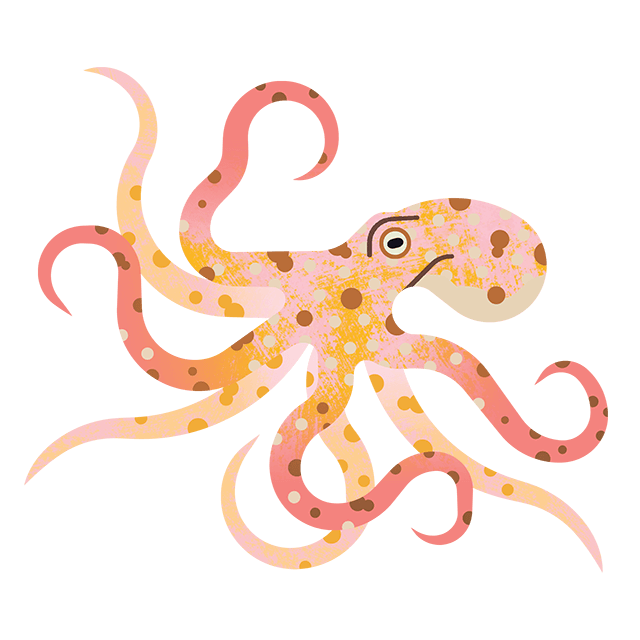

Common octopus
What to check for
UK: UK EEZ (except Cornwall)
Bottom trawl (beam)
Rating summary
There is concern for the biomass of common octopus around the UK, but no concern for fishing pressure. Management measures for common octopus in this region are very limited, with only a minimum landing weight in place. There are no catch limits, and the limited scientific advice available is not well integrated into management. The UK fishery has a well‑developed and effective Monitoring, Control, and Surveillance (MCS) system with reliable enforcement and low levels of IUU activity. Beam trawls have significant impacts on the seabed. As octopus is taken primarily as bycatch, the fishery is considered to have low impact on non‑target species and is unlikely to be contributing to declines in vulnerable or ETP species. At typical population levels and under standard fishing pressure, the removal of octopus is unlikely to have significant impacts on ecosystem functioning or trophic-web dynamics. However, bottom trawling remains capable of causing broader ecosystem impacts.
Rating last updated July 2026
References
D&S IFCA, 2026. Authority Meeting: Octopus Update. Available at: Agenda-Item-12-Octopus-Update-March-2026.pdf [Accessed on 06.05.2026]
D&S IFCA, 2025. Influx of Octopus into South of the D&S IFCA’s District and the South West. Available at: Agenda-Item-11-Influx-of-Octopus-into-Devon-and-the-South-West.pdf [Accessed on 06.05.2026]
GOV.UK, 2025. Technical Conservation and Landing Obligation rules and regulations 2025. Available at: Technical Conservation and Landing Obligation rules and regulations 2025 - GOV.UK [Accessed on 06.05.2026]
Hiddink, J. et al., 2017. Global analysis of depletion and recovery of seabed biota after bottom trawling disturbance. Proc Natl Acad Sci. 114(31):8301–6.
ICES. 2025. Working Group on Cephalopod Fisheries and Life History (WGCEPH; outputs from 2024 meeting). ICES Scientific Reports. 07:71. 74 pp. https://doi.org/10.17895/ices.pub.29390171
ICES. 2024. Celtic Seas Ecoregion – Ecosystem overview. In Report of the ICES Advisory Committee, 2024. ICES Advice 2024, Section 7.1, https://doi.org/10.17895/ices.advice.25713033
ICES. 2024. Greater North Sea ecoregion – Ecosystem overview. In Report of the ICES Advisory Committee, 2024. ICES Advice 2024, Section 7.1, https://doi.org/10.17895/ices.advice.25714239
ICES. 2022. Greater North Sea ecoregion – fisheries overview. In Report of the ICES Advisory Committee, 2022. ICES Advice 2022, section 9.2. https://doi.org/10.17895/ices.advice.21641360
Kennelly, S. J. & Broadhurst, M. K., 2021. A review of bycatch reduction in demersal fish trawls. Rev Fish Biol Fisheries 31, 289–318.
Kynoch, R., Fryer, R. & Neat, F., 2015. A simple technical measure to reduce bycatch and discard of skates and sharks in mixed-species bottom-trawl fisheries. ICES J Mar Sci,72(6):1861.
Marine Biological Association, 2026. Octopus bloom off Southwest UK: New report reveals scale, causes and consequences. Available at: Octopus bloom off Southwest UK: New report reveals scale, causes and consequences | Marine Biological Association [Accessed on 21.07.2026]
MMO, 2026. MMO updates on octopus bloom. Available at: MMO updates on the octopus bloom - GOV.UK [Accessed on 21.07.2026]
MMO, 2026. Minimum Conservation Reference Sizes (MCRS) in UK waters. Available at: Minimum Conservation Reference Sizes (MCRS) in UK waters - GOV.UK [Accessed on 06.05.2026]
MMO, 2025. Feasibility of a Potential Emergent Octopus Fishery. A report produced for the Marine Management Organisation, MMO Project No: 1440, March 2025, 76pp
Otero, J., González, Á.F., Sieiro, M.P. and Guerra, Á., 2007. Reproductive cycle and energy allocation of Octopus vulgaris in Galician waters, NE Atlantic. Fisheries Research, 85(1-2), pp.122-129.
Palomares, M.L.D. and D. Pauly. Editors. 2026. SeaLifeBase: Octopus vulgaris – Common octopus. Available at: Octopus vulgaris, Common octopus : fisheries [Accessed on: 06.05.2026]
Rindorf, A., Gislason, H., Burns, F., Ellis, J. R., & Reid, D. 2020. Are fish sensitive to trawling recovering in the Northeast Atlantic? Journal of Applied Ecology, 57(10), 1936-1947. https://doi.org/10.1111/1365-2664.13693
Stewart, B., Thomas, S., Smyth, T., et al., 2026. Common octopus (Octopus vulgaris) blooms off the Southwest of the UK: History, trends, causes and consequences. Available at: Octopus bloom - history causes consequences (Work Package 1) FINAL.pdf [Accessed on 06.05.2026]
Suay, A., Tena-Medialdea, J., Silva, L., Duque, M. and García-March, J.R., 2025. Reproductive shift of the common octopus Octopus vulgaris Cuvier, 1797 increases vulnerability to recruitment overexploitation in the Western Mediterranean Sea. Fisheries Research, 288, p.107472.
van Denderen, P. et al., 2015. Similar effects of bottom trawling and natural disturbance on composition and function of benthic communities across habitats. Mar Ecol Prog Ser. 2015;541:31–43.