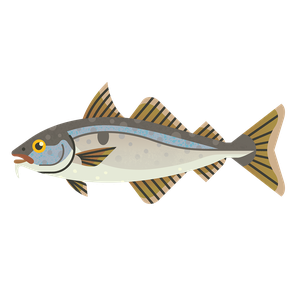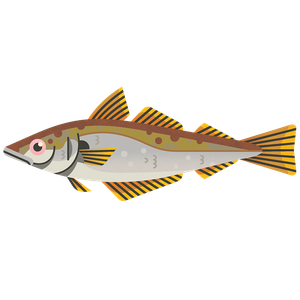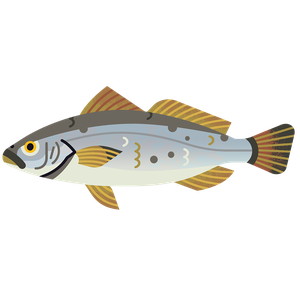

Coley
Pollachius virens
What to check for
Location
Location
Location refers to two things:
- Where the fish population or stock lives, e.g., North Sea, or South Pacific.
- Who is managing the fishery. If it says “All areas”, this means that our scoring for management covers the same area as the fish stock.
Northeast Arctic (Barents and Norwegian Sea): All areas
Technical location
Technical location
A global system is used to split the ocean into different zones, areas, and subdivisions. Each zone is indicated by a number and/or letter. By law, this must be shown on all unprocessed seafood sold in the EU and UK, alongside the fishing method used to catch it. Look for these details on the packet to match your seafood to our ratings.
1: Barents Sea, 2: Norwegian Sea, Spitzbergen, and Bear Island
Caught by
Caught by
Net (gill or fixed)
Gillnetting uses a net, suspended in the water, that is anchored to the seabed. It is kept vertical by buoys, to create a wall of netting that fish swim into and become entangled. The mesh size and length of time the nets are left at sea varies, depending on where they are fishing and what they are targeting.
Net (gill or fixed)
Rating summary
Coley, or saithe, in the Northeast Arctic is overfished and subject to overfishing. Some appropriate management measures are in place. There is a management plan, that follows scientific advice. However, catches have occasionally exceeded advice. Some Arctic saithe catches are by gillnets, which could have a bycatch of golden redfish.
Rating last updated July 2026.
How we worked out this Rating
Please note this rating uses our new methodology.
Stock status
The size and health of a fish population, or 'stock', that is being targeted by fishermen is a crucial indicator of whether a fishery is sustainable. If the stock is too small to withstand fishing, it is at risk of crashing. We look at how big the stock is, and how much pressure there is from fishing, to assess this. The target level that many fisheries aim for is 'Maximum Sustainable Yield' - the most fish that can be caught year after year whilst keeping the population at a healthy size.
Stock Status Score: 0.75
Coley, or saithe, in the Northeast Arctic is overfished and subject to overfishing.
NE Arctic saithe catches have fluctuated since the 1960s, exceeding 250,000 tonnes in the 1970s. Recent catches have averaged around 180,000 tonnes.
The most recent stock assessment was carried out by the International Council for the Exploration of the Sea (ICES) in 2026 using data up to 2026. The reference points for this stock are based on the Norwegian management plan, rather than Maximum Sustainable Yield. ICES has evaluated the management plan and found it to be precautionary.
Spawning-stock biomass (SSB) declined from around 500,000 tonnes in the 1960s and 70s to below the point of reproductive impairment (Blim: 93,923 t) during the 1980s-1990s. SSB has since increased, peaking in 2022 at 392,392 tonnes and has decreased to 212,224 tonnes in 2026. This is below MSY Btrigger (226,430t), but still above Bpa (131,492t). Therefore, the stock is currently being overfished.
Fishing mortality (F) peaked at 0.74 in the 1980s, declined to 0.178 in the 2000s, then rose to 0.39 in the 2010s. It fell again to 0.24 in 2020 but has since increased to 0.4 in 2025. There for F (0.4) is above FMSY (0.32) and 1.1FMSY (0.352) but remains below Fpa (0.45). The stock is therefore subject to overfishing.
ICES advises that when the Norwegian management plan is applied, catches in 2027 should be no more than 127,807 tonnes. This is a 22% decrease from the previous year’s advice due to the downward trend in biomass.
Management
Good management is vital to be sure that fishing doesn't cause fish populations to decline. We look at whether regulations follow the best available scientific advice, how well compliance is monitored and enforced, and whether this is effective in maintaining healthy fish stocks.
Management of the Target Stock Score: 0.5
Alignment with Scientific Advice Score: 0.5
Monitoring, Control and Surveillance Score: 0.25
Some appropriate management measures are in place. There is a management plan, that follows scientific advice. However, catches have occasionally exceeded advice.
Northeast Arctic (NEA) saithe is mainly caught by Norway, accounting for over 90% of the total catch. Most of the rest is caught by Russia, with some catches by the EU, UK, and Faroe Islands. Most of this fishery is MSC-certified. This rating covers uncertified fleets.
This stock is managed through the Norwegian Management Plan. ICES considers it to be precautionary. The goal is to maintain the saithe stock at a level that allows for sustainable fishing, known as Maximum Sustainable Yield (MSY). To determine the amount that can be caught, the plan has used a Harvest Control Rule since 2007, revised in 2013. It calculates catch limits, called Total Allowable Catches (TACs), based on the size (spawning biomass) of the stock. These catch limits are then divided among the countries involved in fishing. The TACs can change by a maximum of 15% from one year to the next, unless the stock falls below a certain threshold. This stability helps to ensure the sustainability of the fishery even if the saithe stock size fluctuates. Stock assessments are carried out by the International Council for the Exploration of the Sea (ICES).
From 2022 – 2026, Norwegian TACs have been set in line with scientific advice. Catches have been below TACs and advice for most of that time, excluding 2022 where catches were slightly above advice. Therefore, management seems to be responsive to the status of the stock, is following scientific advice, and catches are generally compliant.
In addition to the Harvest Control Rule described above, there are various other regulations. There is a minimum landing size to protect juveniles, which varies from 35-45cm, depending on capture method and location. There are limits on how many undersize fish can be caught (15% for cod, haddock and saithe combined of the total catch). Bottom trawlers and seines must use at least 130mm mesh size north of 64N and 120mm south of this. North of 64N, sorting grids in the net, which help small fish and other species to escape, are mandatory. Some areas are closed to fishing to protect juveniles, and vessels that catch too many juveniles must move 5nm away from the location.
Discarding of unwanted or below-minimum-size fish is illegal. It is reported to take place in the saithe fishery at low levels, but there are no estimates to quantify it. As juvenile saithe stay mainly inshore, they are mostly inaccessible to the fishery. In the purse seine fishery, slipping is known to happen to reduce below-minimum-size catches. This is where fishers allow fish to escape from the net before it is hauled out of the water. It can have high mortality owing to the stress of being in the net. Data from observers indicates that fishers may also discard saithe when they are targeting other species and take it as bycatch, but don't have quota for it.
Vessel monitoring systems are required on all Norwegian vessels, regardless of size, allowing real-time tracking of fishing locations and compliance with closed areas. Catches are reported electronically, which helps to monitor compliance with catch limits.
Increased surveillance and monitoring at sea and in the air by Russian and Norwegian authorities, including greater participation by regulation-compliant fishing vessels, and greater cooperation from receiving port authorities, is reported to have practically eradicated Illegal, Unreported and Unregulated fishing in the Barents Sea.
A small part of the centre of the Barents Sea is beyond national jurisdiction and is therefore an area of high seas. It is known as “the Loophole”. Fishing here is managed through the Northeast Atlantic Fisheries Commission (NEAFC) and by coastal states.
Capture method
Environmental impacts of fishing vary hugely, depending on the method used and where it's happening. We look at whether the fishing gear being used could have an effect on seabed habitats, and if so, how severe might this be. We also review whether it catches any other species by accident (bycatch), and what effect this might have on those species - especially if they're Endangered, Threatened, or Protected.
Capture Method Score: 0.5
Habitat Impacts: 0.25
Bycatch Impacts: 0.5
Vulnerable and ETP Species: 0.5
Ecosystems and Trophic Webs: 0.25
Some Arctic saithe catches are by gillnets. This can have a bycatch of golden redfish, which is of concern.
Some Arctic saithe (around 40%) is caught by trawling. Purse seine accounts for 20% of catches, and gillnet, 20%. Most catches are by Norway. The fishery covers the Barents and Norwegian Seas.
Bycatch of golden redfish is a significant concern in this area, mainly by trawlers. This is a long-lived species, vulnerable to the impacts of overfishing, it is on the Norwegian Redlist. Quite high levels of bycatch are allowed because this species cannot easily be distinguished from the more common beaked redfish. Up to 10% by weight is permitted for vessels over 21m, and 30% for smaller vessels. Area closures have not been successful in reducing bycatch.
Beaked redfish catch has been a concern but is no longer under a zero-catch recommendation for 2027. However, catches have been increasing in recent years. In 2025, over 11,000 tonnes were caught, under the 2025 zero catch advice Around 75% of this was by trawling and 17% by gillnet. Around 2000 tonnes of golden redfish catch by gillnets in 2025. ICES reports indicate that the gillnet fishery for saithe is the main source of redfish bycatch after trawling. It therefore seems that this fishery could be contributing to the ongoing poor state of this species.
There are also concerns about the bycatch of Norwegian coastal cod, which is being overfished. ICES advice for the saithe fishery is that bycatch of coastal cod should be kept as low as possible. Around 50% of coastal cod catches are by gillnet, and therefore the saithe gillnet fishery could be contributing to the overfishing of this stock.
Gillnets can have a bycatch of seabirds and mammals. ICES suggests that the coastal gillnet fisheries are mainly responsible for this bycatch. These fisheries generally target cod, monkfish, and saithe. Recorded interactions include northern fulmar, guillemot, harbour porpoise and seals.
In the Norwegian ecoregion, the average annual coastal gillnet porpoise bycatch decreased in 2018 from over 2,900 individuals to around 1,600. This is below the ASCOBANS limit, and therefore the fishery does not appear to be affecting the porpoise population. To reduce porpoise bycatch, Norwegian fisheries have been required to use pingers during winter months since 2021. In the Barents Sea, grey seals are showing reductions in pup production, thought to be from bycatch in the cod and monkfish fishery. There is little data on other marine mammals. Therefore, it is unclear if this fishery is have a population level effect on some species.
The estimated annual bycatch of seabirds in gillnet fisheries along the Norwegian coast during 2006–2015 was around 5000 individuals. For black guillemot and fulmars, bycatch may be a small fraction of the local population. There appears to be little data on other species. Therefore, it is unclear if this fishery is having a population level effect on some species.
Ghost fishing from gillnets can also be a problem, as if lost they can continue to 'fish' for several weeks. The number of gillnets lost increases with depth, where they can also ghost fish for longer as they are less likely to become fouled or tangled.
Gillnets don't tend to have significant habitat impacts. However, if they are using anchoring systems, or are dragged across the seabed during fishing and hauling, they can snag on or otherwise affect vulnerable species such as corals and sponges, which can be slow to recover. There are designated MPAs in Norwegian and Russian waters, within which all fishing is prohibited. It is an offence for any fishing vessel to fish on or near known areas of coral reef or coral garden. Norwegian vessels report the presence of cold-water corals or sponges in a catch and then move 2-5 miles away to continue fishing - this is monitored through Vessel Monitoring Systems.
References
Bærum KM, Anker-Nilssen T, Christensen-Dalsgaard S, Fangel K, Williams T, Vølstad JH, 2019. Spatial and temporal variations in seabird bycatch: Incidental bycatch in the Norwegian coastal gillnet-fishery. PLoS ONE 14(3): e0212786. https://doi.org/10.1371/journal.pone.0212786.
Bostrom, J., Hønneland, G. and Lassen, H., 2022. Marine Stewardship Council Reassessment. Announcement Comment Draft Report: Norway North East Arctic Saithe. Carried out by DNV Business Assurance on behalf of Norges Fiskarlag. 9 December 2022. Available at https://fisheries.msc.org/en/fisheries/norway-north-east-arctic-saithe/@@assessments [Accessed on 16.07.2026].
Bostrom, J., Hønneland, G. and Lassen, H., 2023. Marine Stewardship Council 4th Surveillance Report: Norway North East Arctic Saithe. Carried out by DNV Business Assurance on behalf of Norges Fiskarlag (Norwegian Fishermen’s Association). 10 March 2023. Available at https://fisheries.msc.org/en/fisheries/norway-north-east-arctic-saithe/@@assessments [Accessed on 13.07.2023].
ICES, 2021. Barents Sea Ecoregion - Ecosystem overview. In Report of the ICES Advisory Committee, 2021. ICES Advice 2021, Section 5.1, https://doi.org/10.17895/ices.advice.9438. [Accessed on 16.07.2026].
ICES, 2022. Barents Sea ecosystem - fisheries overview. In Report of the ICES Advisory Committee, 2022. ICES Advice 2022, section 5.2. https://doi.org/10.17895/ices.advice.21640814. [Accessed on 16.07.2026].
ICES, 2022. Golden redfish (Sebastes norvegicus) in subareas 1 and 2 (Northeast Arctic). In Report of the ICES Advisory Committee, 2022. ICES Advice 2022, reg.27.1-2, https://doi.org/10.17895/ices.advice.19453697. [Accessed on 16.07.2026].
ICES, 2022. Norwegian Sea ecoregion –Ecosystem overview. In Report of the ICES Advisory Committee, 2022. ICES Advice 2022, Section 12.1, https://doi.org/10.17895/ices.advice.21731726. [Accessed on 16.07.2026].
ICES, 2024. Norwegian Sea ecoregion – fisheries overview. In Report of the ICES Advisory Committee, 2024. ICES Advice 2024, section 12.2, https://doi.org/10.17895/ices.advice.27879897 [Accessed on 16.07.2026].
ICES, 2026. Arctic Fisheries Working Group (AFWG). ICES Scientific Reports. 08:28. 504 pp. Available at https://doi.org/10.17895/ices.pub.32134696 [Accessed on 16.07.2026].
ICES, 2026. Golden redfish (Sebastes norvegicus) in subareas 1 and 2 (Northeast Arctic). In Report of the ICES Advisory Committee, 2026. ICES Advice 2026, reg.27.1-2. Available at https://doi.org/10.17895/ices.advice.30932315 [Accessed on 16.07.2026].
ICES, 2026. Saithe (Pollachius virens) in subareas 1 and 2 (Northeast Arctic). In Report of the ICES Advisory Committee, 2026. ICES Advice 2026, pok.27.1-2. Available at https://doi.org/10.17895/ices.advice.30932288 [Accessed on 16.07.2026].
Norwegian government, 2023. FOR-2021-12-23-3910: Regulations on changes to regulations on the implementation of fishing, catching and harvesting of wild marine resources (harvesting regulations). Forskrift om gjennomføring av høsting av viltlevende marine ressurser (høstingsforskriften). Available at https://lovdata.no/dokument/LTI/forskrift/2021-12-23-3910 [Accessed on 12.07.2023].
Sustainable swaps
Learn more about how we calculate our sustainability ratings.
How our ratings work
Add impact to your inbox
Join the movement: get updates on the issues you care about.
We'll email you inspiring stories about the work we're doing to save and recover our oceans, and news about our urgent campaigns for positive change.