
Black-bellied monkfish
Lophius budegassa
What to check for
Location
Location
Location refers to two things:
- Where the fish population or stock lives, e.g., North Sea, or South Pacific.
- Who is managing the fishery. If it says “All areas”, this means that our scoring for management covers the same area as the fish stock.
Celtic Seas (South), Bay of Biscay: All areas
Technical location
Technical location
A global system is used to split the ocean into different zones, areas, and subdivisions. Each zone is indicated by a number and/or letter. By law, this must be shown on all unprocessed seafood sold in the EU and UK, alongside the fishing method used to catch it. Look for these details on the packet to match your seafood to our ratings.
8b: Bay of Biscay (Central), 8a: Bay of Biscay (North), 8d: Bay of Biscay (Offshore), 7: Irish Sea, Porcupine Bank, English Channel, Bristol Channel, Celtic Seas, West and Southwest of Ireland
Caught by
Caught by
Bottom trawl (otter)
Otter trawling involves towing a net over the seabed. The net is held open by two panels, known as otter boards. Fish are herded between the boards and into the net, which is then hauled onto the boat.
Bottom trawl (otter)
Rating summary
Black bellied anglerfish in the Celtic Seas and Bay of Biscay is not overfished and not subject to overfishing. There is no management plan but some measures are in place, which are partly effective in managing the stock. There is no minimum landing size and high discards of undersized fish are of concern. There are concerns that catch limits are set for both black-bellied and white anglerfish together, preventing effective control of fishing for each species. However, the stock size of both species is increasing and neither appears to be at risk of over-exploitation. Otter trawlers interact with the seabed and can modify bottom topography and cause damage and removal of some biogenic features including vulnerable marine habitats and benthic communities. Bycatch is moderate and may include vulnerable species.
Rating last updated July 2026.
How we worked out this Rating
Please note this rating uses our new methodology.
Stock status
The size and health of a fish population, or 'stock', that is being targeted by fishermen is a crucial indicator of whether a fishery is sustainable. If the stock is too small to withstand fishing, it is at risk of crashing. We look at how big the stock is, and how much pressure there is from fishing, to assess this. The target level that many fisheries aim for is 'Maximum Sustainable Yield' - the most fish that can be caught year after year whilst keeping the population at a healthy size.
Stock Status Score: 0
Black-bellied anglerfish in the Celtic Seas and Bay of Biscay is not overfished and not subject to overfishing.
Stock assessments are carried out annually by the International Council for the Exploration of the Sea (ICES). The most recent assessment was published in 2026 using data up to 2026. The next assessment is expected in 2027.
The stock assessment defines reference points for fishing pressure (F) and biomass (B). For fishing pressure, there is a target to keep F at or below Maximum Sustainable Yield (MSY). For biomass, there is no target. However, there is a trigger point (MSY BTrigger). Below this level, F should be reduced to allow the stock to increase. Because BMSY is not defined, the Good Fish Guide applies its own definition of 1.4 x MSY BTrigger.
The spawning stock biomass (SSB) in this area has increased overall from a low of around 10,997 tonnes in 2003 to 53,501 t in 2026. This is well above MSY Btrigger (16,776t) and the GFG proxy for BMSY (23,486 t). Therefore, the stock is not in an overfished state.
Fishing mortality (F) has been generally declining since 2013 from 0.21 to 0.103 in 2025. This is below levels associated with Maximum Sustainable Yield (FMSY: 0.163). The stock is therefore not currently subject to overfishing.
ICES advises that when the MSY approach is applied, catches in 2027 should be no more than 19,130 tonnes. This is a 14.6% reduction from the previous year’s advice due to the downward revision of the stock size.
Management
Good management is vital to be sure that fishing doesn't cause fish populations to decline. We look at whether regulations follow the best available scientific advice, how well compliance is monitored and enforced, and whether this is effective in maintaining healthy fish stocks.
Management of the Target Stock Score: 0.25
Alignment with Scientific Advice Score: 0.5
Monitoring, Control and Surveillance Score: 0.25
There is no management plan for black-bellied monkfish in the Celtic Seas (South) and Bay of Biscay, but some measures are in place, which are partly effective in managing the stock.
The EU multiannual plan (MAP) for stocks in in the Western Waters and adjacent waters applies to this stock. There is no agreed shared management plan with the UK for this stock. ICES precautionary approach is applied to catch advice. In 2022 reference points for black-bellied anglerfish were established for this Celtic Seas and Bay of Biscay stock using a category 1 assessment, providing more robust estimates of stock status and fishing pressure.
Management of the stock under a combined TAC (catches of two anglerfish species) prevents effective control of single-species exploitation rates and could lead to overexploitation of either species. Both species of monkfish, otherwise known as anglerfish: white anglerfish (Lophius piscatorius) and black-bellied anglerfish (Lophius budegassa), are taken in a mixed fishery, mainly with hake, megrim and Nephrops. The two anglerfish species are not totally separated in the landings, and landings are generally reported for the two species combined (L. piscatorius and L. budegassa). The combined landings are then split into species at a national level, based on the species composition in the sampling data. A single total allowable catch (TAC) covers both anglerfish species, and species-specific landings are estimated by ICES, whereby black-bellied anglerfish account for 41% of landings between 2021-2025, and white anglerfish make up the rest. ICES considers that management of catches of the two anglerfish species, under a combined species TAC prevents effective control of the single-species exploitation rates and could lead to the overexploitation of either species. However, currently the stock size of both species is increasing and neither species appears to be at risk of over-exploitation. Since 2019, the combined TAC has been set in line with advice. Compliance to the TAC is high, and according to ICES estimations, landings of both species together averaged consistently below the TAC and advice.
There is evidence of considerable potential for long-distance migration, and it is not clear whether this stock definition (Subarea 7, Divisions 8a-b, 8d) is appropriate. Because there is currently insufficient information to change the stock boundaries, the current stock definition remains unchanged. This presents a number of issues for management.
There is no minimum landing size for monkfish (anglerfish). Black-bellied anglerfish reaches maturity at around 65 cm, which corresponds to around 4-5 years. Consequently, these fish are being caught before they have had chance to reproduce. EU Council Regulation (No. 2406/96) laying down common marketing standards for certain fishery products fixes a minimum weight of 500 g for anglerfish.
The EU and UK both have fishery management measures, which can include catch limits, population targets, and gear restrictions. However, compliance in the EU and UK has been inconsistent, with ongoing challenges in implementing some regulations. The goal of reaching Maximum Sustainable Yield (MSY) by 2020 was missed, with less than half of UK TACs in 2024 following ICES advice. In 2024, the EU and UK reaffirmed their commitment to sustainable fisheries by aligning management with scientific advice to gradually approach MSY. However, no new target date has been set for achieving MSY across all fisheries. The Landing Obligation (LO), an EU law retained by the UK post-Brexit, requires all quota fish to be landed, even if unwanted (over-quota or below minimum size). It aims to encourage more selective fishing methods, reduce bycatch, and improve catch reporting. However, compliance is poor, and accurate discard levels are hard to quantify with current monitoring programmes. The UK is in the process of replacing the LO with country-specific Catching Policies.
The Marine Conservation Society views Remote Electronic Monitoring (REM) with cameras is one of the most cost-effective tools for providing reliable fisheries data and aiding informed management decisions. Fully monitored fisheries enhance collaboration, data accuracy, stock recovery, and reduce impacts on marine wildlife and habitats. However, the full potential of REM may only be achieved when it tracks fishing location and documents catch and bycatch, particularly where vulnerable species and habitats are at risk. As of January 2024, the EU is introducing a Remote Electronic Monitoring (REM) mandate for EU vessels, including CCTV cameras on vessels 18m or more that pose a potential risk of non-compliance, within the next 4 years. Across the UK, different approaches to REM are being taken and legislation is expected to be in place across all 4 countries within the next few years.
The Fisheries Act (2020) requires the development of Fisheries Management Plans (FMPs) (replacing EU Multi-Annual Plans) in the UK. 43 FMPs have been proposed and are at various stages of development and implementation, these should all be published by the end of 2028. FMPs have the potential to be very important tools for managing UK fisheries, although data limitations may delay them for some stocks. It is also essential the UK governments define and adopt a standardised approach or model across the four nations to a universally defined FMP design, to ensure the consistence, quality and coherence of all the proposal FMPs.
The Marine Conservation Society is keen to see publicly available Fishery Management Plans for all commercially exploited stocks, especially where stocks are depleted, that include:
- An overview of the fishery including current stock status, spatial coverage, current fishing methods and impacts
- Targets for fishing pressure and biomass, and additional management when those targets are not being met, based on the best scientific evidence
- Timeframes for stock recovery
- Improved data collection, transparency, and accountability, supported by technologies such as Remote Electronic Monitoring (REM)
- Consideration of wider environmental impacts of the fishery, including habitat impacts and minimising bycatch
- Stakeholder engagement
Capture method
Environmental impacts of fishing vary hugely, depending on the method used and where it's happening. We look at whether the fishing gear being used could have an effect on seabed habitats, and if so, how severe might this be. We also review whether it catches any other species by accident (bycatch), and what effect this might have on those species - especially if they're Endangered, Threatened, or Protected.
Capture Method Score: 0.5
Habitat Impacts: 0.5
Bycatch Impacts: 0.25
Vulnerable and ETP Species: 0.5
Ecosystems and Trophic Webs: 0.25
Otter trawlers interact with the seabed and can modify bottom topography and cause damage and removal of some biogenic features including vulnerable marine habitats and benthic communities. They can also bycatch vulnerable species.
Monkfish or black-bellied anglerfish is predominantly caught by beam trawling in the Celtic Seas and Bay of Biscay. Anglerfish are an important component of mixed fisheries, mainly caught with hake, megrim and Nephrops, but also sole, cod, and plaice. The fishery for anglerfish developed in the late 1960s. In recent years, France has taken the vast majority of black-bellied anglerfish (L. budegassa) landings; followed by Spain, Ireland and the UK. The majority of black-bellied anglerfish is consistently taken by demersal otter trawling, targeting demersal fish; accounting for 71% of catch. Gillnets (8%), beam trawls (11%) targeting demersal fish, and otter trawls targeting Nephrops (which tend to be further inshore and shallower) (7%), also contributed to catch. Black-bellied anglerfish are most abundant at depths of 200 - 500 m, and are taken both offshore and inshore. Juveniles are mainly found offshore in the western Celtic Sea and sometimes in the Bay of Biscay.
Demersal otter trawls have the potential to take relatively high quantities of bycatch. In the Northeast Atlantic there are reported catches of demersal elasmobranchs and endangered, protected and threatened (ETP) species (e.g. sharks, rays and marine mammals). Bycatch data is limited in many UK and EU fisheries as they are generally not well monitored. The common skate and spurdogs, are caught as bycatch in demersal trawl fisheries within the Celtic Seas and Bay of Biscay ecoregions, and deep-water sharks are reported to being caught in the mixed deep-water trawl fishery in the Celtic Seas. Therefore, interactions with Endangered, Threatened or Protected (ETP) species are considered to be possible. There have been no reports of bycatch of other non-target species in this fishery, although, incidental bycatch may occur as by nature species close to the sea floor (fish and invertebrate species) share the same habitat as monkfish. Bycatches of non-target species can make up a high proportion of catch weight in demersal otter trawls. A number of areas are closed to fishing at certain times of the year, e.g. the Trevose box, an areas of sea around 11,400 square miles extending from Trevose head in Cornwall to the Gower peninsular in South Wales from January to March. This is the spawning period for a number of demersal stocks, while it is primarily intended to reduce catches of spawning cod, other stocks are likely to benefit.
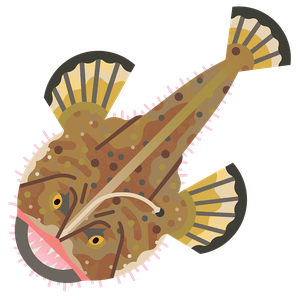
Anglerfish are ambush predators and feed opportunistically on passing prey, which is attracted using a fleshy lure on the illicium. The diet is dominated by fish and, to a lesser extent, cephalopods. Small gadoids have a relatively high importance in their diet. There are no reports of predators that specifically target anglerfish in European waters. Indirect predation by seals of netted fish is common though and seals may prey directly on anglerfish as well. There have been reports of anglerfish being predated upon by sperm whales, and juvenile fish by large cod.
Demersal trawls have contact with the seabed resulting in penetration and abrasion of habitat features. The impact of trawling on the seabed depends on the location and scale in which trawling occurs. For example, areas that are used to natural disturbance through tides and waves, are less sensitive to habitat impacts. Whereas areas not used to mobile towed gears are typically more sensitive to trawling. Trawl gears are known to have some of the greatest impacts on Vulnerable Marine Ecosystems (VME). Demersal otter trawls are likely to be operating on more sensitive, deeper, muddy ground, whereas the Nephrops trawlers operate on the shelf, where the seafloor communities are better adapted to disturbance. EU vessels are required to report significant catches of corals and sponges to assist mapping these communities and must move fishing operations at least 2-miles when they are encountered.
UK regulations to reduce the impacts of fishing on marine habitats and wider species are under development, in the meantime most EU regulations have been adopted. Under EU legislation, bycatch species should be managed within scientifically defined or, where data isn’t available, suitably precautionary sustainable exploitation limits. If stocks fall below trigger levels, measures can be brought in such as limits on characteristics or use of gear (e.g. mesh size, depth); time/area closures; and minimum conservation reference sizes.
Habitat protection measures across European waters include Marine Protected Areas. If those MPAs were found to be subjected to bottom trawling, the Marine Conservation Society would assign a default red rating unless there is evidence (e.g. environmental impact assessment) indicating the activity does not damage the integrity of the site. EU regulations prohibit bottom trawling below 800m and restrict activities between 400-800m. Spatial management is continually being developed, which will restrict the footprint of this gear on the seabed. However, there remains some uncertainty about the location of some sensitive seabed habitats so these remain at risk.
To improve monitoring and reporting of fishing activity, the Marine Conservation Society would like to see remote electronic monitoring (REM) with cameras implemented, used and enforced. To reduce the impacts of fishing on the marine environment we would like to see a just transition to the complete removal of bottom towed gear from offshore Marine Protected Areas designated to protect the seabed. We also want to see reduction and mitigation of environmental impacts including emissions and blue carbon habitat damage.
References
Dars, C., Dabin, W., Demaret, F., Doremus, G., Meheust, E., Mendez-Fernandez, P., Peltier, H., Spitz, J. and Van Canneyt, O. 2017. Les echouages de mammiferes marins sur le littoral francais en 2017. Reseau National Echouages (RNE), Rapport annuel. Available at http://www.observatoire-pelagis.cnrs.fr/IMG/pdf/rapportechouages2017.pdf [Accessed on 23.07.2026].
EU, 2019. Regulation (EU) 2019/472 of the European Parliament and of the Council of 19 March 2019 establishing a multiannual plan for stocks fished in the Western Waters and adjacent waters, and for fisheries exploiting those stocks, amending Regulations (EU) 2016/1139 and (EU) 2018/973, and repealing Council Regulations (EC) No 811/2004, (EC) No 2166/2005, (EC) No 388/2006, (EC) No 509/2007 and (EC) No 1300/2008. Official Journal of the European Union, L 83. 17 pp. Available at http://data.europa.eu/eli/reg/2019/472/oj [Accessed on 22.07.2026].
Eigaard, O. R. et al., 2016. Estimating seabed pressure from demersal trawls, seines, and dredges based on gear design and dimensions. ICES Journal of Marine Science, Volume 73, Issue suppl_1, January 2016, Pages i27–i43, https://doi.org/10.1093/icesjms/fsv099
ICES, 2026. Working Group for the Bay of Biscay and Iberian Waters Ecoregion (WGBIE). ICES Scientific Reports. 8:46. 685 pp. Available at https://doi.org/10.17895/ices.pub.32790321 [Accessed on 16.07.2026].
ICES, 2026. Black-bellied anglerfish (Lophius budegassa) in Subarea 7 and divisions 8.a–b and 8.d (Celtic Seas, Bay of Biscay). In Report of the ICES Advisory Committee, 2026. ICES Advice 2026, ank.27.78abd. Available at https://doi.org/10.17895/ices.advice.30931946 [Accessed on 16.07.2026].
ICES. 2026. White anglerfish (Lophius piscatorius) in Subarea 7 and divisions 8.a–b and 8.d (Celtic Seas, Bay of Biscay). In Report of the ICES Advisory Committee, 2026. ICES Advice 2026, mon.27.78abd. Available at: https://doi.org/10.17895/ices.advice.30932153 [Accessed on 16.07.2026].
ICES, 2024. Celtic Seas Ecoregion – Ecosystem overview. In Report of the ICES Advisory Committee, 2024. ICES Advice 2024, Section 7.1, Available at: https://doi.org/10.17895/ices.advice.25713033 [Accessed on 16.07.2026].
ICES, 2025. Working Group on the Bycatch of Protected Species (WGBYC). ICES Scientific Reports. 7:112. 181 pp. Available at https://doi.org/10.17895/ices.pub.30610370 [Accessed on 16.07.2026].
ICES. 2025 Celtic Seas Ecosystem – fisheries Overview. In Report of the ICES Advisory Committee, 2025. ICES Advice 2025, section 7.2. Available at https://doi.org/10.17895/ices.advice.30710879 [Accessed on 16.07.2026].
ICES, 2022. Stock Annex: Black-bellied anglerfish (Lophius budegassa) in Subarea 7 and divisions 8.a–b and 8.d (Celtic Seas, Bay of Biscay). ICES Stock Annexes. 13 pp. Available at https://doi.org/10.17895/ices.pub.21623154 [Accessed on 16.07.2026].
ICES, 2022. Stock Annex: White anglerfish (Lophius piscatorius) in Subarea 7 and divisions 8.a–b and 8.d (Celtic Seas, Bay of Biscay). ICES Stock Annexes. 17 pp. Available at https://doi.org/10.17895/ices.pub.21623349 [Accessed on 16.07.2026].
Kynoch, R., Fryer, R. & Neat, F., 2015. A simple technical measure to reduce bycatch and discard of skates and sharks in mixed-species bottom-trawl fisheries. ICES J Mar Sci,72(6):1861.
Northridge, S., Kingston, A., Mackay, A. and Lonergan, M. 2011. Bycatch of Vulnerable Species: Understanding the Process and Mitigating the Impacts. Final Report to Defra Marine and Fisheries Science Unit, Project no MF1003. University of St Andrews. Defra, London, 99pp. Available at http://randd.defra.gov.uk/Document.aspx?Document=MF1003-FINALRevisedAugust2011.pdf [Accessed on 17.07.2026].
Peltier, H., Authier, M., Deaville, R., Dabin, W., Jepson, P. D., van Canneyt, O., Daniel, P. and Ridoux, V. 2016. Small cetacean bycatch as estimated from stranding schemes: The common dolphin case in the northeast Atlantic. Environmental Science and Policy, 63: 7-18. doi: 10.1016/j.envsci.2016.05.004. Available at https://www.sciencedirect.com/science/article/abs/pii/S1462901116301514 [Accessed 23.07.2026].
Pérez Roda, M. et al., 2021. A third assessment of global marine fisheries discards. FAO Fisheries and Aquaculture Technical Paper No. 633. Rome, FAO. 78 pp. Licence: CC BY-NC-SA 3.0 IGO.
Rindorf, A., Gislason, H., Burns, F., Ellis, J. R., & Reid, D. (2020). Are fish sensitive to trawling recovering in the Northeast Atlantic? Journal of Applied Ecology, 57(10), 1936-1947. https://doi.org/10.1111/1365-2664.13693
Seafish, 2026. Demersal Trawl - General. Available at: https://www.seafish.org/responsible-sourcing/fishing-gear-database/gear/demersal-trawl-general/ [Accessed 23.07.2026].
Silva, F., Ellis, J. & Catchpole, T., 2012. Species composition of skates (Rajidae) in commercial fisheries around the British Isles and their discarding patterns. J Fish Biol., 80:1678–1703.
van Denderen, P. et al., 2015. Similar effects of bottom trawling and natural disturbance on composition and function of benthic communities across habitats. Mar Ecol Prog Ser. 2015;541:31–43.
Sustainable swaps
Learn more about how we calculate our sustainability ratings.
How our ratings work
Add impact to your inbox
Join the movement: get updates on the issues you care about.
We'll email you inspiring stories about the work we're doing to save and recover our oceans, and news about our urgent campaigns for positive change.