Positive ocean news: June ’26 edition
2 minute read
Even as the UK sweltered through a record‑breaking heat wave, the ocean gave us reasons to feel hopeful. Here are this month’s standout stories.
New marine life A-Z showcases fascinating ocean creatures
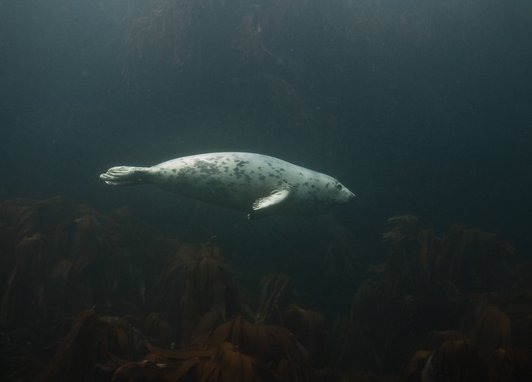
The grey seal is just one of the species you can learn about | Image credit: Peter Bardsley
Native oysters released into South Wales spatting ponds
Alongside the Mumbles Oyster Company, we've deployed more than 120 oysters into spatting ponds in Laugharne, South Wales, where they will reproduce and grow more baby oysters for restoration projects.
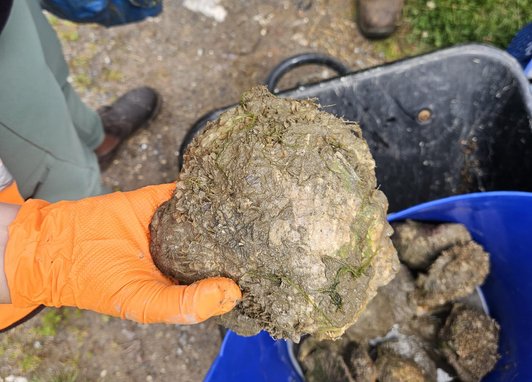
European flat oysters | Image credit: Andy Woolmer, Mumbles Oyster Company
Ireland's beaches are the cleanest they've been for 25 years
Since the introduction of the Republic of Ireland’s Deposit Return Scheme in 2024, 2.5 billion bottles have been recycled, resulting in less litter and cleaner beaches.
Litter from plastic bottles and cans, which are included in the scheme, has halved, as people return their empty containers in exchange for their 25-cent deposit. The findings highlight the success of such schemes in reducing litter both inland and at sea.
The UK is set to introduce its Deposit Return Schemes in 2027, with Exchange for Change running the scheme England, Scotland and Northern Ireland. Wales is yet to appoint the Deposit Management Organisation for its scheme.
World Ocean Day inspires week-long celebrations

The Ocean Learning team speaking to an audience
Image credit: Grace Westgarth
World Ocean Day (8th June) saw a week of ocean-themed events and activities taking place to celebrate and connect to the marine environment.
We organised 19 events throughout the week, with more than 4,300 people attending.
Hundreds of volunteers took part in beach cleans and inland litter picks across the UK, removing almost 5,250 litter items and collecting important data to support the incoming Deposit Return Schemes (DRS) in the UK. The charity also ran an art competition, encouraging people to submit poster designs encouraging people to use the DRS.
Photography exhibition showcasing marine life launched
Secrets beneath the Sea provides a glimpse of the “hidden wonders” in the waters around Sussex.
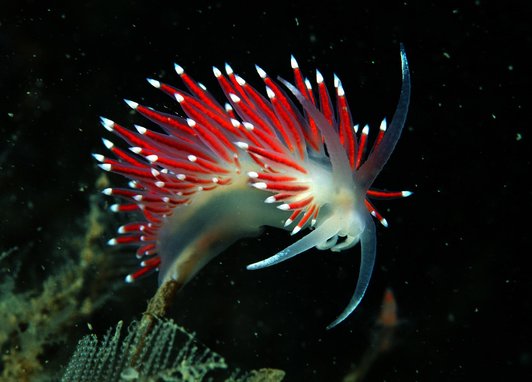
A close-up of a Scarlet lady sea slug | Image credit: Paul Naylor
Real-time pollution monitoring to take place in chalk stream
The water quality of the River Test in Hampshire will be continuously monitored using sensors, in a first-of-its-kind scheme for the UK.
The sensors provide updates every 30 minutes on levels of dissolved oxygen, ammonia and water temperature, which will help river keepers and campaigners understand how pollution incidents affect the river, both upstream and downstream.
The launch of the scheme follows Southern Water’s commitment to invest £84 million into improving the River Test’s water quality after the discharge of sewage overflows in 2024 led to a protest by hundreds of campaigners and residents.
It’s hoped that the sensors will help safeguard the chalk stream, of which there are only 200 in the world.
New buoys and mooring systems aim to protect seagrass meadows
A new ‘no anchor zone’ has been created in Looe Bay, Southwest England to protect one of the largest seagrass meadows in the region. The voluntary zone is marked out with buoys to encourage water users not to anchor there, as this can cause damage to seagrass.
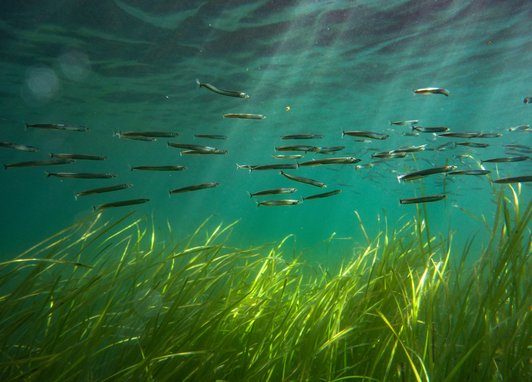
Sandeels in seagrass meadow in Mounts Bay, Cornwall | Image credit: Heather Hamilton
Damaged seabed shows signs of recovery
An area of protected seabed which was severely damaged by illegal fishing has begun to show early signs of recovery, new footage has revealed.
The area in the Summer Isles, Scotland, falls within the Wester Ross Marine Protected Area, but in 2019, a dredger illegally dragged its gear along the seabed, destroying marine habitats.
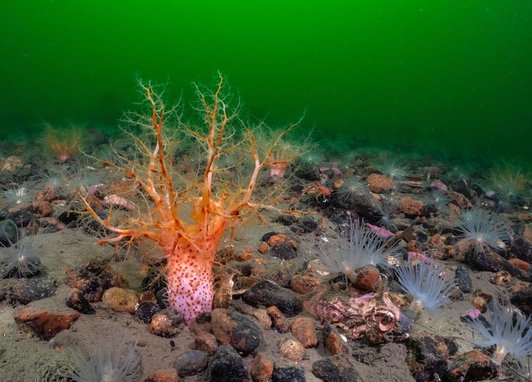
An orange sea cucumber in Loch Duich, Scotland | Image credit: Dan Bolt